
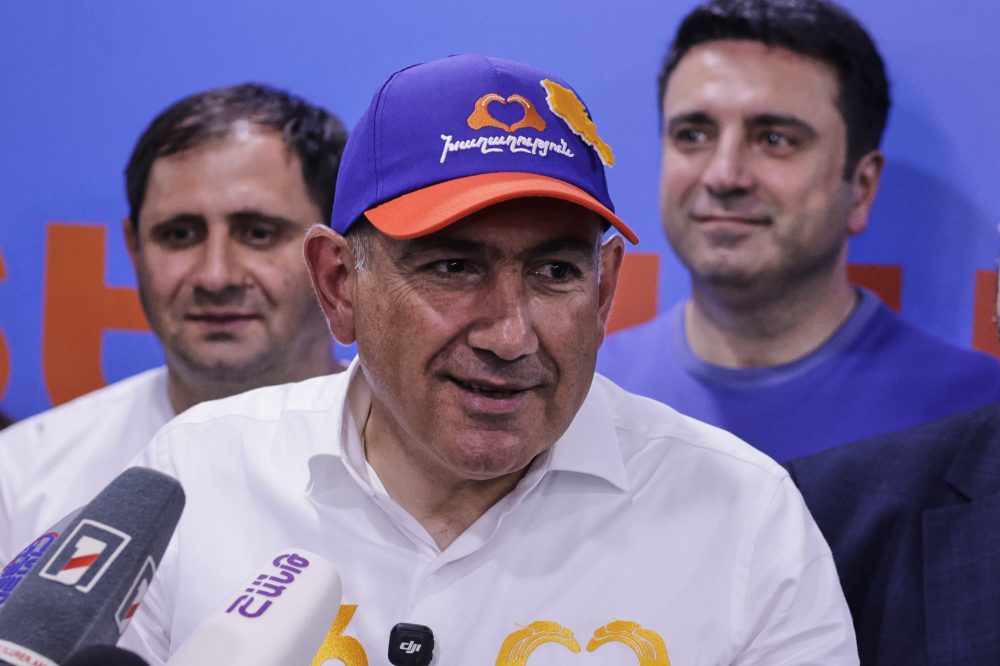
YEREVAN, Armenia (AP) — Armenia’s polling authority on Sunday confirmed that the party led by Prime Minister Nikol Pashinyan won a general election seen as a vote on its geopolitical future and a test of Russia’s influence in the South Caucasus country.
Pashinyan’s government is seeking closer relations with the European Union and the United States despite longstanding ties with Russia that have been championed by his critics.
Final results issued by the Central Electoral Commission for the ballot held on June 7 showed the ruling Civil Contract party won 49.7% of the vote, and it will be able to form a government.
The pro-Russian opposition Strong Armenia party had appealed to the commission to annul the results, citing alleged “widespread violations” during the vote. Strong Armenia and other opposition parties held a rally in front of the Central Electoral Commission while it was meeting to finalize the election results.
The gap between the announcement on June 8 of the preliminary results and the final results gave parties the opportunity to log complaints on any perceived irregularities.
Polling observers for the Organization for Security and Co-operation in Europe (OSCE) said Armenian voters had been offered a “genuine choice” but that the election had been conducted against a background of “highly confrontational…divisive rhetoric” and “uneven campaign opportunities.” Armenian investigators had issued six arrest warrants for members of Strong Armenia on the eve of polling day, accusing them of buying votes.
Samvel Karapetyan, the billionaire leader of Strong Armenia — who made his fortune in Russia — is currently under house arrest after being accused of advocating for the government’s overthrow.
Karapetyan has denied the charge which he has described as politically motivated.
Armenia’s National Assembly must consist of at least 101 members elected for five-year terms. The parties must win at least 4% of the vote to enter, while blocs made up of three or more parties must hit 8%.
Civil Contract’s share of the vote entitles it to 64 seats in the assembly, with Strong Armenia on 29 seats and the Armenia Alliance, led by former President Robert Kocharyan, with 12 seats.
Geopolitical issues took center stage during the election campaign.
“The European Union is our main partner in democratic reform implementation, and we will continue that path,” Pashinyan said as he cast his vote on June 7. Armenia last year officially declared its aspirations to join the EU.
Most opposition parties, including Strong Armenia, campaigned on a pro-Russian platform.
Russia, which has a military base in Armenia, has warned that Yerevan’s Western turn could have dire political and economic consequences. President Vladimir Putin has compared Armenia’s course to that of Ukraine in thinly veiled threats and has suggested Russia’s conflict with Ukraine started with its attempts to join the EU.
Moscow introduced a raft of trade sanctions in the weeks running up to the vote — imposing import bans on Armenian flowers, certain types of cognac and wine, eggplant, potatoes, dried fruits, fish and more — in a move described by the OSCE election monitors as “direct pressure” on Armenia’s vote. Russia said the bans were related to violations of agricultural import rules.
European Commission President Ursula von der Leyen has accused Russia of “weaponizing” economic relations and described the ban on Armenian imports as “nothing short of economic coercion.” She said the EU would send 50 million euros ($58 million) to support Armenia.
Relations between Moscow and Armenia soured as Azerbaijan retook control of the Karabakh region. The mountainous area had been controlled for decades by ethnic Armenian forces backed by Armenia, part of a long conflict between the neighboring countries.
Armenia accused Russian peacekeepers deployed to the region of failing to stop Azerbaijan’s onslaught. Moscow, busy with the war in Ukraine, has rejected the accusations.
Pashinyan has begun cautiously weakening ties with Moscow, joining the International Criminal Court in 2023 and suspending Armenia’s participation in the Moscow-dominated Collective Security Treaty Organization in 2024.
Armenia also hosted the European Political Community summit and its first summit with the EU in Yerevan in early May.
In August 2025, U.S. President Donald Trump hosted Pashinyan and Azerbaijan’s President Ilham Aliyev to sign a deal aimed at ending their decades-long conflict and including provisions for the creation of a new transit corridor from Azerbaijan to its exclave of Nakhchivan.
Brought to you by www.srnnews.com
 Helicopters collide over Rio de Janeiro, killing 6
 Congo says 782 Ebola cases confirmed, two new health zones affected
 Canadian Prime Minister Mark Carney says US AI restrictions underscore risks of dependence
 The Media Line: Are Anti-Israel Candidates No Longer Paying a Political Price?