
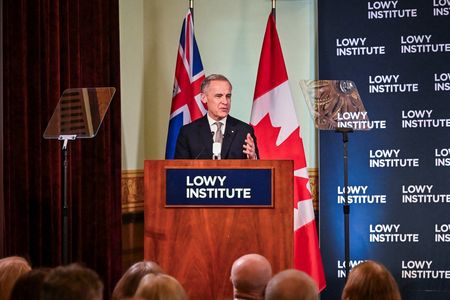
SYDNEY, March 5 (Reuters) – Australia and Canada on Wednesday signed a series of new agreements on critical minerals, Canadian Prime Minister Mark Carney said, including Australia joining the G7 minerals alliance.
Western nations have been attempting to diversify their supply chains away from China, which still controls the majority of production and processing of critical minerals, essential for semiconductors and defence applications.
“Earlier today, we signed a series of new agreements on critical minerals, including Australia joining the G7 minerals alliance – the largest grouping of trusted democratic mineral reserves in the world,” Carney said in a speech to Australia’s parliament, on his final day of a three-day visit to the country.
The two countries produce around a third of global lithium and uranium, as well as over 40% of global iron ore.
Canada believes that the best way to address the issue of concentrated supply of critical minerals is through a production alliance or a buyers’ club rather than just a price floor, Energy and Mining Minister Tim Hodgson told Reuters on Tuesday.
Australia has already allocated funds to build a critical minerals stockpile, beginning with antimony and gallium.
Carney is on a multi-leg trip across the Asia-Pacific region also taking in Japan and India, with his stop in Australia aimed at bolstering relations between the two so-called “middle powers”.
As well as critical minerals, Australia and Canada are also expected to deepen cooperation in areas including defence and maritime security, trade and artificial intelligence, Carney’s office said ahead of the visit.
(Reporting by Alasdair Pal in Sydney, editing by Jamie Freed)
((Alasdair.Pal@thomsonreuters.com; +61 291 717 228; Reuters Messaging: alasdair.pal.reuters.com@reuters.net))
Keywords: AUSTRALIA CANADA/
Brought to you by www.srnnews.com
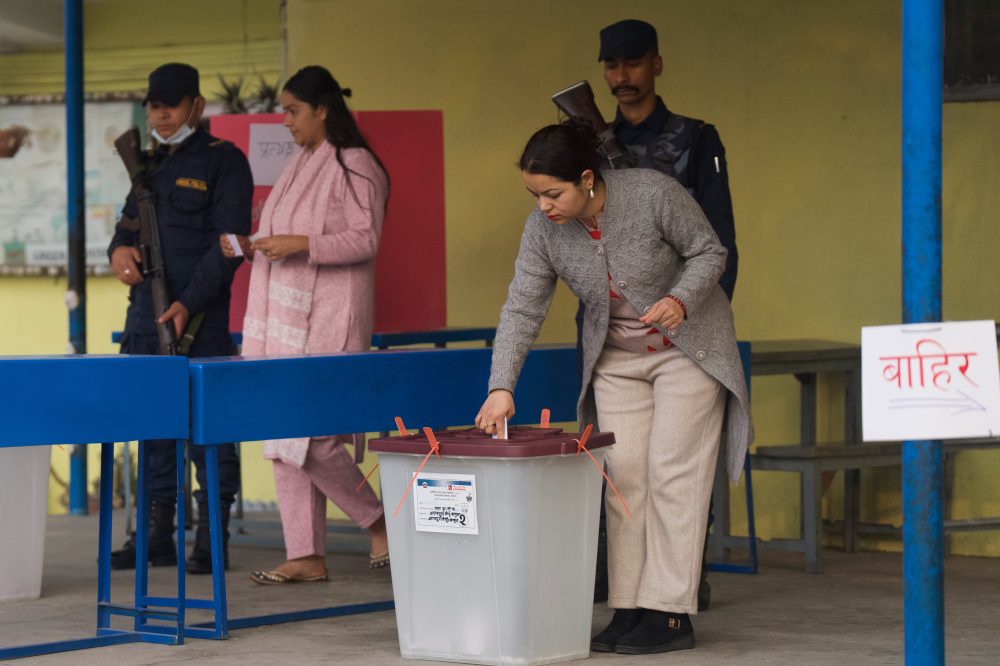 Polls open in Nepal’s first election after last year’s youth-led protests toppled the government
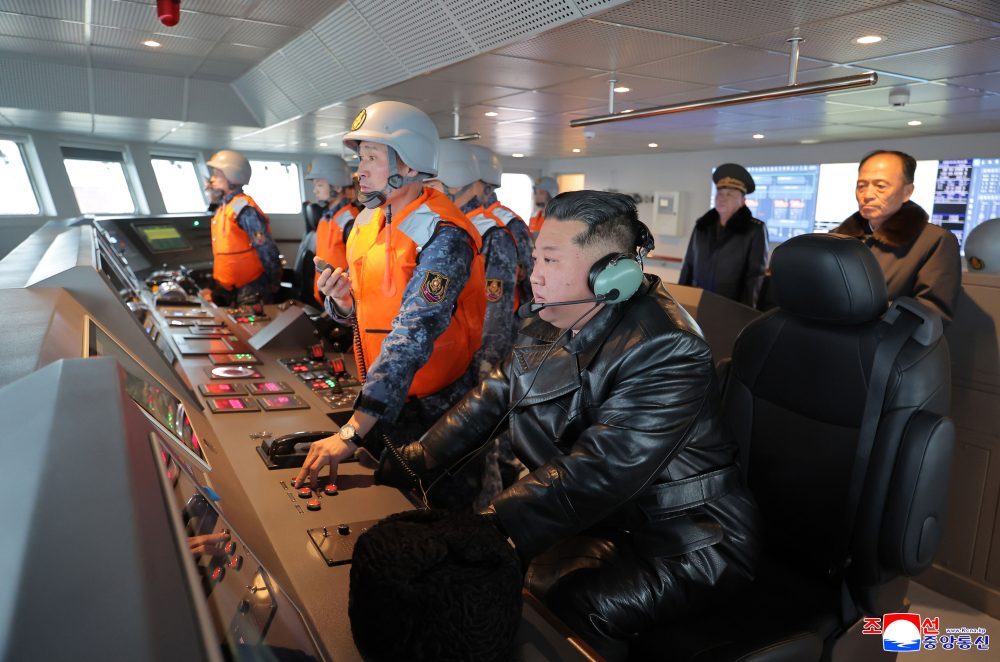 North Korean leader Kim inspects new warship, claims progress toward nuclear-armed navy
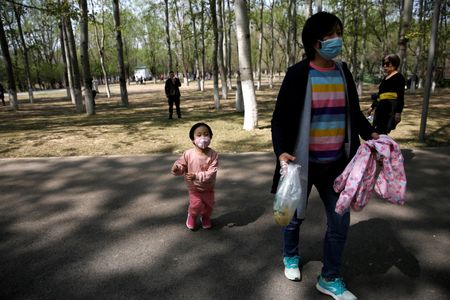 China to build ‘birth-friendly society’, refine social security system
 China sets a lower economic growth target of 4.5% to 5% for 2026 as challenges loom