
By Bart H. Meijer
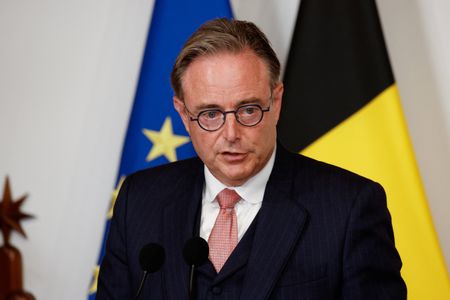
BRUSSELS, Nov 2 (Reuters) – Belgium’s King Philippe sought on Monday to defuse a political crisis after overnight budget talks collapsed, prompting Prime Minister Bart De Wever to offer his resignation.
De Wever tendered his resignation during a 90-minute meeting with the king on Monday morning after coalition parties failed to break months of deadlock over next year’s budget.
The Royal Palace said the king would consider De Wever’s offer but would also consult the leaders of the other coalition parties from Tuesday.
“In light of the large geopolitical uncertainty and severe economic challenges, the country can’t afford a long political crisis,” the palace said.
The government has been arguing for months about €10 billion ($11.2 billion) in budget cuts and tax increases De Wever says are needed to stabilise Belgium’s public finances.
In months of talks, De Wever’s Flemish nationalist N-VA and the liberal MR have not been able to compromise with their socialist and centrist coalition partners.
The N-VA and MR have pushed for deeper spending cuts, including to healthcare, while their partners demand higher wealth taxes to raise additional revenue.
Deputy Prime Minister Maxime Prevot, from the francophone centrist party Les Engagés, renewed that call on Monday, shortly after De Wever’s meeting with the king.
“A contribution from those with substantial financial means is legitimate,” he said in a post on X.
“This sharing of the burden between the wealthiest and other citizens is a matter of balance for the future.”
In an interview with broadcaster VRT, Prevot said there was a “50/50” chance of new elections, as he called on coalition parties to return to the negotiating table.
Opposition parties, trade unions and business associations were also unified in their call on the government parties to resume talks and avert a budget crisis.
BALLOONING DEBT
Like other European countries, including France and Italy, Belgium is struggling to balance ballooning national debt with demands from protesters for greater spending to improve services, such as education. Demonstrators have clashed with police in countries including France, Spain, Italy and Belgium in recent weeks.
Without an agreement, Belgium would be forced to operate under provisional spending rules next year, allowing it to spend only one-twelfth of this year’s budget each month.
The crisis coincides with heightened stress on financial markets, where interest rates have risen sharply on government bonds of Belgium, France and other European countries seen to have weak government finances.
The European Commission forecast in May that Belgium’s debt-to-gross domestic product ratio would be 110.5% this year, behind only Greece, Italy and France among euro zone countries, with a projected general government deficit of 5.2% of GDP.
Belgium’s 10-year benchmark bonds were trading at a yield of 4.39% on Monday afternoon, against 4.90% for France and 3.29% for Germany. Four months ago, Belgian 10-year yields were at 3.48%.
De Wever has repeatedly warned of an “interest snowball”, arguing that without budget cuts Belgium risks borrowing simply to cover the cost of servicing its existing debt.
The king will meet De Wever again on Friday. If he ultimately accepts the prime minister’s resignation, he could ask other parties to form a coalition or call fresh elections.
($1 = 0.8948 euros)
(Reporting by Bart Meijer and Philip Blenkinsop; Editing by Sharon Singleton and Ros Russell)
Brought to you by www.srnnews.com
 French petition seeks to shut down Bollore’s news channel CNews
 Isaac Herzog: the mild-mannered middleman in Israel’s political brawl
 Spain deports African, Asian asylum seekers to Morocco amid rights group outcry