
By Cassandra Garrison
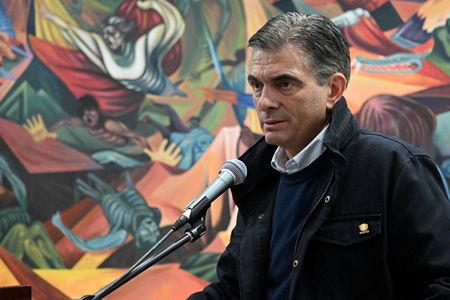
LA PAZ, June 20 (Reuters) – Bolivia’s crisis intensified on Saturday as President Rodrigo Paz declared a state of emergency, enabling wider military deployment to clear blockades and restore order after protests brought the economy to a halt over the past 50 days.
The emergency declaration gives Paz broader constitutional tools to restore order, such as sending armed forces to clear blockades. While the order goes into effect immediately, the president must notify Congress of the state of emergency within 24 hours of issuing the decree, which then has up to 72 hours to approve or reject the measure.
Protesting groups, many allied to former leftist President Evo Morales, have cut off key roads, stranding trucks and choking supplies of food, fuel and medicines to many areas, including La Paz.
The conflict initially erupted after Paz abruptly cut long-standing fuel subsidies to shrink the deficit, amid a worsening dollar crunch and talks with the International Monetary Fund. Despite later steps to stabilize fuel prices and reverse unpopular land reforms, protests intensified into broader discontent, with unions demanding wage increases, an end to fuel and dollar shortages, and Paz’s resignation.
Paz’s declaration came in a live message to the nation just hours after he unveiled a deal struck on Friday with the main union, the Bolivian Workers’ Confederation (COB), that aimed to ease tension.
However, many roads connecting the South American nation’s main production center are under the control of rural associations aligned with Morales, who were not a part of the negotiations and are continuing to protest mainly in the area of Cochabamba.
Paz said the crisis had evolved into an organized attempt to destabilize democracy after weeks of violence and blockades. He said the state of emergency aims to restore order, protect citizens and ensure the flow of essential goods, while warning that those continuing disruptions would face legal consequences.
“This is not a state of emergency to restrict people’s lives … It is a state of emergency to give freedom back to the people, to free Bolivia from those who use political conflict to block roads and harm the population,” Paz said.
(Reporting by Cassandra Garrison and Monica Machicao in La Paz; Additional reporting by Daniel Ramos; Editing by William Mallard, Clarence Fernandez and Mark Potter)
Brought to you by www.srnnews.com
 Pope Leo XIV heads to northern Italy to honor St. Augustine and migrant saint Cabrini
 Fighting persists in Lebanon despite a ceasefire as the US-Iran deal is under threat