
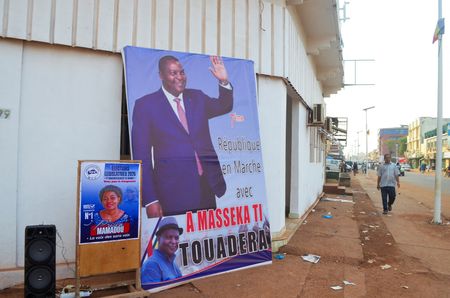
BANGUI Dec 28 (Reuters) – Central African Republic President Faustin-Archange Touadera is seeking a third term on Sunday as the chronically unstable country holds national elections, touting security gains made with the help of Russian mercenaries and Rwandan soldiers.
The 68-year-old mathematician oversaw a constitutional referendum in 2023 that scrapped the presidential term limit, drawing an outcry from his critics who accused him of seeking to rule for life.
A Touadera victory – the expected outcome – would likely further the interests of Russia, which has traded security assistance for access to resources including gold and diamonds. Touadera is also offering access to the country’s lithium and uranium reserves to anyone interested.
The opposition field of six candidates is led by two former prime ministers, Anicet-Georges Dologuele and Henri-Marie Dondra, both of whom survived attempts by Touadera’s supporters to have them disqualified for allegedly holding foreign citizenship.
Though both men remain on the ballot, Touadera is still seen as the favourite given his control over state institutions and superior financial resources, analysts say.
The challenges to the candidacies of Dologuele and Dondra “aligned with an apparent pattern of administrative manoeuvring that has disproportionately impeded opposition politicians while favouring the ruling United Hearts Party,” Human Rights Watch said last month.
“Their late admission to the race raises questions about whether voters have been given a genuine choice.”
RUSSIA AND RWANDA REINFORCE TOUADERA
In 2018, CAR became the first country in West and Central Africa to bring in Russia’s Wagner mercenaries, a step since also taken by Mali, Burkina Faso and Niger.
Two years later Rwanda deployed troops to shore up Touadera’s government as rebel groups threatened the capital and tried to disrupt the 2020 elections, ultimately preventing voting at 800 polling stations across the country, or 14% of the total.
The country is more secure now after Touadera signed several peace deals with rebel groups this year.
But those gains remain fragile: Rebels have not fully disarmed, reintegration is incomplete, and incursions by combatants from neighbouring Sudan fuel insecurity in the east.Beyond the presidential contest, the elections on Sunday cover legislative, regional and municipal positions.
Provisional results are expected by January 5.
If no candidate gets more than 50% of the vote, a presidential runoff will take place on February 15, while legislative runoffs will take place on April 5.
Pangea-Risk, a consultancy, wrote in a note to clients that the risk of unrest after the election was high as opponents were likely to challenge Touadera’s expected victory.
A smooth voting process could reinforce Touadera’s claim that stability is returning, which was buttressed last year with the U.N. Security Council’s lifting of an arms embargo and the lifting of a separate embargo on diamond exports.
In November, the U.N. Security Council extended the mandate of its peacekeeping mission. The U.S. opposed the decision, calling for a shorter extension and a handover of security to Bangui.
(Reporting by Pacome Pabandji; Writing by Robbie Corey-Boulet; Editing by Hugh Lawson)
Brought to you by www.srnnews.com
 Zelenskiy to meet Trump in Florida for talks on Ukraine peace plan
 Russia opposes Taiwan independence in any form, FM Lavrov says
 Polls open for Myanmar’s first election since military seized power
 Guinea votes in presidential election expected to cement Doumbouya’s rule