
By Liz Lee and Ethan Wang
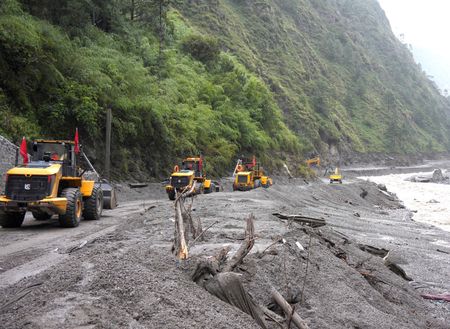
BEIJING, Sept 2 (Reuters) – China has fully reopened the only road leading to the Gyirong border crossing into Nepal a week after sections were washed away by catastrophic flooding, allowing heavy machinery to reach the main disaster zone for the first time.
The extensive damage to the G216 national highway had meant that China had been airdropping equipment and supplies to frontline rescuers, some of whom trekked through the mountains to get to the site.
Large numbers of heavy machines have now reached the area where a Chinese border inspection complex once stood, along with equipment to reinforce search operations, Chinese state broadcaster CCTV said.
Showing footage of rescue teams and excavators, CCTV said rescue crews equipped with life-detection devices and search dogs had been deployed.
Progress has been hampered by persistent rain and challenging terrain, as crews have to work in a narrow mountain gorge, hemmed in between unstable cliffs and a fast-flowing river.
Authorities, which have been monitoring upstream lakes that could cause more flooding if they burst, said those risks have diminished but landslides were still a concern.
In Nepal, authorities said hopes of finding more survivors were fading. At least 1,114 people have been killed there and nearly 4,000 remain unaccounted for.
OVER 30 LATVIAN TOURISTS BELIEVED MISSING
Across the border in Tibet, China’s official toll has held steady since Sunday at 16 dead and 546 missing. That includes 104 Indians, 49 Nepali citizens as well as 33 Latvians who are believed to be part of two tourist groups.
Karlis Eihenbaums, Latvia’s ambassador to China, said the country’s embassy was in permanent contact with the Chinese foreign ministry and authorities in Tibet for updates.
Embassy personnel have not sought to visit the Tibetan disaster site as information received from Nepal suggested the missing Latvians could have been swept away to the Nepali side, he said.
Much of the information about the disaster in Tibet has only been made available through specific sources, mainly China’s state-controlled media.
When asked on Tuesday why the Chinese government had not allowed foreign journalists to visit the disaster zone, the foreign ministry cited loss of access to roads and communication in the area as well as major safety risks from secondary disasters.
(Reporting by Liz Lee, Ethan Wang, Joe Cash, Chu Mei Mei and Qiaoyi Li in Beijing; Additional reporting by Sydney newsroom; Editing by Saad Sayeed and Edwina Gibbs)
Brought to you by www.srnnews.com
 Russian attacks wound 8 Ukrainian civilians as Moscow and Kyiv threaten to raise the stakes
 German authorities probe suspected sabotage after 2 power substation disruptions
 Tugboat sinks off South Korea’s southern coast, leaving 1 dead and 6 missing
 Trump aides, fearing a midterm rout, push to keep Iran war ‘quiet’ for now