
By Alexander Villegas
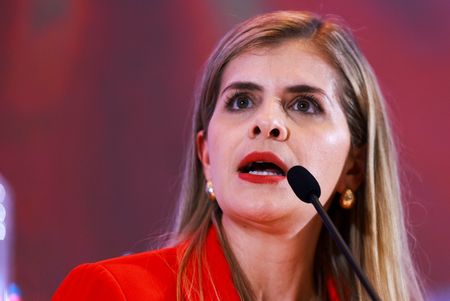
SAN JOSE, Feb 2 (Reuters) – Laura Fernandez’s decisive presidential victory in Costa Rica on Sunday also delivered her Sovereign People’s Party (PPSO) a majority in Congress — the first time since 1990 that one party has secured both the presidency and control of the legislature.
The PPSO won 31 of 57 seats, short of the 38-seat supermajority Fernandez sought to advance more sweeping reforms, including judicial and constitutional changes and the ability to declare states of emergency that could temporarily limit civil liberties to fight crime.
“Those big reforms that people feared the government could implement, we’re not going to see them,” said Maria Fernanda Bozmoski, the director for Central America at the Atlantic Council, a Washington-based international affairs think tank.
While the PPSO can pass laws, budgets and make appointments without needing to negotiate with other parties, it has few allies in the new Congress.
The National Renovation Party (PNR), an evangelical party that often aligned with the government in the previous Congress, was left with zero seats.
The National Liberation Party (PLN), the country’s oldest political party and main contender against the PPSO in the election, won 17 seats while the Broad Front (FA), a leftist party that has mounted the strongest opposition to the government, is the third-largest force with 7 seats.
The progressive Citizen Action Coalition will have one seat, occupied by former first lady Claudia Dobles, who ran against Fernandez and has voiced strong opposition to her, leaving one seat for the traditional right-wing Social Christian Unity Party (PUSC).
“The (ruling party’s) aspirations of reconfiguring the political system fell a bit short with these results,” said Ronald Alfaro, a researcher at Costa Rica’s Center for Investigations and Political Studies (CIEP).
“For things that require 38 votes they’re going to have to negotiate and we’ll have to see how that unfolds,” Alfaro added.
During his concession speech, PLN candidate Alvaro Ramos said his party would work with Fernandez on issues they agree on, but oppose her when they disagree.
“We need to keep fighting, that’s our job, that’s our commitment,” Ramos said.
President Rodrigo Chaves often blamed Congress for blocking progress through gridlock and obstruction.
“The opposition is going to have to redefine itself because it won’t be as easy to obstruct or block things,” Alfaro said, adding that the vast majority of the legislators are new to Congress.
“We’ll have to see how that block manifests, if they go their own ways or form an opposition alliance.”
(Reporting by Alexander Villegas; editing by Diane Craft)
Brought to you by www.srnnews.com