
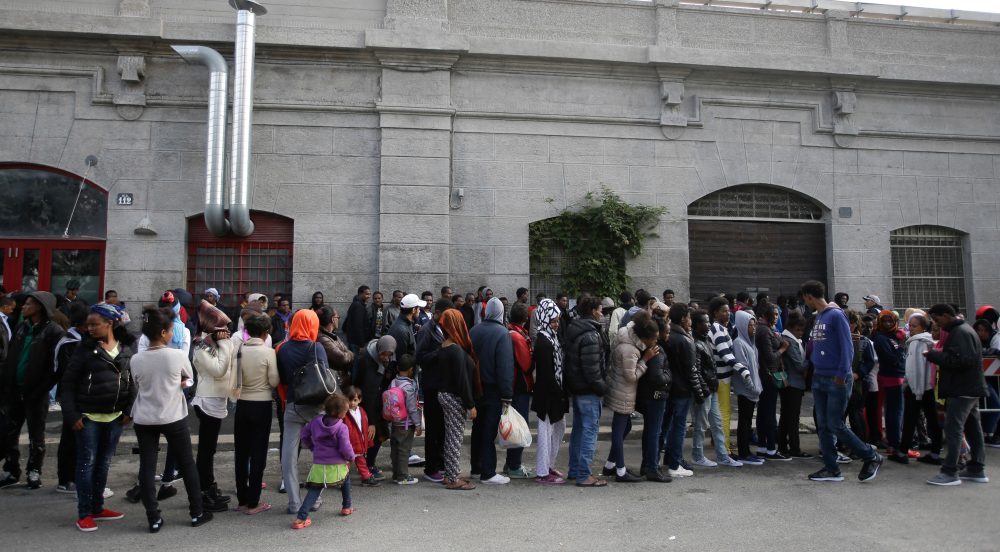
Denmark said it hoped to begin sending rejected asylum seekers to non-European Union “return hubs” as early as 2027, ahead of a Friday meeting of five countries leading European efforts to establish such centers outside the continent.
In June, European lawmakers voted to allow member states to set up migrant detention centers outside the EU, known as “return hubs.” Any EU nation can now negotiate on its own or in small coalitions to deport migrants not to their home countries but to facilities yet to be built in third countries, outside the 27-nation bloc.
“We cannot accept that people without a legal stay continue to reside in our respective countries,” Danish Foreign Minister Lars Løkke Rasmussen said on Friday as he welcomed ministers from Germany, Austria, The Netherlands and Greece to Copenhagen to discuss progress on establishing the deportation centers outside Europe.
“And at the same time we would like to work together with third countries to be able to give irregular migrants a second chance in a partner country,” Rasmussen said.
The five countries have been negotiating with governments mainly in Africa to host sites to hold rejected asylum seekers, pioneering the initiative for the whole of the EU.
In an interview with Danish broadcaster DR published on Friday, Denmark’s Immigration and Integration Minister Morten Bødskov said he hoped that the non-EU return hubs would already be in place in 2027. Bødskov said talks with non-EU countries had reached a crucial phase.
“Today we take the next step, here today with my European colleagues, to realize return hubs as soon as possible in the upcoming years,” Bart van den Brink, Austria’s asylum and migration minister, said in Copenhagen.
In early August, a spokesperson for the Rwandan government told local media that “it was natural” for her government to negotiate with European countries and others to potentially host asylum seekers who are not allowed to live elsewhere.
Migrant rights group have criticized European efforts to set up deportation centers abroad where it may be difficult to monitor and enforce human rights compliance.
In an emailed statement, Council of Europe Commissioner for Human Rights, Michael O’Flaherty, said “vague assurances of compliance with human rights law are not enough.”
“States need to commit to the guardrails necessary to prevent setting up human rights black holes,” he said.
Brussels-based rights group PICUM condemned the meeting in Copenhagen.
“EU leaders may call these centers an “innovative solution,” but outsourcing migration control is an old tactic to simply move people out of sight and evade human rights obligations,” the group’s director Michele LeVoy said. —
AP journalist Philipp Jenne in Vienna and Sam McNeil in Brussels contributed to this report.
Brought to you by www.srnnews.com
 Trump turns to a dual economic and military approach in latest attempt to squeeze Iran
 Kenya’s Ruto orders Indian company Tata Chemicals to leave the country
 China exerts tight grip on information after floods
 Netanyahu partners renew calls for removal of Gazans as Israeli election nears