
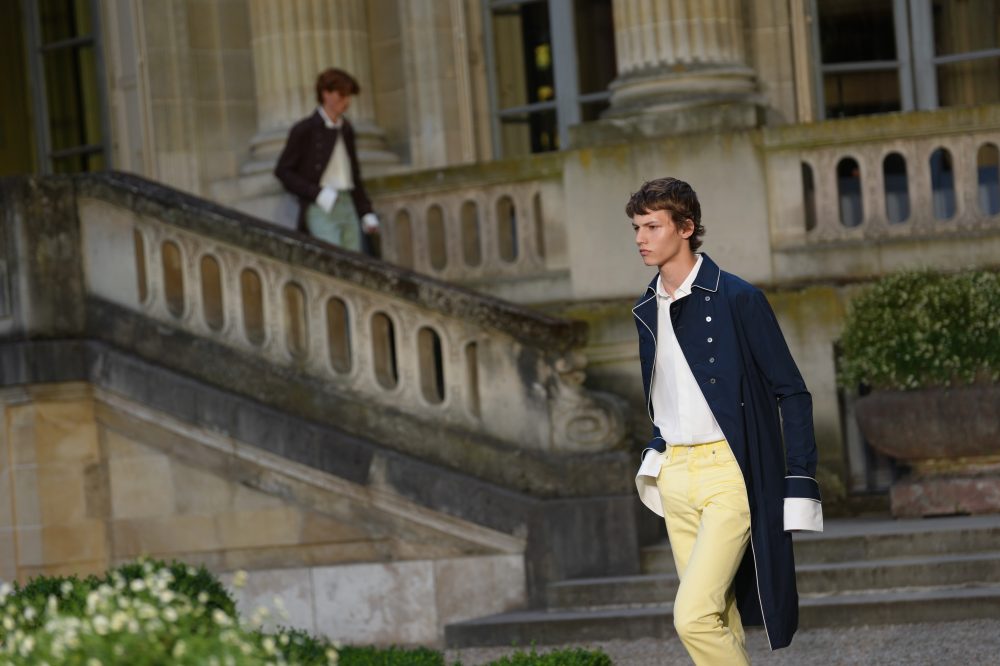
PARIS (AP) — Dior moved its men’s Paris Fashion Week show to 9 a.m. Wednesday to avoid the extreme heat sweeping much of Western Europe. It still was not early enough.
Guests arrived at the Musée Nissim de Camondo as a heat wave gripped Paris. Cold towels, strawberries and parasols were offered at the door.
Inside the mansion, where Northern Irish designer Jonathan Anderson showed his latest Dior men’s collection, the temperature rose quickly. Some guests appeared overcome and water was in limited supply.
The front row still delivered the expected star power. LaKeith Stanfield, Little Simz, James Marsden, Drew Starkey, Mike Faist, 070 Shake, Alexander Ludwig and Sam Nivola were among those at the show.
Anderson’s collection was about formality losing its grip — tuxedos loosened, denim ripped, sequins flashing, disco-ball boots stepping through a house built on old-world taste.
Dior described the mood as “a soiree turning into a house party.” Anderson called it “something quite formal becoming undone.”
That was the show’s clearest idea: the Dior man was not arriving at the party; he had stayed until morning.
Anderson opened with tailoring, but made it lighter and less fixed. Pinstripes and houndstooth were printed onto silk chiffon rather than woven, creating a look that was formal, yet transparent.
The collection pushed Dior’s codes into rougher territory. Sequined trousers resembled jeans, while ripped denim was finished with fine silver chains. A tuxedo came in a looser fit and pink denim shorts appeared under formal coats.
Accessories included crystal sunglasses, disco-ball boots and patchworked Japanese denim shirts.
The best looks worked because they kept Dior visible while disturbing it. A scarf motif came from 1979 Dior haute couture; silver embroidery borrowed from an 18th-century gentleman’s coat.
Boots were made to look deliberately disheveled, with tiny ladybirds across them.
It was not a rejection of Dior’s past. It was a way of making it move.
The Musée Nissim de Camondo gave the show weight.
The mansion, now closed for restoration, was built around Moïse de Camondo’s collection of 18th-century decorative arts, the same century that fascinated Christian Dior.
Anderson showed a collection about loosened formality in a house also caught between preservation and repair. Dior’s own notes described that “in-between” state as part of the point: beauty in imperfection.
The history of the place is also dark. Camondo’s son died in World War I, and later members of the family were deported and killed during the Holocaust.
The mansion now stands as both a museum and a memorial to loss.
Against that background, the show’s playfulness gave the clothes some tension. Anderson took things Dior already owns — the tuxedo, the Bar shape, couture embroidery, 18th-century decoration — and shifted them into a younger, messier register.
The result was one of Anderson’s clearest Dior outings so far.
Brought to you by www.srnnews.com
 Zimbabwe’s Senate approves bill to delay the presidential election and overhaul the vote
 Brazil detains Spanish citizen in the latest detention of a foreigner for racism
 Hong Kong police arrest booksellers on suspicion of selling seditious publications
 South African civil groups warn of dire impact as US phases out HIV program funding