By Mikhail Flores and Karen Lema
CEBU, Philippines, May 7 (Reuters) – Conflicts far beyond Southeast Asia are expected to dominate discussions of leaders of the regional ASEAN bloc meeting in the Philippines, with the Middle East crisis posing significant challenges for its fuel import-dependent economies.
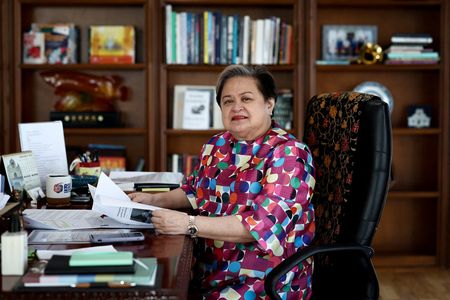
The meetings on the island of Cebu on Thursday and Friday will include leaders and foreign and economic ministers of the 11-member grouping, with energy and food supply security top priorities for the region of nearly 700 million people, Philippine Foreign Affairs Secretary Ma. Theresa Lazaro said.
The energy crisis, diplomats and analysts say, will test the Philippines’ chairmanship, forcing it to coordinate a regional response while preventing ASEAN’s own conflicts, including Myanmar’s civil war and last year’s deadly and still unresolved border dispute between Thailand and Cambodia, from slipping down the agenda.
“Planning to cushion the economic fallout could eventually outweigh other immediate regional issues,” said Don McLain Gill, a geopolitical analyst and lecturer at Manila’s De La Salle University.
While Myanmar’s crisis and troubles in the South China Sea would still be discussed, significant breakthroughs were unlikely, he added.
SCRAMBLE FOR SUPPLIES
The Philippines, however, has insisted the fallout from the U.S.-Israeli attacks on Iran will not hijack ASEAN’s talks.
“Nothing will be sacrificed because our commitment as chair remains,” said Dominic Xavier Imperial, its foreign ministry spokesperson for ASEAN.
The Middle East conflict has left many Asian countries scrambling for alternative oil supplies, with ASEAN ministers convening special meetings ahead of the summit, and the Philippines hopeful of ratification of an oil-sharing framework agreement.
Former Philippine diplomat Laura del Rosario said the scale of the energy supply shock was an issue no ASEAN country could escape and would likely push it beyond rhetoric.
The conflict has also sharpened the wider U.S.–China rivalry in Southeast Asia, analysts say, with Washington preoccupied by wars elsewhere and Beijing positioning itself as a more dependable partner.
“The U.S. will be contrasted as a destabilising power, while China will be seen as a stabilising one,” said Collin Koh, of Singapore’s S. Rajaratnam School of International Studies.
As a supplier of energy‑related inputs and raw materials, China “holds some of the most important cards right now”, he added.
MYANMAR SEEKS RE-ENGAGEMENT
Also set to be addressed is the crisis in Myanmar, an issue that has divided ASEAN, with its new nominally civilian government keen to re-engage with the bloc. The election was swept by a party backed by the military, which had ruled for five years since a 2021 coup.
ASEAN has not recognised the election or indicated when the leadership of Myanmar, with its former junta chief Min Aung Hlaing now president, can return to its summits after five years on the sidelines.
The military-backed government may need to convince ASEAN countries it is sincere about halting fighting and seeking dialogue with rebel groups, after recent steps towards reconciliation that include two amnesties and a reduced sentence and transfer to house arrest of ousted leader, Aung San Suu Kyi.
ASEAN leaders will likely renew calls for completion of a protracted code of conduct between ASEAN and Beijing for the South China Sea, with the 2026 target date a challenge amid competing interests and lingering concerns about their vital economic ties with China.
Some analysts doubt Beijing, which claims sovereignty over almost the entire South China Sea including parts of the exclusive economic zones of several ASEAN states, will make any meaningful concessions.
China is not included in the meeting, but it is a major external partner for the bloc.
“I do not think China would allow itself to be bound by an agreement that would limit its illegal and expansionist interests in the greater South China Sea,” Gill said.
(Reporting by Mikhail Flores in Cebu, Philippines and Karen Lema in Manila; Editing by Martin Petty and Alison Williams)
Brought to you by www.srnnews.com
 Congo’s president warns next elections can’t take place unless the conflict in the east is resolved
 Trump administration can keep 2020 election ballots seized from Georgia election center, judge rules
 Militants ambush fruit trucks on the road to Bamako as a blockade of Mali’s capital persists
 Brazil’s Lula to discuss fighting organized crime, tariffs in Trump meeting