

By Michele Kambas and Ingrid Melander
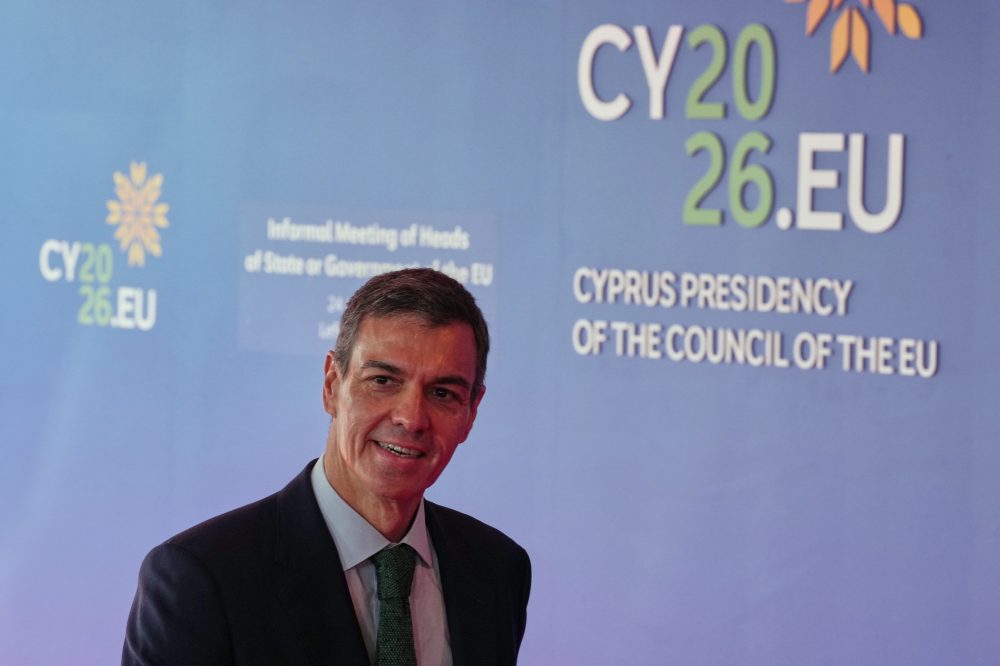
NICOSIA, April 24 (Reuters) – EU leaders have asked officials to prepare a blueprint for how the bloc’s previously obscure mutual assistance clause would work, host Cyprus said at a summit on Friday, amid doubts over the U.S. commitment to the NATO military alliance.
Worries about President Donald Trump’s criticism of NATO for failing to back the war with Iran, along with his threats earlier this year to seize Greenland from ally Denmark, have created greater urgency to define the EU’s mutual assistance provisions.
Cyprus President Nikos Christodoulides said EU leaders agreed at a summit in his country on Thursday evening that it was time to flesh out the pact, set out in Article 42.7 of the bloc’s core treaty.
“We agreed last night that the (European) Commission will prepare a blueprint on how we respond in case a member state triggers Article 42.7. There are a number of questions that we need to have an answer to,” Christodoulides said.
Unlike NATO’s Article 5 collective defence pact, which is seen as the bedrock of European security, the EU’s mutual assistance clause is not backed by detailed operational plans or military structures.
It has been activated only once, by France after Islamist attackers killed 130 people in Paris in 2015, when member states stepped in with contributions to EU and international military missions, freeing up France to redeploy its troops.
CYPRUS KEEN TO FIRM UP PACT AFTER DRONE ATTACK ON BRITISH BASE
Cyprus is particularly keen to firm up Article 42.7 after a drone struck a British air base on the island last month during the Iran war. The country, which currently holds the rotating EU Council presidency, is not a member of NATO.
Some EU countries, however, are anxious to steer clear of any action that might suggest they are turning away from NATO and its Article 5 mutual defence pact.
“For me it is an absolutely crucial thing that Article 5 is the key of our collective defence and collective security and it will remain so,” Lithuania’s President Gitanas Nauseda told reporters on Thursday.
EU TO LOOK AT HOW TO RESPOND IF MUTUAL ASSISTANCE CLAUSE TRIGGERED
Article 42.7 of the Treaty on the European Union says that “if a Member State is the victim of armed aggression on its territory, the other Member States shall have towards it an obligation of aid and assistance by all means in their power.”
“Let’s say France triggers Article 42.7. Which countries are going to be the first to respond to the request of the French government, what are the needs of the government or the country that triggers Article 42.7? All those will be put in a blueprint,” Christodoulides said.
EU foreign policy chief Kaja Kallas briefed leaders on ongoing work to flesh out Article 42.7 at the summit, an EU official said.
“NATO remains the bedrock of collective defence,” said the official, speaking on condition of anonymity. “But the EU has tools available that are complementary to NATO – such as sanctions, financial assistance and humanitarian aid – which could come into play in an Article 42.7 situation.”
Kallas’ team is drawing up scenarios including hybrid attacks, conventional attacks, and a case in which both Article 42.7 and NATO’s Article 5 are triggered in parallel, the official said.
(Reporting by Andrew Gray, Michele Kambas, Julia Payne, Michele Kambas in Nicosia and Inti Landauro, Makini Brice and Lili Bayer; Writing by Ingrid Melander)
Brought to you by www.srnnews.com
 Congolese refugees return from Burundi to take advantage of improved security
 South Korean prosecutors deny police request for arrest warrant for K-pop mogul behind BTS
 Sánchez sidesteps a Spain-US dispute at NATO, brushing off reported Pentagon email