
By Layli Foroudi, Juliette Jabkhiro and Paul Carsten
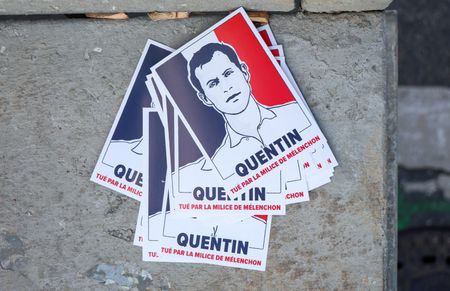
PARIS/BERLIN, March 3 (Reuters) – The killing of a young activist in France – cast by some as the country’s “Charlie Kirk moment” – has galvanised Europe’s far right, sparking coordinated rallies across the continent that highlight how local groups are building cross-border networks.
Quentin Deranque, a 23-year-old far-right activist, died after being beaten during a fight with far-left activists in Lyon on February 14, drawing comparisons with last year’s shooting of the U.S. conservative activist Kirk.
In the days that followed, far-right groups crossed borders to march in Lyon and held memorials in at least two dozen European cities, including Rome, Dresden and Zagreb.
“His death must awaken a European-wide movement,” said Martin Sellner, an Austrian star of the far right who held a vigil in Vienna, in a video posted on X.
Around 3,000 people attended the Lyon march a week after the killing, with participants raising their arms in Nazi salutes and shouting racist and homophobic slurs.
Among the groups present were Germany’s Identitarian movement, classed by that country’s domestic intelligence as an extremist organisation with some ties to the Alternative for Germany (AfD) party. Also present, according to their Telegram channels, were CasaPound and Lealta Azione – Italian groups with roots in neo-fascist ideology.
A French government source confirmed the presence of Italian, Swiss and German far-right groups, without specifying which ones.
Few European governments provide data on far-right group membership. Germany, which closely monitors such groups because of its Nazi past, estimated 50,520 right-wing extremists in 2024, up 50% from 2020.
ENTERING THE MAINSTREAM
A 2023 French parliamentary report said international collaboration was mostly exchanging ideology and did not translate into “operational links” between groups.
But that has now changed, said Eric Poulliat, the report’s author and a former member of parliament. “It is an evolution.”
The shift is also recognised outside France.
“The far right is actually quite successful in forming international bonds,” said Lorenz Blumenthaler, a Berlin-based analyst with the Amadeu Antonio Foundation, adding that Deranque’s killing allowed groups “to mobilise even further” on social media.
Even as governments warn of the threat posed by the far right, the movement is no longer shunned in mainstream politics. Policies such as “remigration” – the expulsion of non-white immigrants and their descendants – have moved from fringe discussion into the rhetoric of parties like Germany’s AfD as well as the Trump administration.
Britain’s right-wing Reform UK has said it would carry out mass deportations and abolish the main system for immigrants to become citizens. France’s National Rally (RN) advocates for “national preference” policies and wants to remove residency from unemployed immigrants and restrict family reunification.
SECURITY CONCERNS
Lyon authorities were concerned about activists travelling from across France and Europe for the march, and stationed police at city entry points, said a source close to the mayor’s office.
French intelligence services are monitoring mobilisation by the radical far right after Deranque’s death, a security source said, noting he had become a European-level rallying point and expressing concern about reprisal attacks.
Responding to a question about external influence on France’s presidential election next year, Foreign Minister Jean-Noel Barrot warned about far-right efforts to weaken democracy following the killing.
“Our responsibility is to prevent it from doing so and to do so to regain control of our public space,” Barrot said on franceinfo television last week, amid French indignation at statements from the U.S. State Department and Italian Prime Minister Giorgia Meloni warning of the threat posed by the left.
Some European governments have barred entry to far-right figures in recent years. Switzerland and Germany have denied access to Austria’s Sellner, and Britain declined visa-free entry to Dutch influencer Eva Vlaardingerbroek.
“These measures just create more attention and more interest in what I have to say,” Sellner told Reuters. Vlaardingerbroek did not comment.
A Greek official said they were monitoring the far-right reaction to Deranque’s death. Switzerland’s intelligence service said it monitors violent right-wing extremists known to maintain international contacts. German, Italian and British authorities did not comment on security concerns around far-right groups and their cross-border reach.
‘SPREAD THE NEWS OF THE MURDER’
The Lyon march brought together diverse strands of the far-right, including groups with ties to prominent far-right parties such as France’s RN and Germany’s AfD.
“As alternative filmmakers, it is our foremost duty to spread the news of the murder of the young patriot as widely as possible,” German media collective Filmkunstkollektiv wrote on its Telegram channel about attending the Lyon march.
Simon Kaupert, the group’s founder, told Reuters it had worked with the AfD and Identitarian movement branches in Austria, Germany and France.
More than 30 members of Italian group Lealta Azione – whose activists have campaigned with and stood for election alongside Meloni’s party and Deputy Prime Minister Matteo Salvini’s far-right League party – travelled to Lyon for the march.
The official organiser and point of contact for French authorities was Aliette Espieux, an anti-abortion activist who ran in the 2020 municipal elections on a joint RN–Christian Democratic Party list titled “For the love of Lyon”.
The AfD, Lealta Azione, RN and Espieux did not comment.
“The right only has potential if it works together,” said a German far-right activist and influencer known online as Arminius, who attended the march and declined to give his real name.
“Networking with other European activists is extremely important to learn from each other and work together on greater projects,” he said.
(Reporting by Layli Foroudi and Juliette Jabkhiro in Paris, Paul Carsten in Berlin; additional reporting by Yannis Souliotis in Athens, Angelo Amante in Rome, William James in London; Editing by Ros Russell)
Brought to you by www.srnnews.com
 At least 42 civilians killed in Afghanistan in conflict with Pakistan, UN agency says
 Netanyahu says US-Israel war on Iran ‘not going to take years’
 Trump hosts Germany’s Merz against backdrop of Iran strikes, tariff threats
 US orders non-emergency staff to leave Bahrain, Iraq and Jordan