
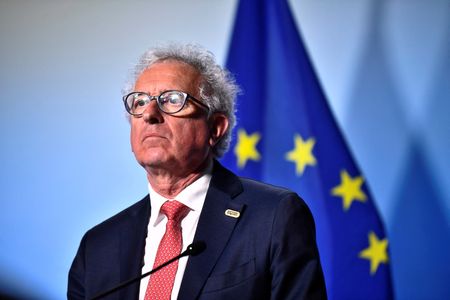
By John O’Donnell
FRANKFURT, Jan 30 (Reuters) – A European crisis fund with more than 430 billion euros ($514 billion) of firepower could lend money to countries for defence, the head of the European Stability Mechanism told Reuters, as the bloc scrambles to reinforce its military.
Pierre Gramegna, managind director of the European Stability Mechanism, said the ESM could give credit lines for defence and would not demand stringent economic reform in return, in part to dispel any stigma that might arise from asking the emergency euro zone fund for money.
“In these times of geopolitical turmoil, which have triggered higher expenditure, defence costs for all countries, we must use the full potential of the ESM,” said Gramenga.
He pointed to the use of credit lines for defence for countries in good financial health but whose budgets are stretched, in particular smaller euro zone states.
“We have instruments,” he said. “It is in the best interests of Europe … to use the full potential.”
“It is obvious that the relationship between Europe and the United States is becoming more and more bumpy.”
REPURPOSING DEBT CRISIS FUND
Any such financial support would be symbolically important, repurposing a fund set up at the height of the euro zone debt crisis to stave off the collapse of national economies, banks and shore up the currency.
U.S. President Donald Trump’s open hostility towards Europe is forcing its political leaders to scour for alternative means of defending the region against Russian aggression.
Gramegna’s remarks suggest a willingness to use the vast European reserve to reinforce euro zone countries, in particular smaller Baltic nations bordering Russia, although loans first need to be signed off by the 21 euro zone countries backing the ESM.
Only countries in the euro zone could get the loans, excluding those who do not use the currency, such as Poland. The ESM makes no explicit mention of defence in its mission and any such shift would require the blessing of member states, including from militarily neutral countries like Austria, Cyprus, Malta or Ireland.
Europe’s attempts to boost its defences, four years after Russia’s full-scale invasion of Ukraine, have taken on greater urgency since Trump threatened trade tariffs on countries that rejected his claim on Greenland, a Danish territory.
Gramegna hinted at a potential role for the ESM, which was set up during the debt crisis to lend to countries such as Greece but has since become largely redundant.
“It is one of our instruments,” he said, referring to using so-called precautionary credit lines for defence. “It’s available. We need to rediscover the potential of that instrument.”
“You need to guarantee that this facility … has to be used for defence expenditure,” he said, adding that it would not come with draconian terms. “The whole goal here is to avoid that this type of tool is combined with restructuring of the economy.”
‘DEFENCE SUPPORT LINE’
His comments breathe fresh life into a “defence support line” earlier suggested by former Italian prime minister Enrico Letta to lend up to 2% of a country’s economic output at low interest rates for defence.
Gramegna’s proposal mirrors an ESM crisis support scheme worth up to 240 billion euros set up during the COVID pandemic to help countries spend on healthcare. That ultimately remained unused.
The Baltic states of Lithuania, Estonia and Latvia could stand to benefit. They have almost quadrupled spending on defence since Russia invaded Ukraine to roughly 5% of their economic output, borrowing heavily to cover the bill.
Those countries, which border Russia and its close ally Belarus, have suffered an increasing number of sabotage attacks that law enforcement agencies blame on Russia.
They borrowed billions of euros from the EU’s oversubscribed SAFE loans scheme for defence projects, where the EU jointly borrows money on the market to lend it on at cost to EU governments for defence. ESM support would work similarly.
If set up like the pandemic support, the loans would have considerable weight across the EU. Estonia had a gross domestic product of roughly 40 billion euros in 2024 – 2% of that would be less than 1 billion euros.
Gramegna said countries could make “collective requests”, which would avoid any stigma attached to asking for assistance from the ESM. “The impetus has to come from the member countries,” he said.
(Additional reporting by Andrius Sytas in Vilnius and Jan Strupczewski in Brussels; editing by Mark Heinrich)
Brought to you by www.srnnews.com
 South Africa declares Israel’s deputy ambassador persona non grata, orders him to leave country
 Denmark unveils legal reform to allow the worst foreign criminals to be deported
 Denmark plans tougher deportation laws, challenging European human rights framework
 Russia halts strikes on Kyiv until Sunday at Trump’s request, Zelenskiy to reciprocate