
By Laila Bassam
BEIRUT, March 5 (Reuters) – Hezbollah has deployed elite fighters to confront Israeli forces in southern Lebanon, sending them back into the border region from which they withdrew after a war in 2024, three Lebanese sources familiar with the deployments said, as the Iran-backed group wades deeper into the conflict in the Middle East.
Members of Hezbollah’s Radwan force had received orders to join the battle and block advances by Israeli tanks, the sources said, citing the town of Khiyam – one of several areas where Israeli troops reportedly advanced on Wednesday – as an example.
Hezbollah, a Lebanese Shi’ite Muslim group established by Iran’s Revolutionary Guards in 1982, entered the war on Monday, opening fire to avenge the death of Iran’s supreme leader, who was killed in a surprise U.S.-Israeli attack on Tehran.
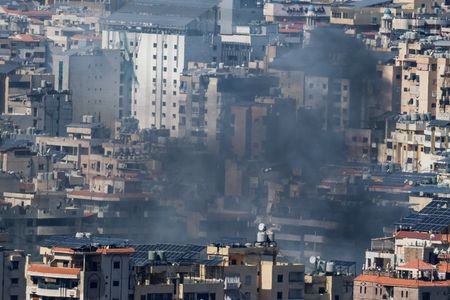
Israel has carried out heavy strikes in southern Lebanon and more widely since then, sending more troops over the border, and ordering Lebanese to leave a swathe of territory in the frontier region, where the Israeli military had kept soldiers at several positions since the 2024 war.
Hezbollah leader Naim Qassem said in a televised speech on Wednesday that the group would confront what he described as an Israeli plan of “occupation and expansion”.
“For us, this is an existential defence,” he said.
The Hezbollah elite fighters deployed to the south after the group opened fire with rockets and drones on Monday, according to the sources, speaking on condition of anonymity because of the sensitivity of the topic.
They had left that part of Lebanon – specifically the area between the Litani River and the border with Israel – after a U.S.-brokered ceasefire in the 2024 war, moving north of the river, the sources said.
The sources did not say how many elite forces had been deployed.
Hezbollah’s opening salvo on Monday was fired from north of the Litani River, Lebanese President Joseph Aoun has said.
THOUSANDS OF HEZBOLLAH FIGHTERS KILLED IN 2024
An Israeli military spokesperson said they were checking but didn’t immediately provide comment on the sources’ accounts. The Lebanese army declined to comment. The office of Prime Minister Nawaf Salam didn’t immediately respond to a request for comment.
The Israeli military said on Wednesday two soldiers were wounded as a result of anti-tank fire against troops in southern Lebanon, the first reported injuries among Israeli forces since the start of the regional war.
Hezbollah has announced several attacks targeting Israeli tanks this week, along with numerous rocket and drone launches targeting Israel.
An Israeli military spokesperson said on Wednesday the military was “positioning troops a little farther” into Lebanon than before, “to prevent any attacks against the northern communities” in Israel.
In May, 2023, before the Hamas-led October 7 attack on Israel triggered a region-wide conflict, Hezbollah invited media to watch Radwan fighters simulate an invasion of Israel.
Some 5,000 Hezbollah fighters were killed in the 2024 war with Israel, many of them members of the Radwan force. The war left Hezbollah severely weakened.
Israel has carried out near-daily strikes targeting Hezbollah since that conflict, including an attack in December on what it described as a training compound used by Radwan forces in the south.
Following the 2024 truce, which demanded the Lebanese army confiscate all unauthorized arms, beginning in the area south of the Litani, the Lebanese army seized many Hezbollah weapons caches. Hezbollah said it respected the ceasefire south of the Litani, but that it didn’t apply to the rest of Lebanon.
(Additional reporting by Maya Gebeily in Beirut and Rami Ayyub in Jerusalem; Writing by Tom Perry; Editing by Aidan Lewis)
Brought to you by www.srnnews.com
 Denmark is set to explore if gastronomy can be recognized as an art form
 Cologne Cathedral, one of Germany’s best-known landmarks, to charge tourists for admission
 Blackout is still on in western Cuba as crews rush to repair damaged thermoelectric plant
 Meet Pedro Sánchez, Europe’s most vocal critic of Trump’s attacks on Iran