
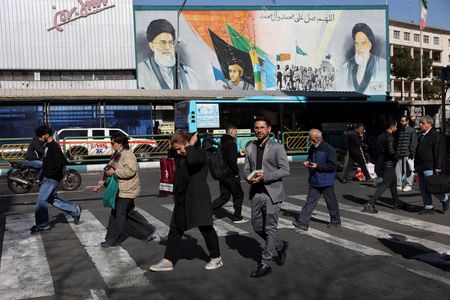
By Parisa Hafezi
DUBAI, Feb 2 (Reuters) – Iran’s leadership is increasingly worried a U.S. strike could break its grip on power by driving an already enraged public back onto the streets, following a bloody crackdown on anti-government protests, according to six current and former officials.
In high-level meetings, officials told Supreme Leader Ayatollah Ali Khamenei that public anger over last month’s crackdown — the bloodiest since the 1979 Islamic Revolution– has reached a point where fear is no longer a deterrent, four current officials briefed on the discussions said.
The officials said Khamenei was told that many Iranians were prepared to confront security forces again and that external pressure such as a limited U.S. strike could embolden them and inflict irreparable damage to the political establishment.
One of the officials told Reuters that Iran’s enemies were seeking more protests so as to bring the Islamic Republic to an end, and “unfortunately” there would be more violence if an uprising took place.
“An attack combined with demonstrations by angry people could lead to a collapse (of the ruling system). That is the main concern among the top officials and that is what our enemies want,” said the official, who like the other officials contacted for this story declined to be named due to the sensitivity of the matter.
The reported remarks are significant because they suggest private misgivings inside the leadership at odds with Tehran’s defiant public stance towards the protesters and the U.S.
The sources declined to say how Khamenei responded. Iran’s Foreign Ministry did not immediately respond to a Reuters request for comment on this account of the meetings.
Multiple sources told Reuters last week that U.S. President Donald Trump is weighing options against Iran that include targeted strikes on security forces and leaders to inspire protesters, even as Israeli and Arab officials said air power alone would not topple the clerical rulers.
PEOPLE ARE EXTREMELY ANGRY, SAYS FORMER OFFICIAL
Any such uprising in the wake of a U.S. strike would stand in contrast to Iranians’ response to Israeli and U.S. bombing attacks on Iran’s nuclear program back in June, which was not followed by anti-government demonstrations.
But a former senior moderate official said the situation had changed since the crackdown in early January.
“People are extremely angry,” he said, adding a U.S. attack could lead Iranians to rise up again. “The wall of fear has collapsed. There is no fear left.”
Tensions between Tehran and Washington are running high. The arrival of a U.S. aircraft carrier and supporting warships in the Middle East has expanded Trump’s ability to take military action if he so wishes, after repeatedly threatening intervention over Iran’s bloody crackdown.
‘THE GAME IS OVER,’ SAYS FORMER PRIME MINISTER
Several opposition figures, who were part of the establishment before falling out with it, have warned the leadership that “boiling public anger” could result in a collapse of the Islamic system.
“The river of warm blood that was spilled on the cold month of January will not stop boiling until it changes the course of history,” former prime minister Mirhossein Mousavi, who has been under house arrest without trial since 2011, said in a statement published by the pro-reform Kalameh website.
“In what language should people say they do not want this system and do not believe your lies? Enough is enough. The game is over’,” Mousavi added in the statement.
During the early January protests, witnesses and rights groups said, security forces crushed demonstrations with lethal force, leaving thousands killed and many wounded. Tehran blamed the violence on “armed terrorists” linked to Israel and the U.S.
Trump stopped short of carrying out threats to intervene but he has since demanded Iran make nuclear concessions. Both Tehran and Washington have signalled readiness to revive diplomacy over a long-running nuclear dispute.
SIMMERING ANGER, ‘DANGER OF BLOODSHED’
Analysts and insiders say that while the streets are quiet for now, deep-seated grievances have not gone away.
Public frustration has been simmering over economic decline, political repression, a widening gulf between rich and poor, and entrenched corruption that leaves many Iranians feeling trapped in a system offering neither relief nor a path forward.
“This may not be the end, but it is no longer just the beginning,” said Hossein Rassam, a London-based analyst.
If protests resume during mounting foreign pressure and security forces respond with force, the six current and former officials said they fear demonstrators would be bolder than in previous unrest, emboldened by experience and driven by a sense that they have little left to lose.
One of the officials told Reuters that while people were angrier than before, the establishment would use harsher methods against protesters if it was under U.S. attack. He said the result would be a bloodbath.
Ordinary Iranians contacted by Reuters said they expected Iran’s rulers to crack down hard on any further protests.
A Tehran resident whose 15-year-old son was killed in the protests on January 9 said the demonstrators had merely sought a normal life, and had been answered “with bullets.”
“If America attacks, I will go back to the streets to take revenge for my son and the children this regime killed.”
(Writing by Parisa HafeziEditing by Samia Nakhoul, William Maclean)
Brought to you by www.srnnews.com
 UK police review reports of alleged misconduct by Mandelson after Epstein files release
 Photos of Hasidic Jews celebrating the ‘New Year of Trees’ in Israel
 Aid agencies in South Sudan decry restricted access as government and opposition troops fight
 Cuban diplomat tells the AP there’s no dialogue with the US but the island is open to one