
By Barbara Erling
WARSAW, Dec 17 (Reuters) – Poland has decided to start producing anti‑personnel mines for the first time since the Cold War and plans to deploy them along its eastern border and may export them to Ukraine, the deputy defence minister told Reuters.
Joining a broader regional shift that has seen almost all European countries bordering Russia, with the exception of Norway, announce plans to quit the global treaty banning such weapons, Poland wants to use anti-personnel mines to beef up its borders with Belarus and Russia.
“We are interested in large quantities as soon as possible,” Deputy Defence Minister Pawel Zalewski told Reuters.
‘EAST SHIELD’
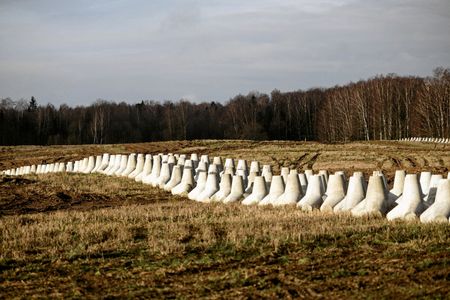
The mines would be part of the “East Shield”, a defensive programme aimed at fortifying Poland’s borders with Belarus and the Russian enclave of Kaliningrad, he said.
Asked whether production of mines could begin next year, once the withdrawal process from the Ottawa Convention was completed, Zalewski said: “I would very much like that… We have such needs.”
Poland began the process of withdrawal from the Ottawa Convention in August and had previously said it could start production of anti-personnel mines if needed, but that no formal decision had been taken. Zalewski’s comments are the first confirmation from Warsaw that it will go ahead with the move.
According to the Landmine and Cluster Munitions Monitor, Poland told the U.N. in 1995 that it had abandoned production of anti-personnel mines in the mid-1980s and the export of such weapons had ceased.
Belma, the state‑owned company that already supplies the Polish army with several other types of mines, said Poland would be equipped with millions of mines under the East Shield programme to secure its 800‑km (500-mile) eastern border.
“We are preparing for Polish demand … to amount to 5-6 million mines of all types,” Belma’s CEO Jaroslaw Zakrzewski told Reuters.
He added that, while the defence ministry has not placed an order yet, the company would be able to produce up to 1.2 million mines of all types, including anti-personnel mines, next year. Belma currently produces about 100,000 mines per year.
EXCESS PRODUCTION COULD BE SUPPLIED TO ALLIES
The minister said supplying mines to Ukraine would depend on production capacity.
“Our starting point is our own needs. But for us Ukraine is absolutely a priority because the European and Polish security line is on the Russia-Ukraine front,” Zalewski said.
Belma’s Zakrzewski said exports to Ukraine were possible and that NATO countries bordering Russia, including the Baltic states, had already signalled interest in buying anti‑personnel mines.
He said Poland’s own needs would take priority, but any excess production could be supplied to allies in the region.
Earlier this year, Lithuania and Finland said they expected to start producing anti‑personnel mines next year amid rising concerns about Russia since its full-scale invasion of Ukraine in 2022.
Latvia and Estonia are also leaving the treaty but have not announced production plans, though officials in Riga said they could launch manufacturing quickly if needed and Estonia sees it as a future option.
Polish anti-personnel mine production could begin once the treaty’s six‑month withdrawal period is completed on February 20, 2026, according to the Polish foreign affairs ministry.
Ukraine has also announced it is withdrawing from the 1997 Ottawa Convention, so that it can defend itself better against Russia, which is not a party to the treaty. Each side has accused the other of using anti-personnel mines during the war.
Other major powers that have not signed the treaty include the United States and China.
(Reporting by Barbara Erling; Editing by Alex Richardson)
Brought to you by www.srnnews.com
 Over 1,600 people have been killed in attacks on health centers in Sudan this year, WHO chief says
 Italy may not support EU-Mercosur free trade deal without changes
 Brazil threatens to abandon Mercosur-EU deal as Italy, France seek delay
 UN chief Guterres urges maximum restraint in Yemen after separatist advance