
By Poppy McPherson and Tim Kelly
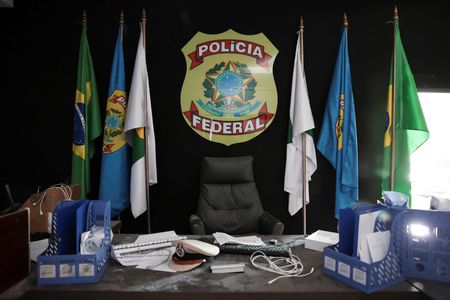
O’SMACH, Cambodia, Feb 6 (Reuters) – In a Cambodian compound with rooms designed to look like Singapore and Australia police offices, papers were strewn across desks and floors: the detritus of a fraud factory abandoned in haste.
Among the documents were profiles of a 73-year-old Japanese retiree, complete with his phone number and bank account balance, and an American woman who disclosed that she was a victim of domestic abuse. Nearby were scripts to commit love scams and impersonate police, as well as a room set up to resemble a Vietnamese bank office.
This is what Reuters reporters found on Monday inside a bombed-out compound near the Thai-Cambodian border, which offers one of the clearest windows yet into the industrial-scale fraud that has fleeced billions of dollars from victims globally.
Police raids and military air strikes have forced criminal gangs to flee scores of scam compounds in Cambodia in recent weeks. The visit to the site, known as Royal Hill, was facilitated by the Thai military, which bombed it during a brief border conflict in December and has since occupied the surrounding area.
Reuters is the first news organization to authenticate some of the papers, which document the sophisticated manner in which the scams are carried out.
The news agency verified one of the documents by contacting the Japanese retiree, who said he had received a call late last year from someone claiming to be from an electricity company and who warned his power would be cut off if he did not provide the scammer with his bank details.
The target did not send any money, but disclosed personal information during the call, including details found in the log seen by Reuters. “If the power was cut off, that would be a real problem as I live up in the mountains,” he said. “I let (details) slip out without thinking and later thought that was a bad idea.”
Reuters could not establish what entity had ultimate control of the Royal Hill compound in Cambodia, where land records are not readily accessible.
Chinese-language documents found at the site outlined that the complex’s unidentified management had leased out space to different scamming groups. A person named Zhang who was identified in the documents as a tenant did not respond to calls seeking comment.
The Cambodian government said in a statement on Wednesday that the compound was a hotel that Thailand had occupied by force.
Interior Ministry spokesperson Touch Sokhak separately said in response to questions about Royal Hill that the government “has the will” to crack down on scam centers and repeated a government pledge to eliminate cyber fraud by April.
Southeast Asia has emerged in recent years as an epicenter of the global cyberfraud industry. Compounds which are mostly run by Chinese criminal gangs and staffed partly by trafficking victims living in brutal conditions have proliferated across Cambodia, Laos, the Philippines, and lawless areas of the Myanmar-Thai border.
Many of these countries have been pressured to crack down by foreign governments like the United States, which estimates that Americans lost $10 billion to Southeast Asian scam centers in 2024.
The December strikes by Thailand – whose military said the centers were also being used to stage drone attacks during the border conflict – and a crackdown by the Cambodian government have led to an exodus of more than 100,000 people from compounds across the country.
Many have lined up outside embassies in the capital, Phnom Penh, seeking help and funds to return home in what Amnesty International has called a “humanitarian crisis.”
Japan’s National Police Agency and the U.S. Embassy in Bangkok did not respond to requests for comment about the documents that appeared to show their citizens being targeted.
HARSH REALITY
The compound visited by Reuters is located in the border town of O’Smach, which the U.S. State Department’s annual Trafficking in Persons Report highlighted in 2024 as a hub for abuses.
Files found in a part of the compound that the Thai military said appeared to be used by the site’s managers show the extent to which criminal gangs go to protect their operations.
One document showed how bosses demanded military-style anti-riot and emergency drills, while another included orders to security guards to stop people “loitering” nearby.
A property management notice also barred the use of food delivery services that could bring outsiders on-site. Other documents prohibited unspecified “illegal activity,” forbade workers from walking around shirtless, and demanded “civilized” behavior.
Reuters also found financial statements that outlined how the unidentified managers of the scam compound charged tenants several thousands of dollars a month in rent. Some of the criminal gangs were overdue on their rent, the statements show.
The news agency also discovered details about a cryptocurrency wallet in one of the documents. Nick Smart of blockchain-analysis firm Crystal Intelligence, which reviewed the wallet at Reuters’ request, said it had interactions with “many known high-risk services,” including gambling sites and cash-conversion locations.
At least some of the businesses in Royal Hill faced occasional struggles carrying out fraud, according to one of the documents, an October 2025 entry in a notebook.
That day, workers making calls faced “only abuse and scam answers” from their targets, the note read.
One former worker of another scam compound next to Royal Hill told Reuters that the conditions Reuters observed were reflective of what he experienced.
The worker, a Madagascar citizen who said he was a trafficking victim, spoke on condition of anonymity due to fear of retribution.
He said he was allowed by captors, who he did not identify, to leave the compound a few days after Thailand started bombing the area. The military action prompted the compound’s managers to return his passport, which they had seized, he said.
Scammers targeted by raids often relocate and reconstitute themselves into smaller operations, said Delphine Schantz, the regional representative for the United Nations Office on Drugs and Crime. Her agency shares expertise with national law enforcement agencies.
“We see those scam centers now kind of mushrooming all over the world in different places, along the same model as what we’ve seen in Southeast Asia,” she said.
(Reporting by Poppy McPherson in O’Smach, Cambodia, Thomas Suen in Bangkok, and Satoshi Sugiyama and Tim Kelly in Tokyo; Editing by Katerina Ang)
Brought to you by www.srnnews.com
 Rescuers search for woman swept away by river as Spain and Portugal battle Storm Leonardo
 An explosion hits a Shiite mosque on Islamabad’s outskirts, wounding dozens
 Trump has been clear on wanting new nuclear arms control treaty, says US official
 Kremlin says it hopes US-Iran talks in Oman will yield results