
By Doyinsola Oladipo
Sept 4 (Reuters) – Several air traffic controllers on duty when two Qantas aircraft nearly collided at Sydney airport in July had been flagged as facing a high risk of fatigue, according to internal records and a call recording obtained by Reuters, a staffing situation one shift manager described as “a bit insane”.
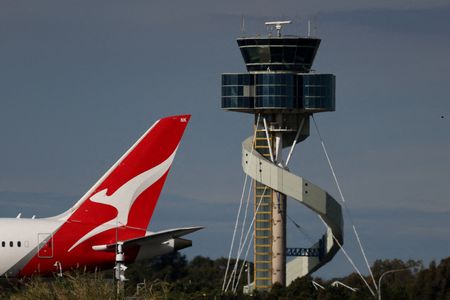
The July 27 incident, in which a landing Qantas turboprop narrowly avoided a Qantas Boeing 737 that had been cleared to cross the runway, was the first of six near-misses at Sydney Airport in about a month, drawing further scrutiny of air traffic control staffing amid global shortages.
Of the 10 controllers on duty at the time, five were rated “H” for high fatigue risk under Australia’s fatigue-management system, according to an internal log reviewed by Reuters. One was rated “M” for medium risk and one was “L” for low risk. The other three were not ranked as at risk of fatigue.
“We’ve got like five high fatigues on this morning. It’s a bit insane,” a controller shift manager told an air traffic management director in an internal call after the near-miss.
“Thankfully, they didn’t hit, but it was pretty close and everyone up here is pretty rattled by it,” he said in a recording reviewed by Reuters.
Two of the three controllers directly involved in the incident were “high fatigued” and the third was “medium fatigued,” the shift manager said.
The fatigue-risk ratings and the internal call, neither of which has previously been reported, occurred as aviation authorities worldwide grapple with concerns about overstretched air traffic control workforces and the risk of accidents.
Airservices Australia, the government agency that employs the country’s air traffic controllers, declined to comment, citing the ongoing investigation into the incident. The Australian Transport Safety Bureau is investigating all six near-misses to determine whether they share common safety issues or contributing factors.
FATIGUE MANAGEMENT SYSTEM
The fatigue management system does not measure whether a controller is actually fatigued. Instead, it uses an automated assessment of factors such as workload and scheduling to estimate the risk of fatigue.
Depending on the rating, controllers may be subject to mitigation measures approved by local shift managers or an air traffic management director, who may be based in another city. Those measures can include longer breaks, limits on traffic volumes handled by a controller, or ending a shift early.
Civil Air President Scott Nugent, whose union represents about 85% of Australian air traffic controllers, told Reuters that an increasing number of shifts in recent years had been assessed as carrying elevated fatigue risk, reflecting controllers getting less rest and working longer hours.
If a controller believed they were highly fatigued, they should not work in accordance with safety regulations, Nugent said.
“However, short staffing leads to people working more overtime, having fewer days off, working under more pressure and fatigue increasing,” he said.
Airservices said in the six weeks to August 28 there had been unusually high short-term absences in Sydney that had a significant impact on its ability to fill all operational shifts, according to presentation slides from a meeting in Canberra last week obtained by Reuters.
Two Australia-based controllers told Reuters that staff are routinely permitted to continue working despite high fatigue-risk ratings and that heavy traffic and staffing shortages can make it difficult to implement mitigation measures effectively. One of them, based in Melbourne, said he had never seen a controller removed from duty because they were deemed too fatigued to work.
Controllers also told Reuters they face significant pressure to work overtime, receiving calls and messages urging them to take extra shifts, while knowing their absence could leave already stretched colleagues under greater pressure.
Globally, there are no uniform rules governing how long air traffic controllers can remain on duty, with countries instead required to develop their own fatigue-management programs. As a result, scheduling limits vary widely.
Under Airservices Australia’s enterprise agreement, controllers can work up to 10 consecutive shifts, including additional and emergency duty, and are capped at 80 hours during a continuous run. By comparison, controllers in Canada can work up to eight consecutive days and those in the United States up to six, according to union officials.
Three Australian controllers and Civil Air told Reuters it is not uncommon for controllers to work 10 days in a row before receiving a single day off.
Longstanding staffing shortages in countries including Australia, Canada and the United States have resulted in controllers frequently working overtime.
In the U.S., overtime spending for air traffic controllers rose more than 300% between 2013 and 2024, reaching $200 million last year, according to a report by the U.S. National Academies of Sciences.
(Reporting by Doyinsola Oladipo in New York and additional reporting by Allison Lampert in Montreal; Editing by Joe Brock and Jamie Freed)
Brought to you by www.srnnews.com
 Reckoning looms for golf carts that zip through Rome’s crowded historic center
 Russia shifts tactics with round-the-clock attacks on Kyiv, disrupting daily life
 2 trapped workers rescued alive from a tunnel in Nepal, officials say
 Bolloré’s CNews gives far-right a bullhorn as French presidential election looms