
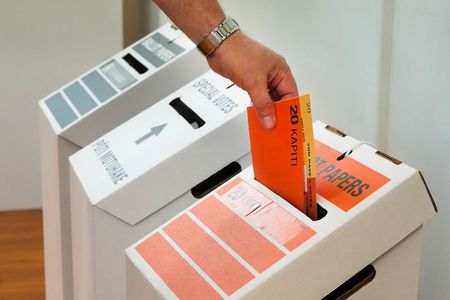
WELLINGTON, Nov 6 (Reuters) – Saturday is the final day to vote in the New Zealand national election, with the incumbent National-led coalition hoping to return to office and left-leaning parties including Labour looking to make them the first one-term government in nearly 50 years.
Advance voting opened on October 26. It is popular in New Zealand, with 58% voting ahead of the last election in 2023. The polls close at 7 p.m. on Saturday (0600 GMT).
Polls have shown that neither of the two largest parties will win a majority and results are sufficiently close that neither a left-leaning nor a right-leaning grouping is clearly ahead. Due to the need for negotiations it is likely to be weeks before New Zealand has a government.
WHAT IS THE STRUCTURE OF NEW ZEALAND’S PARLIAMENT?
There are 71 geographical constituency seats and then 49 seats are doled out to party-selected candidates, called “list members” in proportion to the overall public votes for each party.
If a party wins more constituency seats than its share of the party vote, an overhang of extra seats is created.
HOW IS A GOVERNMENT FORMED?
Under New Zealand’s mixed-member proportional system it is very uncommon for a single party to form a government.
If there is no majority winner, the major parties will start negotiations after the election and can either form a coalition or confidence-and-supply agreements with minor parties.
The party with the largest number of votes does not necessarily win, and negotiations can take days or weeks.
WHAT ARE SOME LIKELY SCENARIOS?
Official results will be released on November 27. These include votes cast overseas or by people who voted outside their electorate.
This has historically slightly changed the make-up of the government, and parties may wait to finalise agreements until these results are out. In 2023, it took 41 days for National, ACT and New Zealand First to sign an agreement and it could take a similar length of time again.
The current coalition government has indicated it is prepared to work together again. On the left, Labour, the Green Party and Te Pati Maori could join forces.
Polls this time indicate Opportunity Party, led by Qiulae Wong, will take on a role as kingmaker, with the party prepared to work with either the left or the right. However, National leader Christopher Luxon has ruled out working with her party.
WHAT ARE SOME KEY ELECTION ISSUES?
The cost of living is set to dominate New Zealand’s November 7 election, with voters focused on inflation, petrol and food prices, housing costs and pressure on household budgets.
Healthcare and hospitals rank alongside the economy as leading concerns, while unemployment, weak wage growth and the pace of the recovery remain politically sensitive.
Housing affordability is still a major issue, even though house prices have broadly stabilised.
The fiscal outlook will also be closely watched. New Zealand faces a structural budget deficit and rising public debt, creating pressure on whichever government takes office to balance spending.
Relations between Maori and the government remain contentious, following sustained disputes over Treaty of Waitangi principles, co-governance and the government’s wider reform agenda.
Climate and environmental policy also divide the parties, particularly over farming emissions, renewable energy, oil and gas exploration, land use and fast-track development rules.
Foreign and defence policy have gained prominence as New Zealand confronts a more uncertain strategic environment, including tension between its security partners and China, its largest trading partner.
(Reporting by Lucy Craymer; Editing by Saad Sayeed)
Brought to you by www.srnnews.com
 Taipei mayor election is a victory for democracy over China whoever wins, says candidate
 China’s Standing Committee of the National People’s Congress passes cross-border corruption law
 China’s marriage rate in third quarter tumbles to 18-year low
 Democratic socialist Raman elected Los Angeles mayor in upset over Bass