
By Olena Harmash
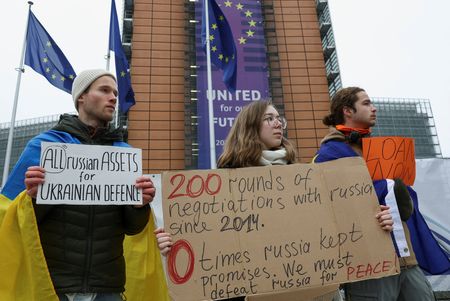
KYIV, Dec 18 (Reuters) – European Union leaders are set to review on Thursday proposals for using the proceeds from immobilised Russian sovereign assets, mostly held in Belgium, to support Ukraine’s financial needs for the coming years – the so-called “reparations loan”.
The main issue still to be resolved is Belgium’s demand that others in the 27-nation bloc share the financial risks if Russia were to successfully sue either Belgium or the Belgian central securities depository Euroclear, where they are held.
President Volodymyr Zelenskiy called this week for unity in Europe on the allocation of frozen assets, saying that Ukraine faced financial difficulties and would be unable to “remain strong economically” without this financing.
How much money does Ukraine need?
BUDGET PLANS FOR 2026
The International Monetary Fund (IMF) estimates that Ukraine will need about 135 billion euros ($158.57 billion) for 2026 and 2027.
For the next year alone, the Ukrainian state budget plans for total spending of 4.8 trillion hryvnias ($112 billion) against revenues of 2.9 trillion hryvnias. The budget deficit is set at around 1.9 trillion hryvnias or 18.5% of gross domestic product.
Finance Minister Serhiy Marchenko said the country would need more than $45 billion in external financing in 2026.
Roksolana Pidlasa, head of the parliamentary budget committee, said the government still needed to secure $18-20 billion in external financing to be able to cover the 2026 budget gap.
DEFENCE SPENDING
With no immediate peace deal with Russia in sight, Ukraine plans to spend the bulk of state revenues – 2.8 trillion hryvnias or around 27.2% of GDP – to fund its defence efforts in 2026.
The front line with Russian forces stretches more than 1,200 km (750 miles) in the east and south, and Ukraine has about one million people in its defence forces.
Demand for weapons and ammunition keeps rising and the daily cost of fighting Russian forces is estimated at $172 million in 2025, compared with $140 million a year ago, officials said.
Ukraine needs international financial assistance to be able to fund its social and humanitarian spending in addition to defence aid. Since Russia’s full-scale invasion in February 2022, Ukraine has received more than $160 billion in foreign financial aid from partners.
Even if a peace deal were signed quickly, that would not remove financial pressures on Kyiv, analysts said. Ukraine’s military needs would stabilise, but not ease quickly. The army would still need re-equipping, rotation, modernisation, and sustained logistical support, they added.
HOW QUICKLY DOES UKRAINE NEED MONEY?
Pidlasa said a positive decision on the reparation loan as soon as possible was crucial. The best-case scenario would be to have a fully approved decision in January, with the first tranches to start arriving in the first quarter of 2026, she said, while adding that Ukraine could manage with its own resources in the first quarter of next year.
An EU approval of the reparation loan would also help to unlock other funding. Last month, Ukraine secured preliminary approval from the IMF on its new four-year, $8.2 billion programme to help maintain macroeconomic and financial stability. But final approval depended on a positive decision on the reparation loan, Pidlasa said.
($1 = 0.8514 euros)
(Reporting by Olena HarmashEditing by Frances Kerry)
Brought to you by www.srnnews.com
 Kenya’s environment court to consider a claim that a lux safari camp was harming wildebeests routes
 Belarusian leader says Russia deployed its latest nuclear-capable Oreshnik missile to the country
 Searches under way in probe involving French Culture Minister Dati