
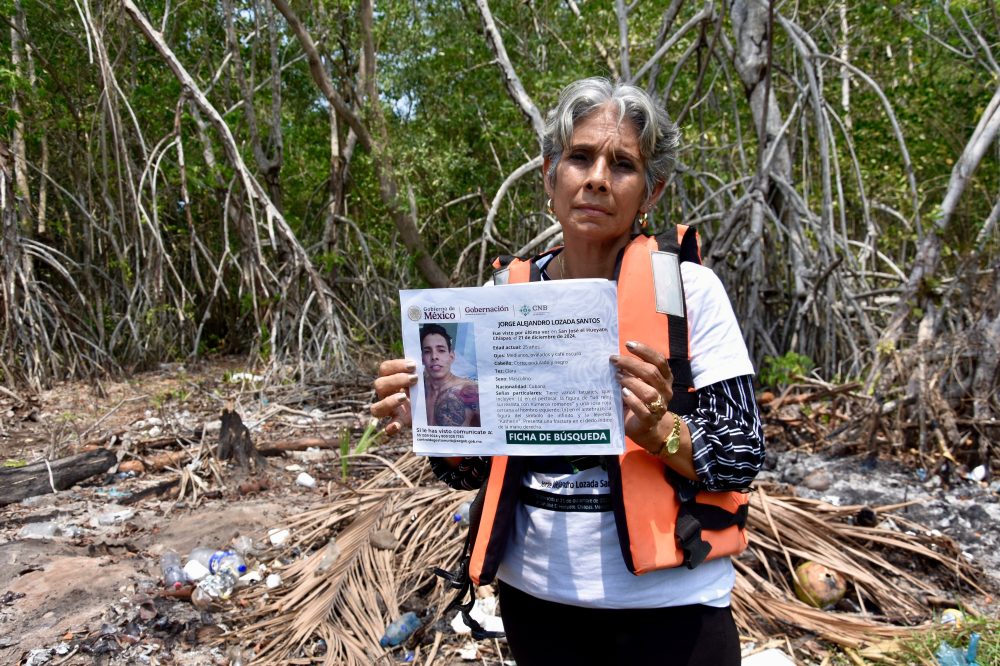
TAPACHULA, Mexico (AP) — On Christmas Eve 2024, Elianis Caridad Morejón Pérez, a young Cuban woman, told her mother by phone that she had put on a life jacket and was boarding a boat to travel from southern Mexico toward the United States. It was her final message from San José El Hueyate, a town in the state of Chiapas, before disappearing alongside 39 other migrants from Cuba, Honduras and Ecuador while traveling a maritime route known as one of the most dangerous paths used by smugglers.
Earlier this month her mother, Isis Pérez, arrived in that same village near the Guatemalan border to search for her, alongside other relatives of the disappeared. Together, they scoured the San José El Hueyate pier, navigated the Pacific coast by boat, and canvassed local merchants and residents for any information.
No one Pérez spoke with could provide concrete information, but many recalled that, before the start of the second Trump administration in January 2025, a steady flow of vehicles would arrive, carrying migrants who would then be transported by sea.
That migratory flow plummeted last year as the U.S. ramped up deportations, either sending migrants to their home countries or to third-party nations willing to accept them.
“As family members, we live in constant torment and anguish, longing to find them,” said Óscar Hernández, a Honduran man who traveled to Chiapas in hopes of locating his brother, who is among the disappeared.
The International Organization for Migration’s Missing Migrants Project has recorded the disappearance or death of 11,475 migrants on the route from South America to the United States since 2014. More than half of them were in Mexico.
According to a recent IOM report, several smuggling seaports have been identified since 2021. Migrants typically board small, twin-engine boats in Puerto de Ocós, Guatemala, before stopping to refuel and resupply in the Chiapas ports of Puerto Madero, San José, Barra de Zacapulco, and Paredón. They eventually disembark in Salina Cruz or Huatulco, Oaxaca, to continue their journey northward by land.
The 40 migrants who vanished in late 2024 were racing to reach the U.S. before U.S. President Donald Trump’s second term, fearing he would dismantle the more flexible immigration policies of his Democratic predecessor, Joe Biden, according to family members of some of the disappeared.
Cubans Meiling Álvarez Bravo, 41, and her 15-year-old son, Samei Armando Reyes Álvarez, were among those who vanished.
“On Dec. 21, 2024, at 8 a.m., she told me they were going to have breakfast because they were about to cross toward Mexico City by boat,” recounted Julia Margarita Bravo Díaz, Meiling’s mother and the boy’s grandmother.
Her daughter and grandson had flown from Cuba to Nicaragua before traveling overland through Honduras and Guatemala into Mexico. However, at the start of their journey, they were unaware that their path toward the U.S. border would eventually take them by sea, according to family members of four of those missing.
Searching for missing persons in Mexico is a grueling task on land, but it becomes exponentially more difficult at sea, said Ana Enamorado, coordinator of the nonprofit Regional Network of Migrant Families.
Between July and November 2025, the Mexican Navy rescued 22 migrants — six from high-seas shipwrecks and 16 from land as they prepared to embark from Chiapas. In response to these risks, Mexican authorities said in March that they had increased high-seas surveillance alongside Guatemalan authorities to disrupt both drug trafficking and the irregular movement of migrants toward North America.
The mothers and relatives of the 40 migrants who vanished in late December 2024 say that while they must return to their home countries, their search will not end. They remain committed to seeking answers from afar.
“We are leaving with heavy hearts but with the hope of finding them,” said Pérez. “We ask that you help us search, help us find them.”
___
Follow AP’s coverage of Latin America and the Caribbean at https://apnews.com/hub/latin-america
Brought to you by www.srnnews.com
 Clashes erupt in Bolivia as miners set off dynamite and police fire tear gas
 Canada doubles down on clean energy commitment, plans to reduce electricity costs
 The Media Line: 4 Wounded, One Critically, in Rosh Hanikra Drone Strike as Israel-Lebanon Talks Resume in Washington