
By Steve Gorman
Aug 5 (Reuters) – Firefighters making big strides against a cluster of blazes near Spokane, Washington, scrambled on Wednesday to secure their gains as they anticipated a return of extremely hot, dry weather in the days ahead.
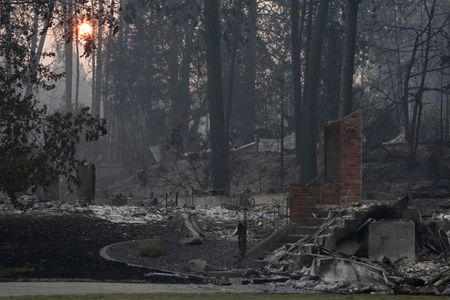
Officials said crews had carved buffer lines around a trio of fires threatening the state’s second-most populous city. The blazes have destroyed hundreds of buildings and forced tens of thousands of people from their homes since Saturday.
However, full containment, in which a wide corridor of ground has been scraped clean of combustible vegetation around a fire’s perimeter, has yet to be achieved, authorities said.
“With primary containment lines now in place, crews are focused on strengthening those lines through aggressive mop-up and extinguishing pockets of heat near homes and other structures to reduce the risk of additional damage,” the Spokane-area fire command said.
The Spokane fires were ranked as the No. 1 firefighting priority in the U.S. as a whole, including the drought-parched Pacific Northwest, where dozens of major wildfires have burned for weeks, fouling air quality across a wide region with smoke and soot.
A total of 94 major wildfires were burning in 13 U.S. states, most of them in the West, and more than half of those in Oregon and Washington, according to the National Interagency Fire Center in Boise.
A local resident, Aaron Farinacci, 37, who had served prison time on a manslaughter conviction for killing his father in Arizona, was arrested on Tuesday and charged with arson in connection with one of the three Spokane-area fires.
The cause of the two others remained under investigation, but unlike many of the other large wildfires raging across the Northwest, authorities have determined that none of the Spokane blazes was triggered by lightning, according to Benjamin Cossel, a spokesperson for the fire command.
The Spokane-area fires have scorched more than 10,000 acres (4,047 hectares) on the northern fringe of the city, home to about 230,000 residents west of the Rocky Mountain foothills near the Idaho border.
At the height of the conflagration, stoked by high winds and unusually hot, arid conditions, as many as 64,000 people were placed under evacuation orders as fast-moving flames swept entire neighborhoods and kept firefighters on the defensive.
At least 700 structures have gone up in flames, the bulk of them homes, and early property-loss assessments showed another 400 buildings may have been heavily damaged or destroyed, Cossel said.
No casualties have been reported, and as of Wednesday, all 14 people initially reported as missing in the fire zone have been accounted for as safe, he said.
A cooling trend and calmer winds on Monday and Tuesday helped ground crews and firefighting aircraft to make significant strides in curtailing the blazes.
“We’re cautiously optimistic about how things are looking, with the knowledge that this weekend is going to test things,” Cossel told Reuters by phone. Forecasts call for temperatures to climb into the mid- to upper-90s Fahrenheit, with relative humidity in the low teens from mid-week into the weekend.
The Interagency Fire Center has tallied 45,184 wildfires year to date nationwide, the most for this time of the year in at least a decade, with nearly 5.5 million acres charred, the most from January 1 through August 5 since 2022.
Conditions propelling heightened wildfire activity in North America, Europe and elsewhere in recent years, especially prolonged drought and extreme heat, are attributed by scientists to climate change, mostly a function of heat-trapping gases emitted from the burning of fossil fuels.
(Reporting by Steve Gorman in Los Angeles; Editing by Cynthia Osterman)
Brought to you by www.srnnews.com
 US and say a Strait of Hormuz deal is close
 Trump talks up the economy at a Las Vegas casino (VIDEO)
 The Media Line: Father of Slain Hostage Ariel Bibas Marks What Would Have Been His 7th Birthday