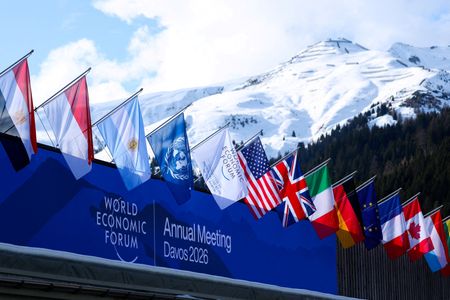
DAVOS, Switzerland, Jan 23 (Reuters) – World leaders and business executives departed from Davos after an eventful World Economic Forum annual meeting which was dominated by U.S. President Donald Trump.
Here’s what we learned:
GEOPOLITICS
Europe learned the value of standing up to Trump. His claim to Greenland crossed all of its red lines on territorial sovereignty and Europe’s resistance, possibly helped by the ensuing fall on financial markets, was seen as one reason he backed off.
But Europe’s trust in the transatlantic relationship with Washington has been badly rattled, and its leaders are looking at how to act faster when the next crisis occurs.
“There are efforts to advance European decision-making. We are probably too slow,” one European Union official said.
Many European leaders and executives said they found the Trump administration’s approach offensive and rude, even as some said the U.S. president had raised legitimate issues.
Ukraine was at first overshadowed during Davos, but as Trump announced a deal on Greenland, Ukrainian President Volodymyr Zelenskiy flew in for talks.
A peace deal appears elusive, despite U.S., Ukrainian and Russian officials speaking of progress and Zelenskiy said territorial issues were still unresolved.
In another sign of the influence of the Trump administration on the agenda, Russian President Vladimir Putin’s envoy Kirill Dmitriev landed in Davos for talks with U.S. officials on Tuesday – the first Russian official to visit Davos since Russia invaded Ukraine in 2022.
Dmitriev held talks at the USA House, without attending the Forum itself.
Leaders openly debated not just whether Trump might strike Iran, but what would come after. Would the regime crumble? And if it did, who would own the fallout? Trump’s unpredictability once again became a defining feature of the event.
MACROECONOMICS AND MARKETS
U.S. threats on the eve of the meeting to impose tariffs on European allies for resisting Trump’s ambition to acquire Greenland inflamed trade tensions and reinforced concerns among some CEOs that Europe can no longer rely on the U.S.
“When you talk to CEOs today, what do they want? Stability, predictability, and the rule of law. I would say it’s in short supply,” Canadian Finance Minister François-Philippe Champagne said during a debate on tariffs.
Trump’s gambit added fuel to arguments of those advocating for countries and companies to diversify commerce away from an increasingly protectionist U.S. and to trade more with each other.
Financial services firms hoped for increased business activity and growth this year, as they contended with potential disruption from U.S. policy, geopolitics, artificial intelligence and financial technology.
JPMorgan CEO Jamie Dimon warned that a proposal to cap credit card interest rates would amount to economic disaster, while other bankers said they were trying to shape the administration’s policy on affordability.
Crypto industry executives talked up stablecoins and blockchain technology’s potential to disrupt finance. Some bankers said they are experimenting with the new technology, while others remained wary.
Meanwhile, the macroeconomic outlook, questions about the U.S. Federal Reserve’s independence and fears about bubbles in AI and other assets weighed on investors’ minds.
ARTIFICIAL INTELLIGENCE
The tech industry came to Davos in full force, with rare appearances by Tesla CEO Elon Musk and Nvidia’s Jensen Huang.
AI startup Anthropic set up office space on Davos’ main drag for the week, aiming to grow its enterprise sales. And unlike the scepticism of late 2025, executives said they were putting concerns that the market overvalued AI companies behind them.
While jobs would disappear, they said new ones would spring up. AI would be an excuse to justify layoffs, not necessarily the cause, two business leaders told Reuters.
But union leaders feared AI would destroy jobs and lead to more inequality, with some demanding regulation and training.
ENERGY
Big Oil returned to Davos with a vengeance after a year of Trump’s presidency, as he orders a pause on wind parks and tells U.S. companies to drill for more oil at home and abroad.
U.S. Energy Secretary Chris Wright told a panel that global oil production needs to more than double to meet rising energy demand, challenging widespread analysts’ views that demand may peak in the next two decades.
Wright also said Europe and the U.S. state of California were wasting too much money on green energy investments. The Trump administration is radically changing the narrative and the oil industry likes it, one oil executive said.
But breaking ranks with Trump on renewable energy, Elon Musk said the U.S. could produce enough solar power to meet all of its electricity needs, including booming demand from the proliferation of Big Tech’s power-hungry data centers.
“You could take a small corner of Utah, Nevada or New Mexico – a very small percentage of the area of the U.S. – to generate all of the electricity that the U.S. uses,” he added.
“Unfortunately, the tariff barriers for solar are extremely high and that makes the economics of deploying solar artificially high,” Musk said.
DEFENCE
The world breathed a sigh of relief after Trump spoke of no military solution to his demands for Greenland. But some executives set their hopes on increased European and U.S. defence spending, including construction projects and hiring.
Trump also talked about a secret sonic weapon that he said was used during the capture of Venezuela’s Nicolas Maduro.
Russia and China will have to go back to the drawing board, Trump said. Russian secret services are looking into it, the Kremlin said.
(Reporting by the Reuters team in DAVOS, Switzerland; Compiled by Alexander Smith; ; Editing by Sharon Singleton)
Brought to you by www.srnnews.com
 Spanish prosecutors drop sexual assault complaint against Julio Iglesias
 South Korea Prime Minister Kim holds talks with US VP Vance in Washington, Yonhap says
 Attorney fears for safety of Ugandan opposition figure Bobi Wine after army chief threats
 Chilean court extends detention of suspect accused of starting wildfire that killed 20