
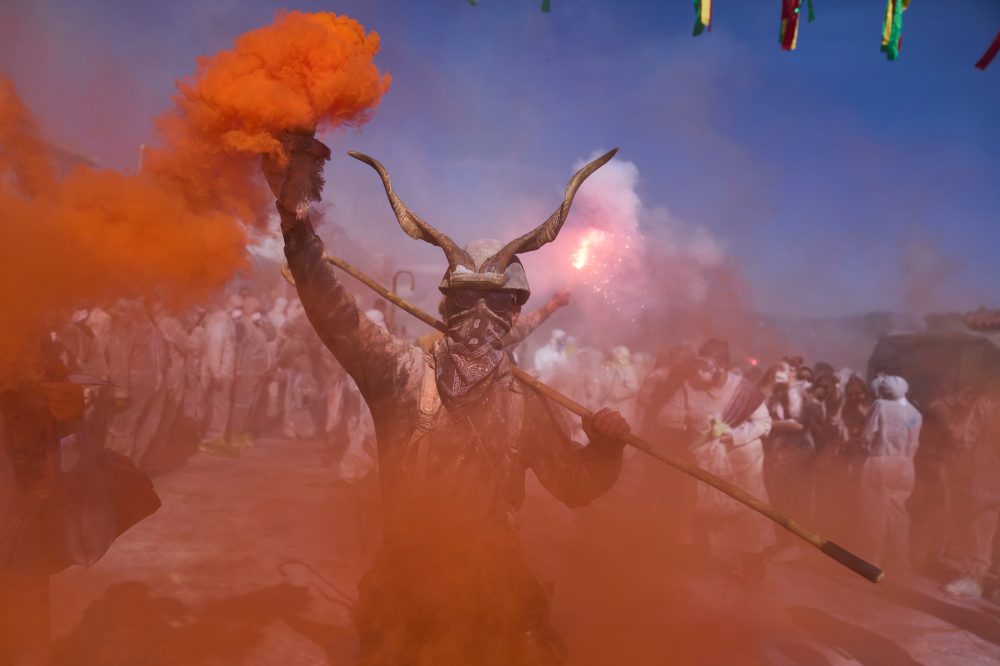
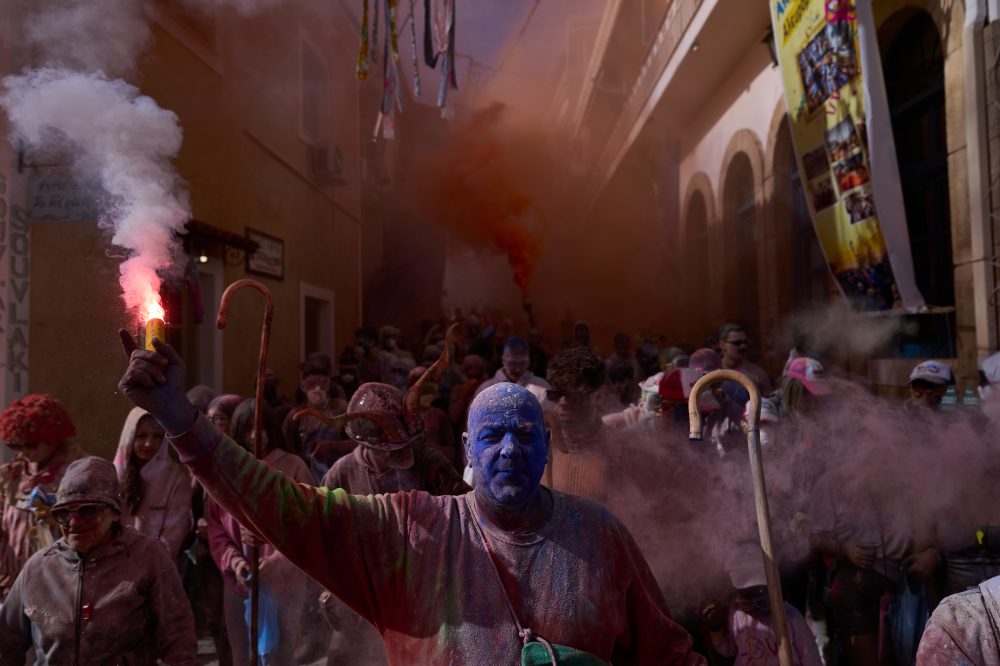
GALAXIDI, Greece (AP) — The Greek seaside town of Galaxidi exploded into a messy and colorful “flour war” on Monday for its annual end of carnival season festivities that mark the start of the Lent season.
Galaxidi’s main coastal road became a flour-strewn mess as revelers pelted each other with bags of dyed flour. Most of the town’s residents, and many visitors, merrily took part, while the more prudent ones enjoyed the show from the safety of their balconies.
Within a couple of hours, the celebration was mostly over, but some diehards were determined to stretch it far into the night.
“This custom was brought here by (our ancestors) in their sailboats, in 1800. It only exists here,” said Panayiotis Paphilis, a local resident.
It’s an explosion of color that takes place every Clean Monday, an Orthodox Christian holiday marking the start of Lent, the 40-day period of fasting that ends on the Easter holiday, and the end of the carnival season that holds onto many of the country’s pre-Christian traditions.
Many of the visitors were young people who had come to Galaxidi for the first time.
“We had a great time. We’ll come back,” said Stephanos Kapetanakis, 28, who was accompanied by several of his friends.
In most of the country, Clean Monday celebrations are rather more sedate, consisting mainly of flying kites and consuming copious amounts of shellfish and other seafood.
But in Galaxidi, a former major port about 200 kilometers (125 miles) west of Athens, the festivities are raucous and participants do their best to turn it up another notch, if they can.
Many similar celebrations have their roots in ancient, pagan times, and have blended seamlessly into the Christian calendar.
In the case of Galaxidi, however, the flour war seems to be of more recent vintage, namely from the 19th century, when traveling mariners took their inspiration from similar happenings in Sicily. It was the time when locally-built white-masted ships plied trade routes around the world.
But the glory days wouldn’t last, and Galaxidi, a town with a population of 1,700 people, lost its contact with the outside world, with traffic to its two harbors shrinking and no road connection to the rest of the country, hemmed in by looming mountains.
A road wouldn’t be built until the 1960s, but the isolation helped preserve the town’s unique character.
___
Demetris Nellas contributed to this report from Athens.
Brought to you by www.srnnews.com
 Surveillance of romantic partner led to El Mencho’s deadly capture, Mexican authorities say
 The Media Line: US Orders Non-Emergency Personnel To Leave Embassy in Beirut as Regional Tensions Rise
 North Korea’s Kim says country to develop economy in next 5 years
 A colorful ‘flour war’ in Greece marks the start of Lent, in photos