
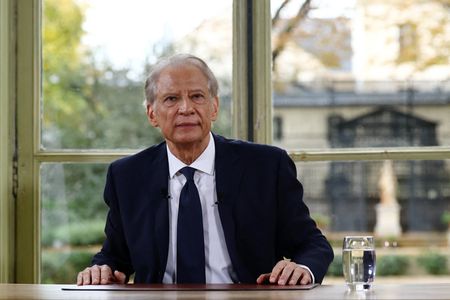
By Michel Rose and Elizabeth Pineau
PARIS, Nov 20 (Reuters) – Former French prime minister Dominique de Villepin announced on Friday that he would run for president in the 2027 election, joining an increasingly crowded field of centrist and centre-right candidates seeking to succeed Emmanuel Macron.
De Villepin, 73, who launched his own political movement last year, said he was running to heal a divided and “rotten” France, attacking what he called the “dead star” of Macron’s movement while rejecting both the far right and the far left.
The veteran conservative politician served as prime minister under former President Jacques Chirac from 2005 to 2007 after holding the post of foreign minister. He remains best known internationally for his speech at the United Nations in 2003 opposing the US-led invasion of Iraq.
“There is something like a death instinct hanging over our country,” de Villepin told a news conference, in his trademark flowery style. “That is why I am a candidate for the presidential election in 2027.”
De Villepin’s entry further crowds the centre ahead of the 2027 race, with former prime ministers Edouard Philippe and Gabriel Attal also vying to inherit voters from Macron’s camp, while candidates from the traditional left and right compete for a shrinking political space between the far right and far left.
Claiming the political legacy of post-war leader Charles de Gaulle, de Villepin has sought to carve out a distinct place in French politics, presenting himself as a defender of a universalist vision of France and rejecting both the far right’s emphasis on preserving a “native France” and what he characterises as the identity politics of Jean-Luc Melenchon’s France Unbowed.
He has attracted attention in recent years for his outspoken support for the Palestinian cause and criticism of Israel’s military campaign in Gaza, positions that have helped raise his profile beyond traditional conservative circles.
His programme combines calls to reduce inequality and public debt, defend international law and rely more heavily on referendums and negotiations with trade unions, including on pension reform. However, the economic policies underpinning those goals remain largely undefined.
He is seen gathering around 3% of voting intentions for the first round of the April-May election in recent opinion polls.
(Reporting by Michel Rose, Editing by Dominique Vidalon and Toby Chopra)
Brought to you by www.srnnews.com
 Myanmar genocide judgment may bolster Gaza case against Israel
 In Yemen’s Aden, divided government forces prepare for a Houthi assault
 The Media Line: Eisenkot Plans Knesset Vote on Minority Government if Coalition Talks Fail