
By Libby George, Nicolás Misculin and Uditha Jayasinghe
LONDON/BUENOS AIRES/COLOMBO, Oct 23 (Reuters) – Gustavo Raul Perez furrows his brow over a notebook at the hardware shop he has run for six years on the outskirts of Buenos Aires.
Since Javier Milei became president of Argentina in 2023 — with Perez’s vote — rapid reforms have thrilled investors and won praise from the International Monetary Fund. Perez, though, mainly feels the pinch.
“This economic plan is for a few,” he said.
Inflation has fallen to roughly 33% from nearly 300%, imports have opened up and subsidies have fallen.
But Perez’s restocking costs have tripled and customers have less to spend.
“There was a middle class three years ago,” he says. “It doesn’t exist anymore.”
Perez’s experience reflects a tension coursing through emerging economies: reforms that restored investor confidence and stabilised public finances have yet to improve living standards for many.
In Morocco, glittering new office towers contrast with frustration on city outskirts. In Sri Lanka, economic crisis and debt default have subsided but poverty remains above pre-crisis levels.
From fuel subsidy removal in Nigeria to privatisation in Egypt and market opening in Uzbekistan, years of reforms have helped emerging economies weather shocks — yet often grate with citizens who hear of economic turnarounds that do nothing for them.
Nigeria’s finance minister warned failing to address inequality is like “sitting on gunpowder”. Morocco’s central bank says stubborn unemployment has widened the gap between economic performance and citizens’ perceptions.
“When people in emerging markets are faced with rising food, fuel and energy costs…that is what they feel immediately,” says Torbjorn Soltvedt of Verisk Maplecroft, warning that unrest and instability could follow. Indeed, average global civil unrest risk hit its highest in nearly a decade this year, according to his company.
‘NO OTHER CHOICE’
The IMF and investors have long pressed emerging economies to reduce subsidies and currency controls.
The pandemic, then food and fuel spikes after Russia’s full-scale invasion of Ukraine, jolted many into action: cutting spending, liberalising exchange rates and hiking interest rates.
Removing subsidies and weakening currencies raises prices even as spending cuts squeeze incomes — but leaders had “absolutely no other choice,” says Simon Quijano-Evans of Macro Hive, or they risk an “abyss” of lost investment.
The changes drew investors back; emerging economies now grow around 4%, roughly twice the pace of advanced economies.
But if public anger derails reform, these countries risk losing more than confidence — backsliding could stall the investment and job creation needed to narrow the gap with richer nations.
TWO-SPEED WORLD
In Morocco, foreign direct investment flow nearly doubled last year, but deadly youth-led protests rocked the country, and in July hundreds of would-be migrants flocked into a neighbouring Spanish enclave.
“Morocco is developing at two different speeds,” civil engineer Anass Sayad said while walking with his family in Casablanca Finance City. He pointed to stadiums and skyscrapers while saying that education and healthcare deserve more attention. The government boosted spending on both in its 2026 budget, though any impact will take time to reach its citizens.
The World Bank estimates 1.2 billion people in developing countries will reach working age over the next decade — raising doubts over whether investment will create enough jobs for them.
WORLDWIDE WORRY
IMF chief Kristalina Georgieva warned higher fuel and food costs and declining development assistance were piling on pressure despite years of “hard work”, while the Fund called for more low-income country support.
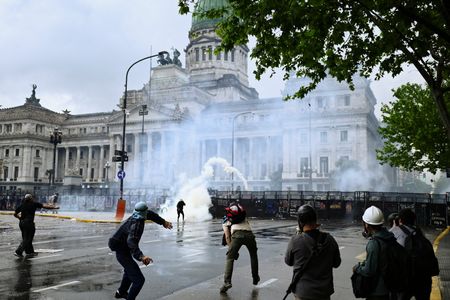
Anger and unrest are not confined to emerging economies; cost-of-living pressures have brought protesters onto the streets of France, Italy and Spain.
But wealthy countries have greater fiscal firepower to cushion households. In developing economies inflation can also bite harder, with food accounting for 30% to 50% of consumer price baskets, compared with 13% to 14% in the US.
In Colombo, food vendor Sirimodara Wadaramge Sriyakanthi wakes before 5 a.m. to prepare herbal porridge and rice packets for lunch, absorbing higher costs to keep her prices near $2.
“I sell the lunch packets at a reasonable price so people can afford it,” she says, worrying about her son’s school fees and daughter’s dance lessons.
Sri Lanka may have emerged from crisis — but to her, little feels different.
“We have so many expenses,” she says.
($1 = 331.3500 Sri Lankan rupees)
(Additional reporting by Abdelhak Balhaki in Casablanca and Miguel Lo Bianco in Buenos Aires, editing by Karin Strohecker and Hugh Lawson)
Brought to you by www.srnnews.com
 Nigeria Ebola patient did not travel to Congo, Swiss government says
 French businesses, events to close with more weekend protests expected
 Pope Leo cancels Assisi trip to aid recovery from cancer surgery