
By Libby George and Dhara Ranasinghe
LONDON, Feb 2 (Reuters) – From Japan to Brazil, elections could add yet more uncertainty this year to markets already whipped by U.S. policy gyrations and heightened geopolitical tension.
Japan’s election this coming weekend is among the most unpredictable in years, while polls across Latin America will test the region’s rightward shift.
Here are some of the year’s most significant elections for markets:
JAPAN
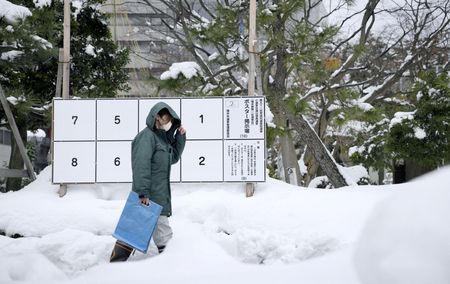
Japan’s snap election on February 8 could loosen fiscal purse-strings in the developed world’s most indebted nation, on a debt-to-GDP basis. Prime Minister Sanae Takaichi wants to convert personal popularity into support for her expansionary fiscal policies and bolster her coalition government’s position in parliament. Latest polls show her approval rating has slipped a touch.
Investors expect pressure on Japanese bonds to continue, and some analysts reckon 10-year yields will hit 3% this year, from just over 2% now.
COLOMBIA
Colombians will vote as many as three times, starting in March, to choose new legislators and a new president to replace Gustavo Petro, a leftist who has clashed with U.S. President Donald Trump.
Colombian stocks outperformed regional peers last year, but bond investors hope Latam’s rightward shift will sweep up Colombia, too, restoring orthodox economic policies.
“If there is a change to the right…there’s potential for some fiscal adjustment,” said Ninety One portfolio manager Nicolas Jaquier.
Jaquier said a victory for Ivan Cepeda of Petro’s coalition could allow him to make structural changes at the central bank and supreme court – removing roadblocks that slowed some of Petro’s policies.
HUNGARY
Hungary’s April vote is the opposition’s best chance in years to end Prime Minister Viktor Orban’s 16-year-long run.
Centre-right party Tisza has a polling lead over Orban’s right-wing Fidesz, but the outcome remains uncertain.
Cost of living concerns are high, and Orban has used fiscal giveaways to assuage voter worries.
Fitch Ratings cut Hungary’s credit rating outlook to negative last year, citing “significantly worsened” public finance projections that reflected new measures in advance of the election.
Tisza has pledged to repair ties with the European Union and unblock funding. Citi’s Luis E. Costa estimates that could mobilise 10 billion euros ($11.9 billion), which alongside other reforms could “enable higher investment spending, accompanied by a lower fiscal deficit and reduced risk premia”.
UNITED KINGDOM
Local elections usually don’t attract the attention of foreign investors, but May’s ballot might. Keir Starmer’s ruling Labour Party is trailing in opinion polls to the populist Reform UK and has struggled to deliver on promises to strengthen the economy.
Markets are sensitive to signs that the fiscally restrained Starmer might be replaced, as seen by a recent bond selloff.
Societe Generale’s UK economist Sam Cartwright says a new British leader would not have scope to significantly lift government borrowing if Starmer is replaced, his base-case scenario. Britain’s next parliamentary election must be held by August 2029.
ETHIOPIA AND ZAMBIA
Ethiopia and Zambia, both battling back from debt default, hold summer elections.
Ethiopian Prime Minister Abiy Ahmed’s Prosperity Party will almost certainly win a June vote, as key opposition groups plan a boycott.
In Zambia, President Hakainde Hichilema is currently expected to win in August, though Chatham House experts warn that citizens’ lives have yet to improve despite progress on debt restructuring and economic reform.
Investors are closely watching both countries as they seek opportunities in frontier markets. Zambia’s economy has proved more resilient than expected, and Ethiopia’s defaulted bond is trading above par despite the ongoing default.
BRAZIL
Brazil’s President Luiz Inacio Lula da Silva is leading polls for the October election against Flavio Bolsonaro – a right-wing senator and the son of previous President Jair Bolsonaro.
Leftist Lula, 80, managed a truce with U.S. President Donald Trump despite clashing over tariffs, Venezuela and the elder Bolsonaro’s conviction for plotting a coup.
“A Lula victory…could be quite negative for prices,” Tellimer’s Geronimo Mansutti wrote, citing concerns of “four more years of wide deficits and a higher debt path”.
A fourth term could also leave Lula – a progressive champion – facing more clashes with Trump.
But Ninety One’s Jaquier pointed to Lula’s value as a “known quantity”, adding that he is pragmatic and likely to appoint a credible team to make fiscal adjustments.
UNITED STATES
The U.S. November mid-term elections will determine who controls Congress and are an important test for Trump.
Affordability is a hot-button issue and the White House has scrambled to offer proposals to ease cost-of-living concerns, including capping credit card interest rates.
Polls show that Americans are broadly unhappy with Trump’s handling of the economy. The incumbent’s party historically suffers during mid-terms and the president recently conceded that his Republican Party could struggle to retain its tenuous grip on Congress.
“Clearly the president would like to see economic growth booming and financial markets rallying, and this will play a big part in his narrative and policies in the coming months,” said Zurich Insurance chief markets strategist Guy Miller. “The policies in to that election will impact all of us.”
($1 = 0.8393 euros)
(Reporting by Libby George and Dhara Ranasinghe; Additional reporting by Rodrigo Campos and Lewis Krasukopf in New York, Rocky Swift and Kevin Buckland in Tokyo and Bill Schomberg in London. Graphics by Gergely Szakacs and Nikhil Sharma. Editing by Karin Strohecker and Kirsten Donovan)
Brought to you by www.srnnews.com
 Russia’s Medvedev says expiry of New START should alarm the world
 Germany closer to US than China despite recent tensions, foreign minister says
 Russia does not want a global conflict, Medvedev says
 Syrian rapper Al Darwish returns home after 13 years to perform in post-Assad Damascus