
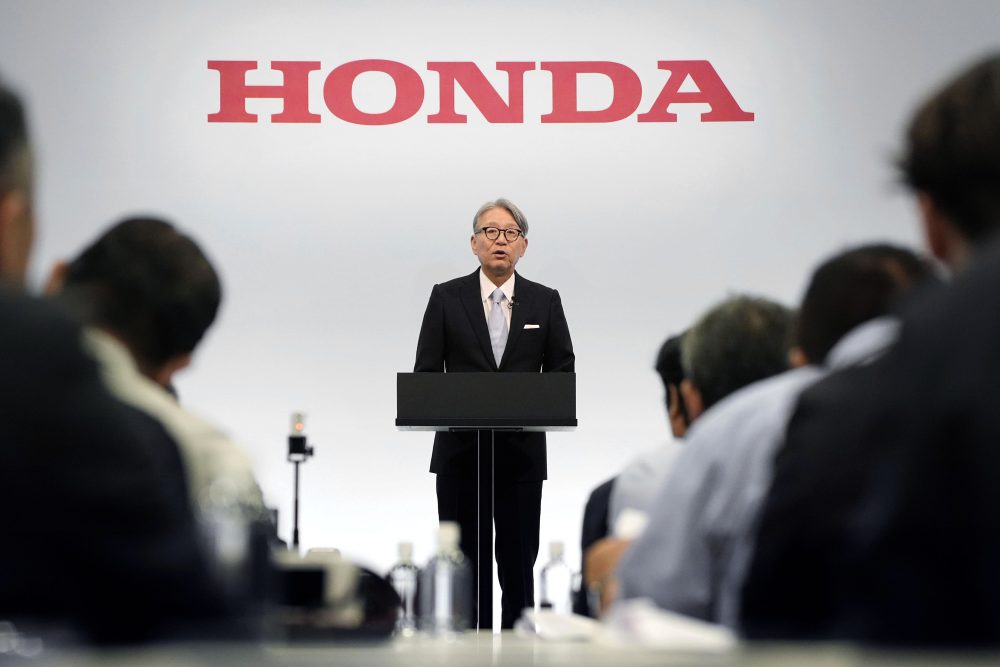
TOKYO (AP) — Honda racked up a 423.9 billion yen ($2.7 billion) loss Thursday, the first-ever full year loss for the Japanese automaker, acknowledging heavy costs for its electric-vehicle plans, stemming from President Donald Trump’s pro-U.S. policies.
The Japanese automaker said losses related to its EV operations are estimated to total 2.5 trillion yen ($16 billion), incurred mostly in the fiscal year just ended and the current fiscal year.
Analysts say Honda Motor Co. might have been too ambitious too fast, when many markets weren’t ready. As a result, Honda abandoned many of its plans for EV models, including those in the works in a joint venture with Sony Corp.
“EV demand has declined considerably, due to the rollback of environmental regulations in the U.S. and other factors,” Honda said in a statement.
The Trump administration has pulled back on incentive programs for EVs and withheld money to states wanting to add more EV charging stations, even as gas prices have soared over the war in Iran.
Trump also blocked California’s stringent electric vehicle mandates last year, backpedaling on the shift to environmental models.
Trump’s tariffs on imported autos and auto parts, although lowered to 15% from the initial 25%, also worked to dent Honda’s profitability.
Tokyo-based Honda’s bottom line got a lift from its healthy motorcycle business, helping Honda’s overall sales for the fiscal year through March to rise 0.5% to 21.8 trillion yen ($138 billion).
Honda, which makes the Accord sedan and Super Cub motorcycles, sold 3.4 million vehicles around the world in the fiscal year through March, down from 3.7 million the previous year.
It sold 22.1 million motorcycles, up from 20 million a year before. Honda dominates some markets in motorcycles, including India.
Honda forecast a return to profit for the fiscal year through March 2027, at 260 billion yen ($1.7 billion).
Chief Executive Toshihiro Mibe outlined a new growth strategy that included a continued pursuit of carbon neutrality. But he acknowledged the need to work on hybrids and regular gasoline-engine models as well, not just electric vehicles.
When asked by a reporter whether he was considering stepping down to take responsibility for the dire results, a common response in Japan, Mibe said he wanted to carry out the revival plan first.
“We will continue our research to develop future technologies including electric vehicle batteries,” he said. “We will get back on a growth track.”
___
Yuri Kageyama is on Threads: https://www.threads.com/@yurikageyama
Brought to you by www.srnnews.com
 Latvian prime minister resigns after controversy over stray Ukrainian drones
 Philippine senator wanted by the International Criminal Court flees from Senate
 Hungary summons Russian ambassador to protest attack in Ukraine near its border
 Dust storms and lightning kill at least 96 people in northern India