
By Leah Douglas and Yasmeen Abutaleb
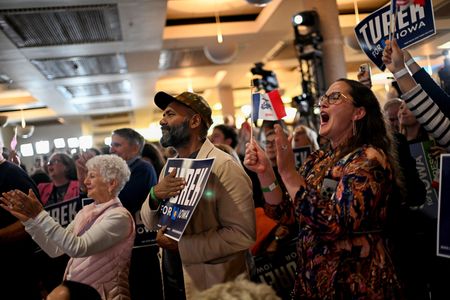
Nov 4 (Reuters) – A Democratic Party fundraiser in Warren County, Iowa in October 2025 was so crowded that local party chair Jim Culbert found himself ordering pizza after the food ran out.
“If we don’t have enough food, that’s a good problem,” he recalled telling volunteers.
The big turnout offered an early glimpse of the mounting Democratic enthusiasm in rural America — traditionally a stronghold of US President Donald Trump’s Republican party. A year later, it would help propel Democrats to sweeping victories in Tuesday’s midterm elections.
Democrats flipped House, Senate and gubernatorial seats in rural Republican strongholds including in Iowa, Kansas, Texas and Wisconsin, where farmers and others have been hard hit by his global tariff campaign and high fuel prices caused by the Iran war.
The victories followed a years-long Democratic effort to compete more aggressively in rural communities, where the party had steadily ceded ground to Republicans, according to interviews with 16 Democratic candidates, campaign staff and political experts and strategists.
Democratic strategists said that push was part of a broader Democratic National Committee effort to compete in places the party had long neglected. Rather than concentrating resources on a handful of battleground states, the DNC invested in every state party and pushed to field candidates in every race, they said.
“A lot of folks in rural America feel left behind because (Democrats) haven’t been showing up to talk to people,” said Democrat Rebecca Cooke, who unseated the Republican incumbent to win Wisconsin’s third congressional district on Tuesday. Now, she told Reuters, “there’s no community too small” to visit.
The question now is whether Democrats can hold on to their gains through the 2028 presidential election cycle. Tuesday’s election was widely seen as a rebuke of Trump rather than an embrace of the Democratic Party.
Republicans still won races on Tuesday in rural states including Arkansas, Oklahoma and Nebraska. And history shows that so-called wave elections dominated by one party do not necessarily translate into a presidential victory for the same party two years later.
To make their gains durable, Democrats will need to stick with their expansive electoral strategy, continuing to invest time and money in rural communities and other areas where they have made inroads, three Democratic strategists told Reuters.
“This was a rejection in essence of the way the party had worked in recent years, which was this focus on six or seven states,” said Simon Rosenberg, a Democratic strategist. “We had been operating on a very narrow map — too narrow.”
Rural Americans have steadily moved towards the Republican party over the past 25 years, according to Pew Research Center, driven by splits with Democrats on cultural issues and economic policies.
At the White House on Wednesday, Trump acknowledged to reporters that the war in Iran contributed to his party’s midterm losses but that he still felt the war was worth it.
The Republican National Committee did not immediately respond to requests for comment on their party’s rural-state losses.
SHOWING UP
Every week for 11 months, on what she dubbed “Small Town Tuesday,” Iowa Democratic House candidate Christina Bohannan, focused on canvassing rural towns. Her team regularly heard from residents that no political campaign had ever contacted them before, campaign manager Dan Driscoll said in an email. Bohannan flipped the state’s first congressional district.
For her campaign in Wisconsin, Cooke said she hired four regional field organizers and knocked on 54,000 doors, many in rural areas, in addition to those knocked on by the statewide Democratic Party.
Cooke, Bohannan and other Democratic candidates in rural districts aimed to capitalize on declining support for Trump. Approval of the president in rural areas fell to a new low in October of 45%, down from 60% at the start of his term, according to Reuters/Ipsos polling.
Across more than 1,500 rural counties where nearly all ballots had been counted on Wednesday, Republican candidates were collectively underperforming Trump’s 2024 share of the vote by 8 percentage points, according vote totals compiled by Reuters and USA Today, which are partnering this year to collect live election results for US Senate and House races.
The Democratic Congressional Campaign Committee said it also implemented a program for engaging rural voters for the first time this year.
“That ground game and commitment to showing up and listening is one of the many reasons why Democrats have expanded the map into seats Trump won by double digits,” DCCC spokesperson Katie Smith said in a statement to Reuters.
STRONGER COORDINATION
In Iowa, Democratic candidates united for the state’s first coordinated campaign since 2018, said Frances Patano, who ran the effort for the Iowa Democratic Party. That meant candidates could chip into a joint organizing effort that saved on costs and boosted lower-profile campaigns.
“By coordinating, you can run a far more efficient field program because you’re not competing” for the same group of organizers, Patano said.
In the first two weekends of October, the statewide campaign nearly doubled its door knock attempts from the 2018 midterms, Patano said.
In rural Warren County, the coordinated program paid for a staffer who led six canvassing shifts every weekend out of the county’s party office.
The added capacity boosted volunteer turnout. After years of organizing the same local Democrats to volunteer, Culbert said he would glance at a list of doorknockers and think: “Well, I don’t know half these names.”
YEARS OF PREPARATION
In Kansas, efforts to elect Adam Hamilton, the first Democratic senator elected from the state in nearly a century, began four years ago.
When Jeanna Repass became chair of the Kansas Democratic Party in 2022, she knew the party would need to make inroads in a heavily rural state that Trump won by double digits in 2016 and 2020. She hired a year-round organizer and grew the number of county party chapters from 57 to 68.
The effort “helped us to stir people’s passions and get them organized,” Repass said.
This year, the party knocked about 50% more doors than they did in the 2022 midterms, Repass said. Notably, some volunteers were independents or Republicans who had previously voted for Trump, she said.
That strategy paid dividends for Hamilton on Tuesday, particularly in Seward County, where about half of eligible voters are Hispanic. Hamilton won by 13 points in Seward, a dramatic shift from 2024 when Trump won the county by 39 points.
“We are not flyover country,” Hamilton said in his victory speech late on Tuesday night, to huge cheers. “We are the heart of America.”
(Reporting by Leah Douglas and Yasmeen Abutaleb in Washington; additional reporting by Tim Reid and Jason Lange in Washington; editing by Ross Colvin and Richard Valdmanis)
Brought to you by www.srnnews.com
 Zelenskiy in Spain to meet Sanchez, other leaders at Ibero-American summit
 Serbia detains police officers over alleged use of force against protesters
 Trump says Republicans harmed by Iran war, inability to ‘transfer the love’ for him
 Politics of fear failed to stop El-Sayed’s historic US Senate win