WASHINGTON, Aug 12 (Reuters) – From the beginning, something didn’t add up.
During the closing hours of the NATO Leaders’ Summit in Ankara in July, U.S. President Donald Trump posted on Truth Social that he would not be flying home aboard the new presidential plane that had brought him to the Turkish capital after Qatar gifted it to the administration last year.
Instead, Trump said, he had sent the aircraft ahead to Mildenhall Air Force Base in England so servicemembers could tour it. He wrote, without making clear how he would ultimately get home to Washington, that he would fly to Mildenhall aboard an older Air Force One.
As part of the press pool traveling with Trump, I was along for the ride.
The itinerary change was confusing, and Trump’s explanation seemed implausible. Reporters’ questions to one another turned to whether Iran had hatched a concrete plot to assassinate the president. At first, our precise itinerary also remained a mystery, though we assumed we were still heading back to Washington as initially planned after the stop in the United Kingdom.
If our initial hunch regarding a security concern proved accurate, the Qatari-provided plane – which is known to lack certain safety features – might not be up to snuff. That could explain why the White House would want to switch out the planes, and it would mean that we were in for a much more dangerous flight than usual.
Trump had inadvertently stoked speculation about potential threats during the final day of the summit on July 8. As he met with various world leaders, from Syrian President Ahmed al-Sharaa to Ukrainian leader Volodymyr Zelenskiy, he repeatedly brought up Iran’s longstanding attempts to kill him in comments to reporters.
After a press conference shortly before leaving Turkey in which Trump largely deflected questions about the plane swap, the sense that something was out of the ordinary only grew.
As we boarded what we believed was the aircraft carrying the president, White House staff directed journalists to close our window shades. When we pressed for an explanation, we were told it was a request from the Secret Service.
Having traveled on the presidential plane before, I knew this demand was atypical. Was it, perhaps, an attempt to obscure some sort of classified defense technology?
Only weeks later would we find out that the instruction was designed to help hide a covert operation in which Trump left the aircraft via a catering truck and boarded a different government jet due to a security concern.
On Air Force One itself, answers can be surprisingly hard to come by. For security reasons, reporters have no access to WiFi. Access to White House staff, meanwhile, is usually limited to a logistical staffer known as a “wrangler,” who often lacks access to or authority to distribute sensitive information.
The flight from Ankara to Mildenhall was uneventful, though it was hard to relax. We believed, falsely, that the president could appear at any moment and the circumstances surrounding our flight remained a mystery.
While Trump did not “gaggle” with journalists for reasons that are now obvious, I thought little of his absence as he often forgoes speaking to journalists on Air Force One.
But when we landed in England in the late evening, the trip took another unusual turn.
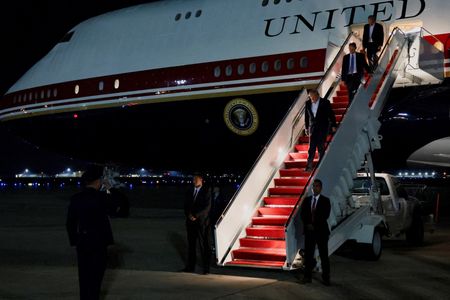
As we walked off the plane, we saw Trump descend from another section of the aircraft, an elaborate part of the ruse in hindsight.
White House staff then asked us to follow Trump on foot as he walked to the Qatari-provided Air Force One, which was parked several hundred yards in front of the aircraft we had just exited. Secret Service agents flanked the president, and a black government SUV to our right rolled slowly forward.
The maneuver – which resembled nothing I had seen before on the White House beat – immediately struck me as notably performative and cinematic, particularly as I was unsure of its purpose.
After loading up on the new plane and taking off, a White House aide provided journalists with a printout of a Truth Social post from Trump that included a dark picture of servicemembers and their families gathered in front of the Qatari-provided plane.
In the post, Trump said the “entire” base had requested to see the plane, and that stopping in Mildenhall required “virtually no deviation” from the standard Ankara-to-Washington flight path.
Moments later, the president visited the press cabin, where we peppered him with questions about the real reasons for why he didn’t take the Qatari-provided plane to England.
It would not become clear for another month that Trump had not traveled with us to Mildenhall at all and that there was a third plane involved.
During the flight, he denied that security concerns were a factor. But when I asked him why we had to close our window shades, he acknowledged the persistent threats he faced from Iran.
“But if I go, you go. Right?” Trump told us. “Perhaps someday you want to change professions.”
(Reporting by Gram Slattery, editing by Colleen Jenkins and Nick Zieminski)
Brought to you by www.srnnews.com
 Two US Army soldiers killed in Texas helicopter crash
 Zambia votes in elections expected to favour incumbent Hichilema
 Factbox-After Trump’s Turkey ruse, a look at past secret presidential trips
 Oman says the oil spill from a grounded tanker has reached its coastline