
JUBA, South Sudan (AP) — A South Sudanese prophet — as the story goes — wielded a sacred stick during a tribal battle in 1878 and summoned a deadly thunderbolt that struck down rival fighters.
That stick is known as Ngundeng Bong’s dang, and not only has its reputation as a magical and dangerous weapon lived on, but it also plays a role in the latest cycle of violence in the world’s youngest nation.
The dang has emerged as a contentious relic in the quarrel between South Sudan President Salva Kiir and opposition leader Riek Machar, who took ownership of the stick years ago. Machar is believed by his followers to be the gap-toothed, left-handed man who would become president in fulfillment of Ngundeng’s prophecy.
While that sustains Machar’s struggle, it also makes him a target for his opponents. Kiir and Machar are from different ethnic groups. Kiir is Dinka, the country’s largest group, while Machar — like Ngundeng — is Nuer, the second largest.
Fighting exploded along ethnic lines when Kiir and Machar disagreed in 2013. Kiir claimed Machar was plotting a coup. Machar then launched a rebellion that became a deadly civil war in which an estimated 400,000 people were killed. Machar returned as Kiir’s deputy following a 2018 peace deal that has collapsed.
Now fighting has escalated so badly that authorities are ordering civilians to evacuate rebel-held towns. That’s despite the fact that Machar is under house arrest and accused of treason. A South Sudanese general was recently filmed urging government troops to “spare no lives.”
Some rebels, including a militia known as the White Army, believe they are fighting to fulfill Ngundeng’s words and finally install Machar as president.
Douglas H. Johnson, the British-American historian who brought the dang back to South Sudan, compares the stick’s authority to a parliamentary speaker’s mace, needed for official business to proceed.
Machar is said to keep the dang as a religious object, using it to galvanize political support, according to Johnson and others who spoke to The Associated Press.
“Very much of the conflict is linked to spirituality,” said Mawal Marko, an independent researcher in Juba. “Most of the people fighting, especially the eastern Nuer, you find so many fighting in the name of Ngundeng.”
South Sudanese mythology abounds with cruelty, and the fight between Kiir and Machar is the latest installment of the hatred Ngundeng himself witnessed and later sought to stop: Dinka against Nuer, Nuer against Dinka.
Ngundeng’s prophecies were expressed in songs that even today some people play on the internet, searching for revelations about their country’s fate. There can be disagreement on the literal meaning of Ngundeng’s words.
“If we look at a prophecy progressively, there is always room for doubt,” said Christopher Tounsel, a historian of greater Sudan who teaches at the University of Washington, speaking of Ngundeng’s prophecies.
“That’s the most powerful thing: What people think and what they feel. That is the thing that can be the most impactful — not what it is, but what people perceive to be.”
Ngundeng, who died in 1906, is believed to have predicted his country’s independence. He foresaw violence. And he is said to have prophesied about a messianic Nuer leader for South Sudan who lacked the facial marks of his tribe, was left-handed and gap-toothed, and had been with a white woman. Machar is said to check those boxes.
“We know it can have power,” said Alex Miskin of the Rift Valley Institute think tank, speaking of Ngundeng’s dang. “Can (Machar) speak power into that stick? That is something I don’t know.”
“Who has the stick and what is the story may make some people a bit frightened” of Machar, said Miskin.
The dang was fashioned from the root of a tamarind tree and decorated with copper wire. It is about 110 centimeters (three and a half feet) long. One end of it broke during the 1878 battle won by the Nuer. Afterward, Ngundeng would say the dang was broken; there’s no account of him using it so successfully again.
The dang was inherited by Ngundeng’s son, who was shot dead trying to use it against colonial troops. He is said to have cried when he raised the stick and nothing happened.
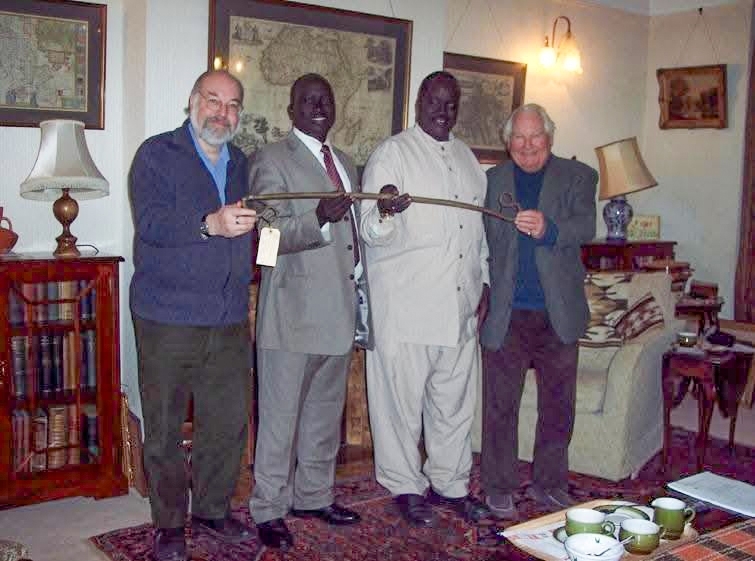
Collected as a trophy, the stick was presumed lost forever until it was discovered in the British town of Bournemouth by Johnson, a prominent South Sudan specialist. He bought the relic and sought to return it to South Sudan, which didn’t have a museum.
Machar, as the highest-ranking Nuer leader in a government then at the cusp of independence from Sudan, received the dang in the South Sudan capital of Juba in 2009. A white ox was slaughtered in a ritual overseen by Machar, who was photographed holding the dang aloft.
The dang’s return was seen as a national event. Kiir welcomed its arrival in a statement that warned the dang should not be used to wage war.
While serving as the vice president, Machar kept the dang in his house and showed it off to visiting Nuer leaders, said Johnson. “In a way, he was using this as a cultural object, something of interest to the Nuer rather than to South Sudan, to bring in other people as part of his coalition,” he said.
Johnson recalled that the dang looked ordinary in an umbrella stand when he first saw it. But if Machar has the stick, it wouldn’t be surprising that Kiir “would be worried that it was out of the control of the government,” he said.
The AP was unable to reach Machar for comment. His spokesman, Puok Both Baluang, said that freeing Machar would be “synonymous with the release of peace.”
Despite his detention, the 73-year-old Machar remains a formidable opponent for Kiir, who has governed without an electoral mandate for 15 years. Authorities say elections will be held in December. But a vote without Machar on the ballot and which returns Kiir as president would be seen as disenfranchising the Nuer.
Their military rivalry began in the bush in the 1990s, when Machar led a breakaway unit that drew accusations of treachery against him during the long war for independence. Amid the split, forces loyal to Machar carried out a massacre that targeted the Dinka, angering Kiir and others.
Fighting among southerners briefly undermined their struggle for independence, and sowed lifelong distrust between Machar and Kiir. Machar remained influential because he had the loyalty of Nuer fighters.
Kiir suspended Machar as his deputy in September after Machar was accused of remotely playing a role in an attack on a garrison of government troops. Machar regularly appears in a cage in the criminal trial he says is politically motivated. It is unclear if Ngundeng’s dang is still kept in his house.
The stick “is the heritage of South Sudan,” even though it isn’t at the building in Juba that holds national archives, said archivist Peter Tako.
“We hear it is with Riek Machar,” Tako said of the dang. “I don’t even talk about it.”
The dang, he said, was a sacred item “embedded” with the kind of political authority that made him feel unqualified to discuss it.
___
Associated Press religion coverage receives support through the AP’s collaboration with The Conversation US, with funding from Lilly Endowment Inc. The AP is solely responsible for this content.
Brought to you by www.srnnews.com
 Israeli parliament passes budget, allowing Netanyahu to avoid early elections
 Israeli parliament to vote on death penalty for Palestinians convicted of murdering Israelis
 South Korea considers nationwide driving curbs as oil prices soar
 Indonesia to loan endangered Komodo dragons to Japan for breeding programme, ministry says