
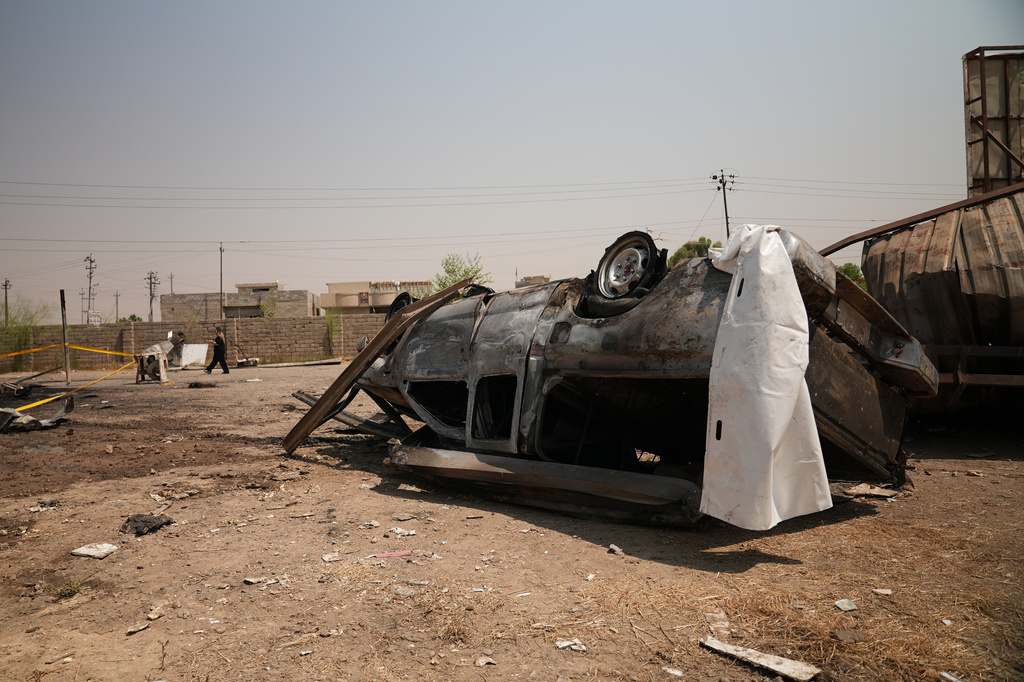
CAIRO—(AP) Iran struck American forces across the region early Wednesday, launching a barrage of missiles at U.S. military positions in Jordan as the United States teamed up with Saudi Arabia to hit Iran-backed militias inside neighboring Iraq. The sudden flare-up, coming after several days of relative calm, sharply raised the risk that a limited campaign could slide back into something larger—at a time when Americans are increasingly questioning whether the conflict can be wound down without spiraling costs at home and abroad.
Iran’s Revolutionary Guard said it fired ballistic missiles at the Muwaffaq Salti Air Base and at the headquarters of the U.S. Central Command in Jordan. Jordan’s military said five Iranian missiles were intercepted and destroyed, with no immediate reports of casualties or damage. While Jordan absorbed the immediate impact, the broader threat was aimed at American credibility and deterrence along a volatile arc stretching from the Levant to the Persian Gulf.
Later Wednesday, the U.S. military announced strikes by American and Saudi fighter aircraft against multiple logistics and weapons sites in eastern Iraq. The action followed allegations that Iraqi militias had used drones to attack Saudi oil facilities over the past two days. Saudi Arabia warned it “does not seek escalation but will respond to any aggression,” underscoring a posture shaped by self-defense—yet one that critics say keeps the region trapped in retaliatory cycles.
In Iraq, the Popular Mobilization Forces—an umbrella coalition of primarily Shiite, Iran-backed armed groups officially tied to the Iraqi state—said at least 20 fighters were killed and 32 others wounded in the overnight attacks. Though the Iraqi government has formalized the PMF as an “independent military formation” within the armed forces, these groups often operate with significant autonomy, including occasional strikes against U.S. facilities. Iraq’s leadership condemned the strikes, with President Nizar Amidi calling them “an unacceptable attack and a blatant violation” of sovereignty, and Prime Minister Ali al-Zaidi ordering an emergency meeting of the National Security Council.
The renewed violence also threatens to intensify the already fragile energy picture. Oil prices jumped after the attacks, with Brent crude rising 3.1% to $84.58 a barrel. Saudi Arabia is fighting multiple pressures at once: a separate conflict with Yemen’s Houthi rebels, which have declared a blockade affecting shipping through key routes between the Gulf of Aden and the Red Sea.
Attacks on Saudi energy infrastructure could prove especially destabilizing. Satellite imagery analyzed by the Associated Press showed damage to Saudi Aramco’s Abqaiq processing facility—an asset capable of processing about 7 million barrels of crude per day. The damage echoes a vulnerability demonstrated in earlier attacks, when disruptions helped spike global prices.
Meanwhile, diplomacy is under strain. Mediators had expressed optimism about bringing the U.S. and Iran back to negotiations, but an interim agreement collapsed amid renewed fighting near the Strait of Hormuz. Iran’s deputy foreign minister rejected an Oman proposal for jointly managing ship traffic, insisting that the strait “never” return to its prewar free-transit conditions.
With missile salvos and drone threats now surfacing again on multiple fronts—U.S., Saudi, Iraq, Yemen, and Iran moving in parallel—the world faces a grim test of whether containment is possible, or whether this conflict will resume at full momentum.
PHOTO- AP
Brought to you by www.srnnews.com
 Iraq’s balancing act is only getting harder as the war between the US and Iran widens
 Lebanese lawyers file complaint against banker who met with Israel’s Netanyahu
 Telegram’s billionaire founder Pavel Durov has faced legal woes before — in Russia and France
 Dominican Republic’s zoo offers home for confiscated animals as seizures of exotic species soar