
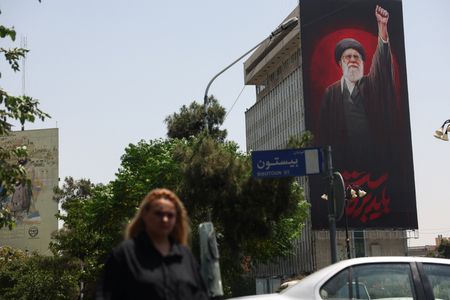
By Jana Choukeir, Nayera Abdallah and Elwely Elwelly
DUBAI, July 21 (Reuters) – U.S. forces bombed targets in southern Iran overnight after President Donald Trump said Tehran would pay dearly for the deaths of American soldiers, while Iran targeted U.S. sites in Bahrain, Kuwait and Jordan and a tanker was hit in the Strait of Hormuz.
The exchanges came a day after Yemen’s Iran-aligned Houthis said they would impose a naval blockade on Saudi Arabia, opening a potential new front in the war and raising the threat to global energy supplies and trade beyond the Gulf.
Despite the escalating cycle of attacks that has all but wrecked an interim peace agreement signed last month, signs that Tehran and Washington want to resume diplomacy kept oil prices in check.
U.S. Central Command said it had completed its latest round of strikes on Iran, saying it hit Iranian military command centers, maritime capabilities, missile and drone launch sites, and air defence systems.
Explosions were heard around the city of Shiraz in southern Iran, while Konarak and Chabahar on the southern coast also came under attack, according to state media.
Iran responded with renewed attacks across the Gulf, where recent strikes on desalination facilities have raised concerns about water shortages and underscored the growing threat to civilian infrastructure.
Iran’s Revolutionary Guards said they targeted infrastructure in Bahrain belonging to U.S. tech company Amazon in retaliation for what they described as a U.S. strike on the construction site of Iran’s planned Darkhovin nuclear power plant.
Iranian state media reported that Iranian forces also targeted accommodation facilities used by U.S. military personnel at Bahrain’s Sheikh Isa Air Base. There was no immediate comment from the U.S. military, Bahrain or Amazon on the reported incidents, which Reuters was unable to verify.
The Iranian army said it launched drone attacks against three U.S. military bases in Kuwait on Tuesday. The Revolutionary Guards said they attacked a U.S. military site in Jordan, and Jordan said its forces intercepted and destroyed five Iranian drones.
TANKERS STRUCK
The United Kingdom Maritime Trade Operations agency said on Tuesday a tanker in the strait reported being struck by an unknown projectile, forcing its crew to abandon the vessel and board a lifeboat.
Also on Tuesday, Iran’s Revolutionary Guards said two oil tankers had caught fire after explosions while attempting to transit the southern route of the Strait of Hormuz. It was not immediately clear when those incidents took place.
Iran had been pressing the Houthis to close the Bab el-Mandeb gateway to the Red Sea if the U.S. continued to attack Iranian power infrastructure — putting two of the world’s most vital energy arteries at risk.
A full closure of Bab el-Mandeb would reduce global oil supply by 7% as it would leave most Saudi oil exports unable to leave the region. The disruption would add to the huge cut to oil flows from the war in the Gulf, which has already reduced shipments by 10% of global supply.
After the Houthis announced their blockade, the Saudi-led coalition in Yemen said it began implementing protection measures for its ships moving through the Bab el-Mandeb Strait.
Oil markets weighed the threat to shipping against reports of diplomatic efforts to contain the conflict, with benchmark Brent crude prices easing slightly in early trading.
DIPLOMATIC PUSH TO RESTORE CEASEFIRE
A senior Iranian official told Reuters on Monday that Tehran had received a proposal from mediators for a 10-day ceasefire in efforts to salvage the interim deal, intended to pave the way to a lasting agreement to end the war that began on February 28 with U.S.-Israeli attacks on Iran.
Iranian Interior Minister Eskandar Momeni had asked Pakistan to resume its mediation role in the conflict. He later arrived in Islamabad for further talks.
The latest phase of fighting has proved to be among the deadliest of the conflict for U.S. forces. U.S. troop deaths rose to 17 over the weekend.
Trump, under mounting pressure at home over rising gasoline prices since the war began, said the latest U.S. strikes on Iran were honoring the deaths of American service members.
“Every time Iran kills an American Soldier they will pay for that killing many times over! This directive has been passed on to Secretary of War, Pete Hegseth, Chairman of the Joint Chiefs of Staff, Daniel Caine, and every Leader in the Military,” Trump wrote on Truth Social on Monday.
The war has killed thousands of people, mostly in Iran and Lebanon. Parts of Lebanon remain under Israeli occupation following attacks on Israel by Hezbollah fighters, who said they were acting in solidarity with Tehran.
Lebanese President Joseph Aoun is due to meet Trump at the White House on Tuesday to present a plan on how to disarm Iran-aligned Hezbollah and secure an Israeli withdrawal.
(Reporting by Reuters bureaux; Writing by Ros Russell; Editing by Philippa Fletcher)
Brought to you by www.srnnews.com
 Explainer-When are Turkey’s next elections, and can Erdogan run again?
 The Media Line: Israel Criticizes Australian Labor for Focusing on Israel While Downplaying Hamas
 ‘Interaction’ with Iran’s injured Supreme Leader increasing daily, president says
 Russian attack kills three in Ukraine’s Zaporizhzhia, officials say