
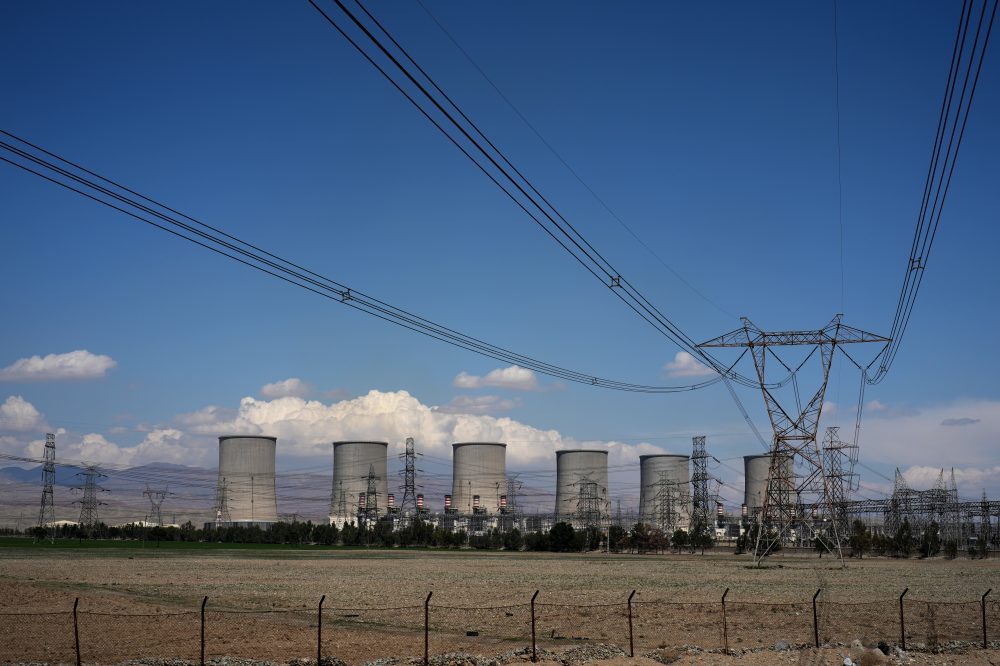
TEHRAN, Iran (AP) — Three times a week, Asghar Hashemi undergoes dialysis treatment at a hospital in northern Tehran. He fears that if power stations are knocked out, as U.S. President Donald Trump has threatened in escalating rhetoric, his life will be in danger.
Tehran residents rushed Tuesday to stock up on bottled water and charge cellphones, flashlights and portable power banks as the hours ticked down to Trump’s latest ultimatum for a deal that includes Iran reopening the Strait of Hormuz or face attacks on power plants and bridges. Despite the threats and risks to his health, the 56-year-old employee at Tehran’s subway authority said he’s no worse off than other Iranians who’ve been living under attack for more than five weeks.
“I am worried, but I am more worried about my fellow citizens,” Hashemi said, lying on his bed at Tajrish Martyrs Hospital for the treatment. “Whatever happens, we will stand until the end.”
As Trump stressed that his deadline — 8 p.m. in Washington — was final, some Iranians said they were terrified. Others expressed resignation. And some, like Hashemi, said they’d be prepared to defend their country.
“I will be ready to pick up a gun and start a fight against the enemy,” he said.
The Associated Press has been granted permission by the Iranian government to send an additional team into the country for a brief reporting trip. AP already operates in Iran. The visiting team must be accompanied by a media assistant from a government-affiliated company. AP retains full editorial control of its content.
Tehran, like other parts of the country, has been shaken by almost daily airstrikes by the United States and Israel since Feb. 28. Iranians’ main concern quickly became electricity as Trump’s deadline grew closer.
“When there is no electricity, there will be no water, no hygiene, nothing,” said Mahan Qayoumi, 23, who works at an artisan shop, where he said business would stop under a power outage. He brought emergency lights to his apartment to prepare, noting that “all aspects of life” would be affected.
A young designer in central Tehran, speaking on condition of anonymity for her safety, said her parents left at the beginning of the war, but she stayed behind to take care of her cat, Maya. Now, because of Trump’s threats, she said she plans to drive north — which has largely been spared heavy strikes — with Maya and join her family.
“If there is no electricity, there is no water,” she told AP on the messaging app Telegram, noting Tehran’s low water pressure and electric water pumps. “You can’t cook, either.”
The streets of sprawling Tehran, overlooked by snow-capped mountains, have seen less traffic over the past several weeks, with many residents leaving to seek safer areas. Schools and many state institutions remain closed.
But even as some residents frantically prepared, stocking up on water and canned foods, life in one of north Tehran’s largest covered markets seemed almost normal Tuesday. People went on with business as usual, fresh bread was made at bakeries, and Iranian sweets such as gaz and sohan were prepared.
“We are living our normal lives,” said Said Motazavi, 58, who owns a home appliances shop. Motazavi said Iranians have a lot of experience preparing for and living with conflict, referring to the 1980-88 Iraq-Iran war and the 12-day war with Israel last year.
At Tajrish Martyrs Hospital, the director told AP that a generator can keep much of the medical facility functioning if needed. He said the hospital has enough fuel to power it, as well as ample medicine and supplies for six months.
“I do not see any problem,” Dr. Masoud Moslemifard said, adding that the hospital has been prioritizing operations for those wounded in the war and postponing nonurgent surgeries.
In the streets of Tehran, security was tighter than usual Tuesday, with checkpoints in different parts of the capital. At major intersections, jeeps with heavy machine guns mounted on top were deployed.
Iran’s internet remains largely shut off, throttling news even as panic spread over Trump’s warnings.
A 26-year-old Pilates instructor told AP on condition of anonymity for her safety via Telegram that she’s been unable to prepare for possible attacks. She called this week the “worst atmosphere” since the war began.
“Honestly, we’ve kind of lost it at this point,” she said, describing how she’s not left home for the last few days and she and her family refuse to leave Tehran. “Whatever is going to happen, let it happen. We are dying bit by bit.”
One resident told AP that if the U.S. follows through on its threat, the people of Iran — not the government — will be the victims.
“By attacking infrastructure, the Islamic Republic will not be destroyed, only we will be destroyed,” the woman, a teacher in her 20s, told AP via a message on Telegram, on condition of anonymity for her safety.
She fears the attacks will spread chaos. “If we don’t have the internet, and if we don’t have electricity, water, and gas, we’re really going back to the Stone Age, as Trump said.”
____
Associated Press reporters Amir-Hussein Radjy in Cairo and Sahar Ameri in Berlin contributed.
Brought to you by www.srnnews.com
 US disrupts Russian military-run DNS hijacking network, Justice Department says
 US and Canadian astronauts capture global attention with Artemis II moon flight
 Turkey’s parliament debates a bill to restrict access to social media for children under 15