
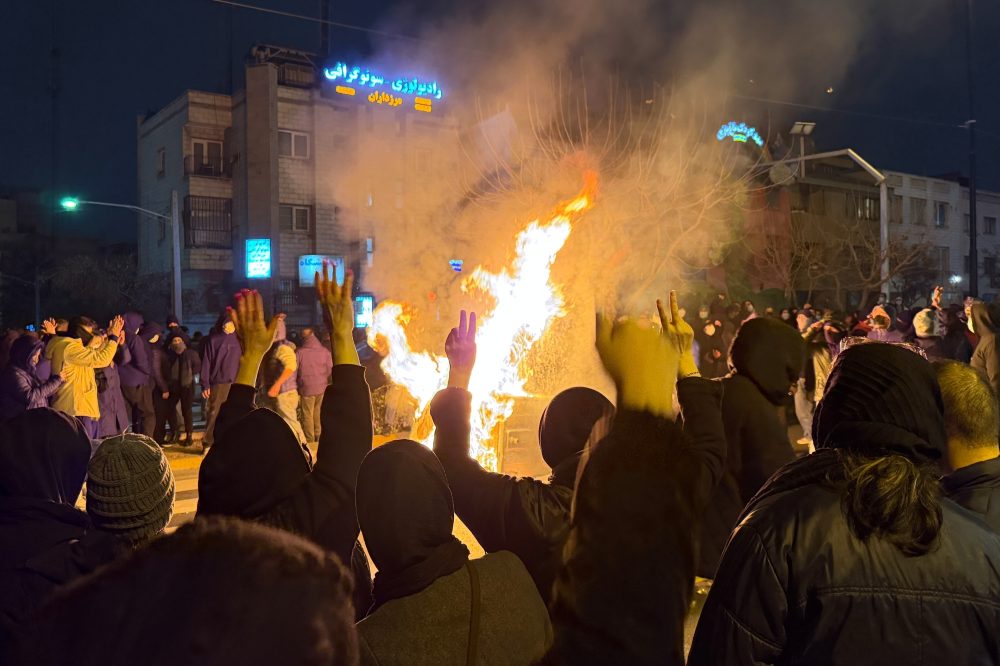
CAIRO (AP) — Standing on her balcony in the Iranian capital, Tehran, the teacher shouted out into the darkness, “Death to the dictator!” and “Death to the murderer, Khamenei!” on a recent night, joining the slogans coming from windows and rooftops around her relatively affluent neighborhood.
A few voices in the darkness responded with slogans in support of Iran’s 47-year-old Islamic Republic.
“Shut up! Choke on it!” her neighbors shouted back, drowning out the pro-government voices, the teacher recounted to The Associated Press, speaking on condition of anonymity for her safety.
Iranians across the country are still reeling with shock, grief and fear after massive nationwide protests were crushed by the deadliest crackdown ever seen under the rule of the 86-year-old Supreme Leader Ali Khamenei. Thousands were killed and tens of thousands are believed to have been arrested.
But a vein of defiance persists. A seething anger at Iran’s rulers is evident in videos shared on social media and in conversations with protesters. At the same time, three protesters reached by the AP also expressed futility over what can be done after hundreds of thousands braved taking to the streets only to be met with overwhelming violence. The protesters all spoke on condition of anonymity, fearing retribution or arrest.
Adding to the uncertainty is the United States’ threat to strike Iran. The U.S. has positioned warships and fighter jets nearby even as it holds negotiations with Iran over its nuclear program.
The defiance appears in the shouting of slogans from windows and rooftops at night, a ritual displayed in past waves of protests.
It is also evident at memorial gatherings for those killed 40 days earlier. Such commemorations — known as the “chehelom,” Persian for “the 40th” – are traditionally held by families for anyone who has died. But in times of unrest, chehelom can have a political dimension.
This week marks 40 days since Jan. 8 and 9, the deadliest days of the crackdown, and multiple videos circulating online show 40-day ceremonies in towns and cities around Iran. Some appear to have drawn hundreds of people, who often break into anti-government chants.
Often they are festive, with friends and loved ones of the slain protester singing and throwing flowers – a rejection of the solemn atmosphere encouraged by the state at official ceremonies. Most avoid calling the dead “shaheed,” or “martyr,” a term with Islamic religious connotations. Instead, they use the term, “javid nam,” a Persian phrase meaning, “Long live the name.”
Videos posted this week and verified by the AP showed a crowd of hundreds at the main cemetery in the small western Iranian town of Abdanan, chanting, “Death to Khamenei” and pumping their fists at the chehelom of Alireza Seydi, a 16-year-old boy killed on Jan. 8. The videos show security forces firing from an armored vehicle, raising clouds of what appeared to be tear gas, sending men and women running.
During the 1979 Islamic Revolution that toppled the shah and brought the Islamic Republic to power, 40-day memorials for slain protesters often turned into rallies that security forces tried to crush, causing new deaths – which then would be marked 40 days later with new protests.
Postings on social media have reported security forces trying to restrict people from attending some chehelom ceremonies.
“For every person killed, a thousand more stand behind him,” a crowd of several hundred chanted Tuesday while gathered in the eastern city of Mashhad for the chehelom of Hamid Mahdavi, according to a video verified by the AP. When a few police officers harassed some people commemorating Mahdavi, a fireman shot to death in January protests, the crowd shouted, “Shameless! Shameless!”
The government held its own chehelom for those killed, whom the Revolutionary Guard in a statement depicted as victims of violence caused by foreign-backed armed “terrorist” groups that exploited “legitimate public demands.” It said the 40-day commemoration was “a chance to renew commitment to national unity.”
“More than sad, people are angry. Everyone is so angry. Everyone is waiting for some kind of explosion,” said a resident of Karaj, a city just outside of Tehran.
He joined street marches on Jan. 8 and Jan. 9 and said five of his relatives and family friends were killed when security forces opened fire on protesters.
The Human Rights Activists News Agency has so far counted more than 7,000 dead and believes the death toll is far higher. Iran’s government offered its only death toll on Jan. 21, saying 3,117 people were killed; it has depicted many of the protesters as “terrorists.”
“I don’t know anyone around me who doesn’t know someone who was killed, or someone who was arrested or wounded,” the 26-year-old teacher in Tehran said. Two of her acquaintances were killed and the husband of one of her co-workers arrested, she said.
Iranians are also struggling with a rapidly worsening economy, as the value of their currency plummets.
Every day, prices rise, said the Karaj resident. “We are getting near an economic collapse,” he said. “Buying fruit has become a luxury.”
A resident of north Tehran who works in tourism and joined last month’s protests said that with the Persian New Year approaching in March, the bazaar would usually be full of shoppers, but not now.
“It’s a combination of grieving, lack of money and inflation,” he said, describing people in the capital as being in a state of “mass depression.”
The mood has dampened Iran’s normally vibrant cultural sphere. One prominent actor posted that she would no longer accept new roles “in this land that smells of blood.”
Alireza Ostad Haji, who referees a popular television strongman competition, offered condolences to “all mourning families” in an Instagram post and resigned from two national athletic committees. He broke down in tears as he spoke of a former bodybuilding champion, Masoud Zatparvar, who was killed. “He was not a terrorist, he was a protester,” he said.
There is also a fear that street protests can’t bring change in the face of the state’s overwhelming use of violence.
The Karaj resident and the Tehran protester who works in tourism both expressed support for the son of the ousted shah, Reza Pahlavi, who from exile has put himself forward as a leader of the fragmented Iranian opposition. Pahlavi has encouraged protests and called for the U.S. to strike Iran.
The depth of support for Pahlavi around Iran is impossible to gauge. But during January’s wave of protests, chants in support of him were common, a notable change from the past, when the shah’s son drew scant attention within the country or was seen as out of touch.
Some are even taking what was a previously unimaginable step for many — expressing hopes for an American attack.
“Every night, every hour, I wish I could hear (U.S.) strikes,” the protester who works in tourism said. “We cannot fight anymore with our fists against machine guns.” He said many of his friends who took to the streets alongside him in January say they won’t do so again because of the state’s violence.
The teacher said that, while she joined past protests, she didn’t in January because she didn’t like the expressions of Pahlavi support.
But she said some of her friends who also oppose the shah’s son joined the January protests and even repeated the slogan, “Long live the shah!”
“People have become very tired, and they see no alternative,” she said.
She worried a U.S. attack will bring war, civil strife and even more bloodshed.
“I am afraid there will be more massacres,” she said.
___
Chehayeb reported from Beirut. Associated Press writer Lee Keath in Cairo contributed to this report.
Brought to you by www.srnnews.com
 France’s Macron invites Brazil’s Lula to G7 summit in June
 Chilean authorities raid homes of former Codelco executives in El Teniente investigation