
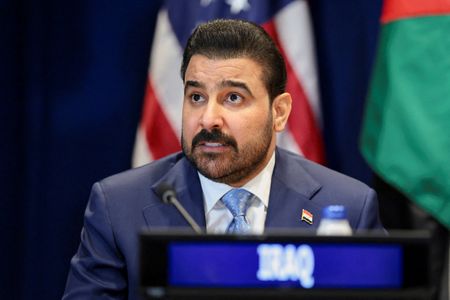
By Ahmed Rasheed and Michael Georgy
BAGHDAD/DUBAI, Nov 24 (Reuters) – Just six months since taking power as a political novice, Iraq’s Prime Minister Ali al-Zaidi has emerged as an unexpectedly bold risk-taker, launching simultaneous showdowns against armed Iran-backed Shi’ite militias and the semi-autonomous Kurds.
The two moves put the 41-year-old multimillionaire businessman on a course for direct confrontation with two of the most powerful entrenched groups that have defied Baghdad’s central control for decades.
Last week he ordered the military to stand by to enter a city controlled by Iran’s most powerful armed Shi’ite proxy group in Iraq, Kataib Hezbollah, after an investigation concluded the group was running an oil smuggling ring there.
Kataib, initially defiant, agreed to let troops enter in a compromise brokered by Shi’ite politicians.
Then on Tuesday Zaidi’s office announced that he had ordered the federal oil ministry to manage oilfields now under Kurdish security control, a source of longstanding dispute between Baghdad and the semi-autonomous Kurdistan region.
Zaidi also ordered the border crossings authority to take over all crossings in Kurdistan, and directed the Kurdistan Regional Government to allow exports of crude oil and petroleum products only through the federal ministry.
The prime minister of Kurdistan called the moves unacceptable.
“Prime Minister Ali al-Zaidi’s decisions are bold,” said Baghdad-based political analyst Hamza Mustafa.
“In taking these decisions, he has moved away from political dealmaking and favouritism. He is unconcerned about securing the support of those political forces for another term,” Mustafa said. “These decisions, important as they are, need mechanisms to put them into effect.”
HUGE PERSONAL RISK
Both moves pit the neophyte politician against entrenched groups that have resisted Baghdad’s authority for decades.
Baghdad-based political analyst Ahmed Younis called the decision to confront Kataib Hezbollah and other Iran-backed armed groups “a huge personal and political risk”.
“These groups have demonstrated both their military capabilities and their willingness to use force against those who challenge their influence. This is a high-stakes test of the government’s authority, and the consequences could extend far beyond a political confrontation.”
As for the subsequent decision to assert authority over Kurdish-controlled oil fields, one person familiar with the plan said it would be surprising if the Kurds allowed the federal oil ministry to take over management without resistance.
Analyst Mustafa called the move even riskier than the showdown against the Shi’ite militia.
Both moves encroach on vital interests of groups that have grown hugely powerful throughout the tumultuous decades of ethnosectarian civil war since US-led forces toppled dictator Saddam Hussein in 2003, when Zaidi was still a teenager.
‘I WILL NOT BACK DOWN’
Zaidi has said he will stand firm.
“I will not back down from bringing all weapons under state control, and I will press ahead with the confrontation, even if it costs me my life,” he told a government meeting in August after launching a campaign to disarm militias.
A multimillionaire businessman with interests across sectors of the Iraqi economy, Zaidi emerged as a compromise candidate for prime minister in April after US President Donald Trump publicly opposed a return of the powerful former Prime Minister Nouri al-Maliki, viewed in Washington as too close to Iran.
Zaidi’s relative youth and business background helped make him an alternative to established political figures, with supporters seeing an opportunity to bring a different approach to government. But his lack of a political track record left questions about his ability to navigate Iraq’s entrenched political networks.
SUPPORT FROM TRUMP
He has so far received open support from Washington that other recent prime ministers had lacked. But, like all Iraqi leaders, Zaidi must tread carefully in challenging Iran, which has steadily gained vast influence in the country through its ties to Shi’ite militias and politicians.
Trump has pressured Zaidi to disarm the militias that have struck US troops and targets in Saudi Arabia and the United Arab Emirates in solidarity with Tehran since the United States and Israel launched their war against Iran in February.
In August, Iraqi special forces reporting directly to the prime minister arrested the intelligence chief of the Iran-aligned faction Harakat al-Nujaba on accusations of involvement in drone attacks against US interests.
The detention, which lasted 48 hours, triggered threats of retaliation from the group and prompted intervention by senior Shi’ite politicians who helped defuse tensions. A week later, Iraqi special forces arrested four militia members over allegations they facilitated attacks on US interests.
(Writing by Michael GeorgyEditing by Peter Graff)
Brought to you by www.srnnews.com
 Zelenskiy confirms Ukraine hit Russian ship in Gulf of Finland, ally Norway urges caution
 China probes Shanghai party boss, Politburo’s Chen Jining