
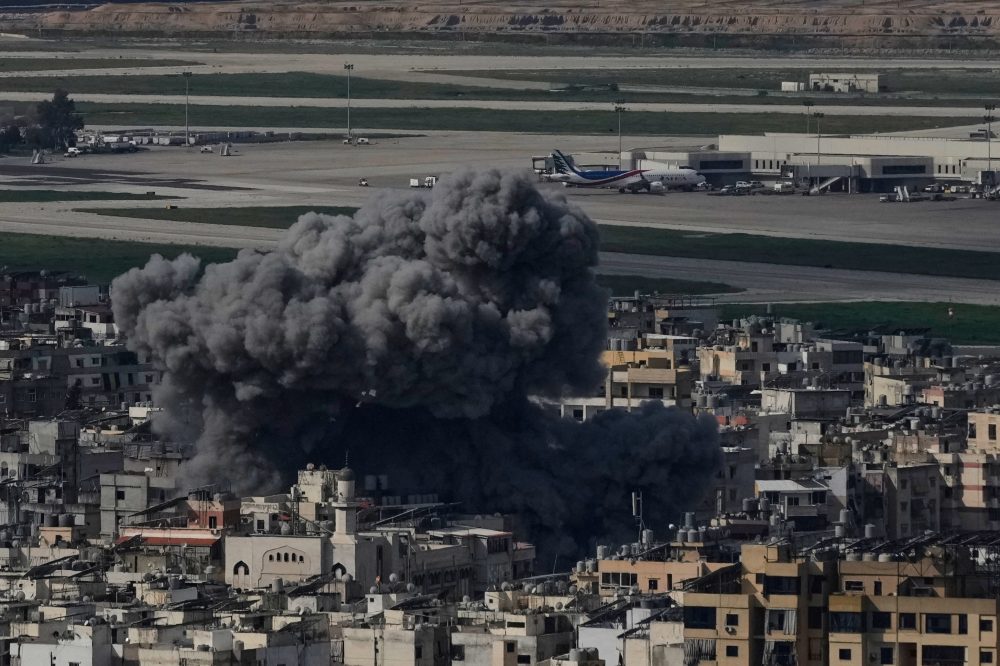
BEIRUT (AP) — Israel’s military ordered on Wednesday residents of dozens of border villages in southern Lebanon to evacuate “immediately” as airstrikes on suburbs of Beirut intensified and Hezbollah claimed more attacks.
Lebanon was dragged early Monday into the war in the Middle East, which erupted following U.S.-Israeli strikes on Iran, when Hezbollah fired rockets and drones into northern Israel, triggering Israeli retaliatory airstrikes on different parts of the country that killed more than 50 people wounded about 300 and dispalced tens of thousands of people from southern Lebanon, the eastern Bekaa Valley and Beirut’s southern suburbs.
Israeli authorities and Hezbollah agreed to a ceasefire in late 2024 after the Iranian-backed militant group started firing at Israel following the war in Gaza. Despite the ceasefire, Israeli strikes killed nearly 400 people in Lebanon until Monday’s escalation.
The Israeli military issued a statement Wednesday telling people living in dozens of villages in southern Lebanon close to the border with Israel to evacuate and move “immediately” north of the Litani River.
The Israeli army’s Arabic spokesperson warned on X that if people decide to move south of the river, they will be endangering their lives.
The area south of the Litani River, about 8% of the size of Lebanon, is mostly along the border with Israel. The Lebanese government says it has cleared the area of Hezbollah’s military presence there over the past months.
The order came after airstrikes overnight on the predominantly Christian southeastern suburb of Hazmieh that struck a hotel. Others hit the towns of Aramoun and Saadiyat just south of Beirut’s international airport, killing six and wounding eight. Another strike hit the eastern city of Baalbek, killing six people and wounding 15, according to state media.
The four airstrikes came without a warning in advance, which usually implies targeted assassinations. Security officials speaking on condition of anonymity in line with regulations said the man targeted in Hazmieh was a local official in Beirut’s southern suburb of Ghobeiri who got wounded.
“We live in a country where a missile can fall on your head at any moment,” said Maggie Shibli, wife of the owner of the Hotel Comfort in a Hazmieh neighborhood that was struck early Wednesday.
Abbas Najdeh, who was displaced from the southern port city of Tyre and was staying at the hotel, said: “We were sleeping then suddenly I, my children and my wife were thrown away.”
Also Wednesday, the Israeli military issued several warnings to people to evacuate buildings in Beirut’s southern suburbs, which were struck shortly afterward.
Hezbollah said Wednesday that it carried out several attacks on Israel, including two in which the group claimed that it used precision-guided missiles.
The warning for people to leave the area south of the Litani River came a day after Israel sent additional troops into southern Lebanon. Israeli forces had already been occupying several border points in Lebanon since a cease-fire ended a 14-month Israel-Hezbollah war in November 2024.
It was not immediately clear if Israel was preparing for a wider ground invasion. Lebanon’s state-run National News Agency reported Israeli artillery shelling on several Lebanese villages along the border, including Aid al-Shaab and Beit Lif.
In eastern Lebanon, the main border crossing with Syria was briefly closed Wednesday after Lebanese officials received a warning of an impending Israeli strike, which officials later said turned out to be a false alarm. There have been false alarms elsewhere in Beirut and other parts of Lebanon, causing fears among residents.
Anxieties have also been running high in Lebanon in recent days over a buildup of Syrian forces on the border. The current Syrian government is hostile to Iran and Hezbollah, as they were on opposite sides of Syria’s civil war that ended with the ouster of former President Bashar Assad in December 2024.
But a high-ranking Syrian official told The Associated Press Wednesday that the troop buildup “certainly has no offensive dimension — it is purely defensive.”
“The deployment is perfectly normal and within reasonable limits, primarily to prevent smuggling and also to counter any unforeseen eventuality,” said the official, who spoke on condition of anonymity because they weren’t authorized to comment publicly.
The ongoing conflict is not the first between Hezbollah and Israel. Hezbollah began firing into Israel a day after the Oct. 7, 2023, Hamas-led attack on southern Israel triggered the war in Gaza. After months of low-level fighting, a full-scale war erupted in September 2024 and Israel later launched a ground invasion of Lebanon.
Israeli forces withdrew from most of southern Lebanon after a U.S.-brokered ceasefire halted the fighting in late 2024, but continued to occupy five points on the Lebanese side of the border. Israel also pressed on with near-daily strikes, primarily in southern Lebanon, saying that Hezbollah has been trying to rebuild its positions there.
—
Associated Press writer Abby Sewell in Beirut contributed to this report.
Brought to you by www.srnnews.com
 China to send envoy to Middle East for mediation, foreign minister says
 Iran could disrupt the Strait of Hormuz with drones for months
 Sri Lanka says an Iranian warship has sunk off its coast in the Indian Ocean
 UK’s Starmer vows to keep a ‘cool head’ after Trump castigation