
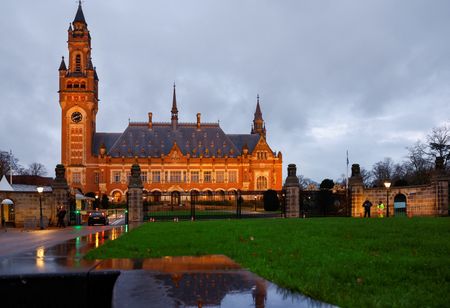
THE HAGUE, Jan 12 (Reuters) – A landmark case accusing Myanmar of committing genocide against minority Muslim Rohingya will open at the United Nations’ top court on Monday.
It will be the first genocide case the International Court of Justice (ICJ) will hear in full in over a decade. The outcome will have repercussions beyond Myanmar, likely affecting South Africa’s genocide case at the ICJ against Israel over the war in Gaza.
Myanmar has denied accusations of genocide.
“The case is likely to set critical precedents for how genocide is defined and how it can be proven, and how violations can be remedied,” Nicholas Koumjian, head of the U.N.’s Independent Investigative Mechanism for Myanmar, told Reuters.
The predominantly Muslim West African country of Gambia filed the case at the ICJ – also known as the World Court – in 2019, accusing Myanmar of committing genocide against the Rohingya, a mainly Muslim minority in the remote western Rakhine state.
Myanmar’s armed forces launched an offensive in 2017 that forced at least 730,000 Rohingya from their homes and into neighbouring Bangladesh, where they recounted killings, mass rape and arson.
A U.N. fact-finding mission concluded the 2017 military offensive had included “genocidal acts”.
Myanmar authorities rejected that report, saying its military offensive was a legitimate counter-terrorism campaign in response to attacks by Muslim militants.
In 2019 preliminary hearings in the ICJ case, Myanmar’s then leader, Aung San Suu Kyi, rejected Gambia’s accusations of genocide as “incomplete and misleading”.
The hearings at the ICJ will mark the first time that Rohingya victims of the alleged atrocities will be heard by an international court although those sessions will be closed to the public and the media for sensitivity and privacy reasons.
The hearings start at 10 a.m. (0900 GMT) on Monday and will span three weeks.
Myanmar has been in further turmoil since 2021, when the military toppled the elected civilian government and violently suppressed pro-democracy protests, sparking a nationwide armed rebellion.
The country is currently holding phased elections that have been criticised by the United Nations, some Western countries and human rights groups as not free or fair.
(Reporting by Stephanie van den BergEditing by Frances Kerry)
Brought to you by www.srnnews.com
 Off the ballot, Ugandan president’s son waits in the wings this election
 Australia PM Albanese recalls parliament early in wake of Bondi attack
 Trump says he will talk to Musk about restoring internet in Iran
 Trump says he and US military weighing ‘strong options’ on Iran