
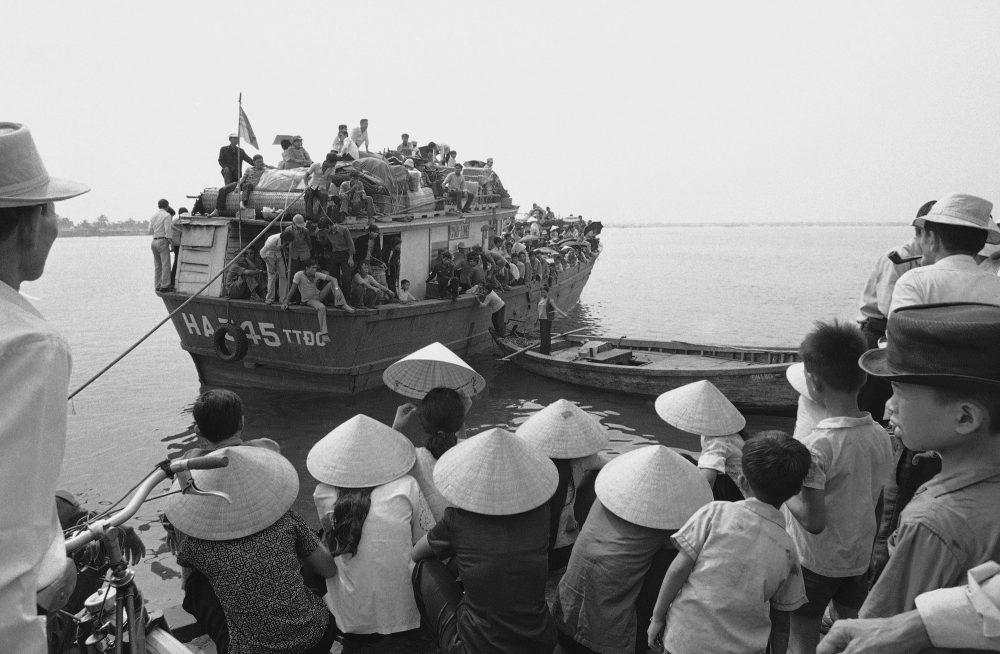
BANGKOK (AP) — Lionel Rosenblatt, who as a U.S. Foreign Service Officer carried out an unauthorized evacuation of hundreds of Vietnamese citizens before the 1975 fall of Saigon, has died at age 82.
The episode set off a career as a high-profile advocate for refugee rights. Rosenblatt was president of the Washington-based Refugees International from 1990 to 2001, and he lobbied for more active humanitarian intervention in crisis spots such as Bosnia and Rwanda.
Rosenblatt died Saturday in the Washington area after a battle with cancer.
Refugees International President Jeremy Konyndyk recalled Rosenblatt as a “fierce, creative, passionate champion for refugees” who “helped to shape a generation of humanitarian leaders.”
Rosenblatt was especially devoted to helping refugees in Southeast Asia.
He served in Bangkok as the U.S. Embassy’s refugee coordinator in 1976-1981, dealing with Vietnamese “boat people” and Cambodians escaping famine after Vietnam ousted the murderous Khmer Rouge from power in 1979.
Born in New York in 1943, Rosenblatt joined the State Department in 1966 and had early postings in Sri Lanka, Vietnam, Thailand and Washington.
As communist forces swept toward South Vietnam’s capital Saigon in early 1975, Rosenblatt was among several State Department officials concerned about safely evacuating Vietnamese who had ties to the U.S. government and military.
Stymied by U.S. Ambassador Graham Martin’s reluctance to act decisively, Rosenblatt and colleague Craig Johnstone defied regulations to launch a rescue mission, taking personal leave and traveling privately to Saigon. They arranged flights out of the country for 200–400 at-risk Vietnamese.
According to Rosenblatt, on their return to Washington, Secretary of State Henry Kissinger gave them an in-person pro-forma scolding accompanied by warm personal compliments, and they suffered no official consequences.
Rosenblatt displayed special empathy for ethnic minorities whose fates were largely regarded as collateral damage.
These included the Hmong hill-tribe minority in Laos, who served as proxy soldiers for the U.S. in its ” Secret War ” to support a pro-Western government against the communist Pathet Lao.
Expecting retribution after the Pathet Lao triumphed in 1975, tens of thousands of Hmong fled to Thailand. Recognizing that the tribal Hmong faced significant prejudice and poor resettlement prospects in the U.S., Rosenblatt and his team obscured their ethnic status on official paperwork to ensure their acceptance.
“It was always a mystery to me why they were good enough to fight for us but not good enough to consider for resettlement,” Rosenblatt said in a 2022 television interview.
Brought to you by www.srnnews.com
 Pope heads to epicenter of Cameroon’s separatist conflict to preach message of peace
 Russian missiles and drones bombard Ukraine in hourslong attack, killing at least 16 people
 Modi is pushing to get more women into India’s Parliament. That could have other consequences
 South African politician Malema sentenced to prison in firearm case