
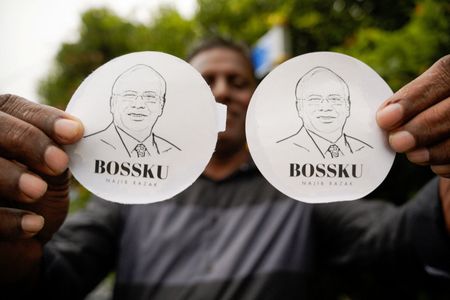
KUALA LUMPUR, Nov 7 (Reuters) – Malaysia’s king warned on Saturday that any attempt to challenge his order letting former Prime Minister Najib Razak go from jail to house arrest could amount to defying his decree, a day after authorities delayed Najib’s transfer.
Najib has been in jail since 2022 after being found guilty of corruption and money laundering in a case linked to a multibillion-dollar scandal at state fund 1Malaysia Development Berhad. He has consistently denied wrongdoing.
He was due to be transferred home on Friday, after his party paid a 50-million-ringgit ($12-million) fine to fulfil a condition of a royal pardon issued by King Sultan Ibrahim in September that would allow him to serve his remaining two years at home.
The transfer, however, was suspended after the attorney-general’s office said questions had arisen over the legal interpretation of the royal pardon and a court order issued on Friday allowing Najib to leave jail.
Sultan Ibrahim said on Saturday his pardon order was “clear, explicit and without any ambiguity”, noting that the attorney-general and federal territories minister had attended the pardons board meeting at which the order was issued.
“There should therefore be no confusion over its interpretation, nor should there be prolonged uncertainty over the implementation of the decision that has been granted,” the king said in a statement issued by the national palace.
The attorney-general’s chambers did not immediately respond to a request for comment outside office hours.
The AGC responded, however, to accusations by Najib’s lawyers of executive overreach, saying in a statement it was only seeking legal clarity and had “never disputed, set aside or intended to suspend the conditional pardon order granted by His Majesty.”
“The AGC considers that the issue … should be referred immediately to the court for a clear determination and directions,” it said.
The king, a position held in rotation by Malaysia’s nine regional sultans, plays a largely ceremonial role in Malaysia but has the authority to grant pardons, according to discretionary powers under the constitution.
The monarch and the country’s other sultans are held in deep respect by Malaysians. Negative remarks about the royalty can be prosecuted under the colonial-era Sedition Act.
($1 = 4.0560 ringgit)
(Reporting by Rozanna Latiff; Editing by William Mallard)
Brought to you by www.srnnews.com
 Russia says it hit targets in and around Kyiv in massive overnight strike
 As COP31 comes to Turkey, satellites reveal a landfill methane problem
 Delhi world’s most polluted major city on eve of Diwali, Swiss group says