
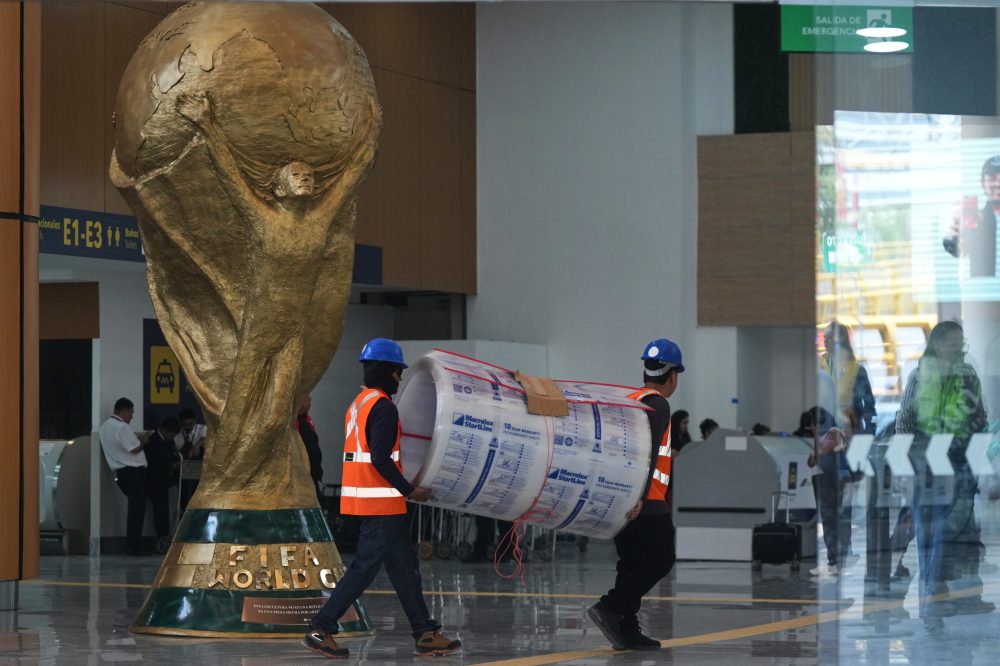
MEXICO CITY (AP) — With the 2026 FIFA World Cup less than a month away, thousands of passengers arriving at Mexico City’s Benito Juárez International Airport are greeted by a chaotic construction site of buzzing drills, scattered pipes and unfinished flooring.
The construction work coexists with hundreds of posters promoting the soccer tournament, as well as large-scale figures of soccer balls and trophies, which help passengers forget the inconveniences caused by renovations that have dragged on for a year.
Seating beside one of the six cranes remaining at the Terminal 1 entrance, 28-year-old engineer Luis Ibarra says he isn’t bothered by the renovations. After all, he noted, the airport has suffered for years from flooding, leaky roofs and severe overcrowding.
The countdown to complete one of the largest renovations at Mexico’s largest airport has more than 3,000 people working 20 hours a day, airport authorities told The Associated Press.
It has not been an easy task.
One year into the renovation — with the first phase over 90% complete — complications have been “more than we expected,” Juan José Padilla, general director of the Benito Juárez International Airport, told the AP. He explained that the unexpected challenges stemmed from half-century-old infrastructure and a lack of original blueprints for some areas.
“We are facing years of neglect,” said Padilla, acknowledging that years of underinvestment had affected the terminals handling some 120,000 daily passengers.
Against this backdrop, work began in May 2025 on a $500 million modernization project. The massive undertaking is fully funded by the airport itself, which has been administered by the Mexican Navy since 2023.
Project coordinator Capt. Arturo Flores noted that the massive upgrade includes new terminal facades, renovated restrooms, refreshed baggage carousels, and the replacement of nearly 100,000 square meters of flooring and lighting. An internal redesign also reclaimed 30,000 square meters of waiting space for travelers. Phase two will begin in August — following the World Cup — and run through December.
The renovations also include an increase in security cameras — rising from 2,200 to over 4,000 — which will operate using artificial intelligence to detect suspicious vehicles, luggage or individuals.
Padilla noted that an anti-drone system is also expected to be installed shortly to address any contingencies.
Earlier this month, Mexico’s foreign ministry announced an agreement with the U.S. Department of Transportation to enforce the 2015 bilateral transportation pact through a new series of measures.
These measures include expanding the number of slots — the specific windows allocated for aircraft takeoffs and landings — which Washington had requested for U.S. airlines. During the previous administration, available slots at the capital’s airport were slashed from 61 to 43 per hour, before ticking back up to 44 last year.
In this regard, Padilla reported that the number of slots available to both foreign and domestic airlines will soon be increased to 46.
The latest airport upgrade is a major initiative by President Claudia Sheinbaum, following a turbulent period under her predecessor, Andrés Manuel López Obrador, who had attempted to reroute capital flight operations to a new, military-run airport in a different location — an effort that ultimately failed to gain traction.
___
Follow AP’s coverage of Latin America and the Caribbean at https://apnews.com/hub/latin-america
Brought to you by www.srnnews.com
 Brazil’s Lula adds pressure on big techs by increasing their liability for illegal user content
 Final case at UN tribunals for Yugoslavia and Rwanda atrocities comes to an end
 9 deportees from US arrive in Sierra Leone under third-country agreement
 Turkey’s Erdogan tells Trump issues with Iran can be resolved, Ankara says