

By Adriana Barrera and Ana Isabel Martinez
MEXICO CITY, Aug 5 (Reuters) – Mexican President Claudia Sheinbaum is evaluating potential pilot fracking projects in the northern states of Coahuila and Tamaulipas that could help boost domestic gas production, according to four sources familiar with the discussions.
Mexico already produces a small amount of crude oil and gas through fracking, but the government and state company Pemex are evaluating a much broader rollout as the country seeks to reduce its reliance on U.S. gas imports.
Hydraulic fracturing is a technique in which water, sand and chemicals are injected at high pressure to break apart rock and extract resources. The technique has long raised concerns over groundwater contamination, methane emissions and earthquakes, while also delaying the transition to renewable energy.
Once an opponent of fracking, Sheinbaum has recently changed her position and has said that new techniques exist with lower environmental impact and more efficient water use.
A few weeks ago, Sheinbaum received the findings of a panel of specialists in geology, water, engineering and environmental issues tasked with helping the government “make the best possible decision,” three of the sources said.
If approved, Pemex could begin work on the first pilot projects as early as September, one of the three sources said.
Neither the presidency nor Pemex responded to requests from Reuters for further comment.
Pemex currently produces an average of 4.869 billion cubic feet of gas per day in addition to 1.658 million barrels of oil and condensate.
With conventional reserves declining, one of the sources said there was no alternative for Mexico if the country wanted to boost production, and another one described the country’s dependence on U.S. gas imports as “alarming.”
CHALLENGES POSED BY DEVELOPMENT AREAS
Pemex has drilled 25 exploratory wells in the Sabinas-Burro Picachos, Burgos and Tampico-Misantla basins, which span Coahuila, Tamaulipas and Veracruz, and has used hydraulic fracturing in the Chicontepec project, company data shows.
Last year, in its strategy through 2035, the company proposed bringing unconventional fields into production, with a “modest” contribution between 2026 and 2028 and “significant volumes” beginning in 2029.
The plan projects cumulative production through 2030 of 197 million barrels of crude oil and 303 billion cubic feet of gas, from a resource potential of 64 billion barrels of oil equivalent.
Each potential development area presents distinct challenges: Coahuila is governed by the opposition, Tamaulipas faces security risks linked to organized crime, and water scarcity remains a concern in parts of the resource-rich Tampico-Misantla basin.
Although the Tampico-Misantla basin, located mostly in Veracruz, has the country’s largest unconventional hydrocarbon potential, the government is studying an area near the U.S. border in Coahuila within the Burro-Picachos platform, the sources said.
The sparsely populated area borders the Eagle Ford formation, one of the largest shale oil and gas producing regions in the U.S. and the source of most Mexican gas imports.
In June alone, Eagle Ford produced 4.3 billion cubic feet of gas per day, a volume roughly equivalent to all of Pemex’s gas production nationwide.
Intensive unconventional development would require hundreds of wells and continuous operations, making any interruption costly; such wells typically decline rapidly and require constant investment to sustain production.
(Reporting by Adriana Barrera and Ana Isabel Martinez; Editing by Stefanie Eschenbacher and Muralikumar Anantharaman)
Brought to you by www.srnnews.com
 4 people have been stabbed in London’s Covent Garden area and a woman arrested, police say
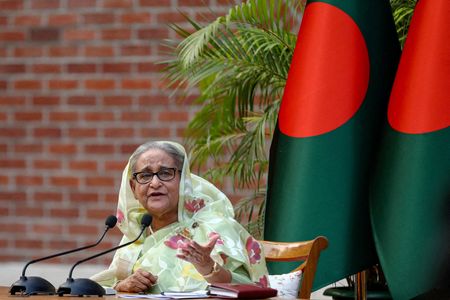 Bangladesh ex-PM Hasina says ban on her party should be lifted
 Explainer-Why Congo’s Ebola outbreak is spreading faster than previous epidemics
 Meta apologises to India for restricting PM Modi’s post