
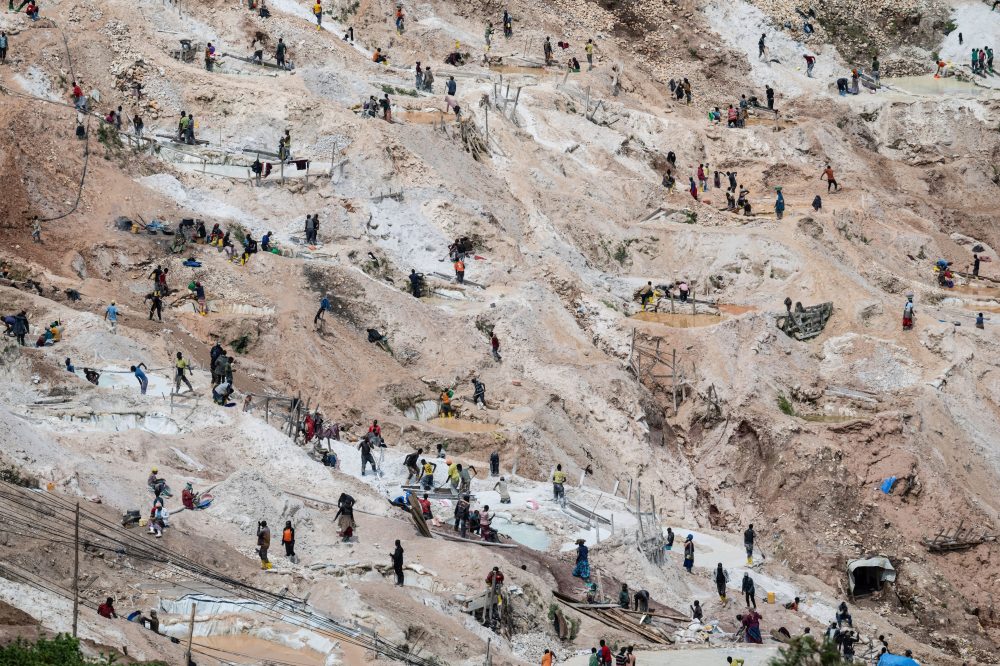
DAKAR, Senegal (AP) — A landslide that collapsed several tunnels at a major coltan mine in eastern Congo is reported to have left at least 200 people dead in the rebel-controlled site.
Rebels and government spokespeople traded accusations of responsibility and disputed the death toll, however analysts say that the collapses are the deadliest in years.
The collapse follows a similar event in January that also left over 200 dead in an area already facing a humanitarian crisis and ongoing conflict.
In May 2024, the Rwandan-backed M23 rebel group seized the town of Rubaya and took control of its mines.
Here’s what to know about the collapse:
Several hand-dug tunnels collapsed on Tuesday, killing at least 200 artisanal miners, according to the Congolese Ministry of Mines.
The mine, located about 25 miles (40 kilometers) west of the regional capital, Goma, employs thousands of miners who operate largely by hand. Miners dig long tunnels, often parallel to one another, with limited support and no safe evacuation route in case of a collapse.
Details about the collapse are sparse due to the mine’s remoteness and the pressure on the miners from rebels and mine owners to stay quiet afterward.
Ibrahim Taluseke, a miner at Rubaya, told The Associated Press that because mine owners must pay $300 to victims’ families, there is an incentive to obfuscate the true death toll.
“Imagine if you give a high number, these owners could even eliminate you. Because often they even hide the victims’ bodies to avoid compensation,” said Taluseke.
Other miners gave varying death tolls from the collapse.
Due to the difficulty of accessing Rubaya, analysts disagree on the reason for the back-to-back collapses.
Christian-Géraud Neema, a nonresident scholar in the Carnegie Africa Program, blamed heavy rains for the collapse and emphasized the need to be skeptical of official narratives.
“It’s normal for Kinshasa to exaggerate the numbers,” he said, adding collapses are common and that it would be a mistake to try to draw a causal relationship between the two collapses and the rebel control of the mines. “We should not be shocked; we should expect another collapse in three weeks’ time or in a month,” said Neema.
Guillaume de Brier, a researcher with the International Peace Information Service (IPIS), said that while recent collapses are among the deadliest in recent years, part of the problem stems from M23’s control of the mines.
“Because of M23, there are no more civil society protections or state services,” said de Brier. There is a lack of regulation during an ongoing conflict, which has increased the number of miners, said de Brier, adding that many people have lost their jobs and are unable to find work outside of the artisanal mining sector.
The mines produce coltan — short for columbite-tantalite — an ore from which the metals tantalum and niobium are extracted.
Both are considered critical raw materials by the United States, the European Union, China, and Japan. Tantalum is used in mobile phones, computers, and automotive electronics, as well as in aircraft engines, missile components, and GPS systems. Niobium is used in pipelines, rockets, and jet engines.
According to a U.N. report, since seizing Rubaya, the M23 has imposed taxes on the monthly trade and transport of 120 metric tonnes (118 tons) of coltan, generating at least $800,000 a month. The coltan is then exported to Rwanda, U.N. experts said. But even before M23 seized control of the mine, analysts said that the mineral was sold to Rwanda, the only difference being that it was done through Congolese intermediaries.
Brought to you by www.srnnews.com
 Denmark is set to explore if gastronomy can be recognized as an art form
 Cologne Cathedral, one of Germany’s best-known landmarks, to charge tourists for admission
 Blackout is still on in western Cuba as crews rush to repair damaged thermoelectric plant
 Meet Pedro Sánchez, Europe’s most vocal critic of Trump’s attacks on Iran