
By Mei Mei Chu
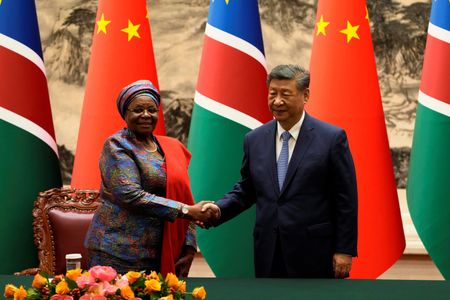
BEIJING, July 10 (Reuters) – China on Friday said it would step up cooperation with Namibia in the Southern African state’s energy, farming, infrastructure, and minerals sectors during talks in Beijing between Chinese leader Xi Jinping and Namibian President Netumbo Nandi-Ndaitwah.
Nandi-Ndaitwah has been on a seven-day visit to China since Sunday, seeking investment from the world’s top lender and second-largest economy to help implement election pledges to create jobs and diversify the Namibian economy.
“In Namibia, we affirm (an) unwavering commitment to this longstanding friendship between Namibia and China,” said Nandi-Ndaitwah, noting that her entourage included dozens of business people.
“Your decision to make China your first state visit outside of Africa after assuming the presidency demonstrates the importance you attach to this significant relationship, for which I express my appreciation,” Xi said.
Nandi-Ndaitwah took office in 2025, extending the 34-year rule of the South West Africa People’s Organisation that led the country to independence from apartheid South Africa in 1990, despite analysts’ doubts over its electoral prospects amid growing frustration over high unemployment and inequality.
COOPERATION IN MINERALS, ENERGY
China and Namibia signed eight documents, including agreements on cooperation in green minerals and a framework agreement on economic partnership.
“China is willing to deepen cooperation with Namibia in infrastructure construction, energy, minerals, agriculture, education, youth, and science and technology,” read a readout of the meeting published by Chinese state agency Xinhua.
“Both sides recognise the strategic value of critical minerals… and agreed to strengthen cooperation in the development of key minerals such as uranium, lithium and rare earths,” Xinhua reported citing a China-Namibia joint statement.
The statement emphasised the role of promoting local processing — a theme raised recently by a number of African commodity producers — technological transfer and local skills development.
Resource-rich Namibia could become the continent’s fourth-largest oil producer by 2030, after Shell and TotalEnergies discovered an estimated 2.6 billion barrels of crude and announced plans to start producing.
Neighbouring Angola produces about 1.1 million barrels per day, and is using that oil wealth to help finance a China-backed overhaul of its economy and shift away from fossil fuels.
CHINESE FIRMS HEAVILY INVESTED IN NAMIBIAN METALS SECTOR
China is a key export market for Namibia, taking around a quarter of the country’s total shipments, according to a recent International Monetary Fund report. Of the $1.3 billion worth of Namibian goods China bought last year, uranium accounted for 85%.
Chinese firms have invested $4.2 billion in Namibia, data from the American Enterprise Institute think tank shows, all but $100 million of which was in the country’s metals sector.
In her inauguration speech, Nandi-Ndaitwah called for a “green revolution”, built on monetising the country’s agricultural sector and water resources.
The IMF, meanwhile, said structural reforms would help create more jobs, highlighting agriculture and fisheries alongside the emerging oil and gas and green hydrogen sectors.
(Reporting by Mei Mei Chu and Shi Bu; Writing by Joe Cash; Editing by Jan Harvey)
Brought to you by www.srnnews.com
 The Media Line: Syria Arrests Senior ISIS Leader, Exposes Group’s Criminal Financing Network