
By Sahana Bajracharya
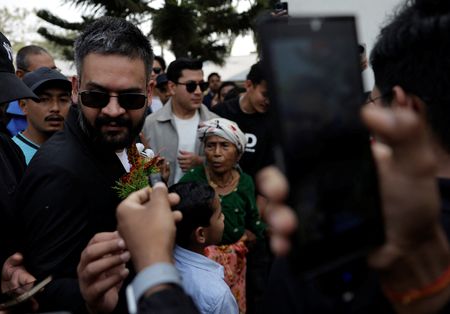
DAMAK, Nepal, March 2 (Reuters) – Everybody wants a photograph with Balendra Shah.
The rapper-turned-politician – better known as Balen – dominating Nepal’s electoral race was surrounded by supporters in the country’s east last week, ahead of a March 5 election that could be pivotal in the mountainous nation locked between China and India.
“I am here to see Balen, even though I have a fever,” a seven-year-old girl said, at her first sighting of the centrist Rastriya Swatantra Party’s prime ministerial candidate.
Next to her, a middle-aged woman admitted she left a heart check-up midway for a photo with Shah, a former mayor of the capital Kathmandu who was catapulted into national politics last September after historic youth-led protests swept the country.
The “Gen Z” demonstrations, fuelled by popular anger against Nepal’s ruling class over rampant corruption and unemployment, left 77 people dead and forced then Prime Minister K.P. Sharma Oli to resign.
Shah is now taking on the four-time prime minister on the latter’s home turf, the Jhapa district from where 74-year-old Oli has won six times during his long political career.
If Shah and the RSP are able to take power, it could upend the politics of the Himalayan nation, which has been long roiled by instability wrought by established parties led by Oli and his generation of veterans.
Across wide swathes of Nepal, analysts say public sentiment is one of disenchanment with established political parties that have been given multiple opportunities to govern but failed to deliver.
These include Oli’s Communist Party of Nepal (Unified Marxist–Leninist or UML), the Nepali Communist Party comprising former Maoist rebels and the centrist Nepali Congress, which have shared power between them for decades.
Still, these groups retain some influence in parts of the country, including in hill districts such as Kavrepalanchok, where 38-year-old Raju Rasaili will cast his vote.
“In my village, there are loyal supporters of both the Maoists and the CPN-UML. I don’t think people easily let go of that kind of political loyalty,” he said.
But back in Jhapa’s Damak town, Bipana Oli, who like millions of Nepalis earns a living in the Middle East, made her choice even before flying back home from Kuwait to vote in Thursday’s election.
“How long I continue working in Kuwait as a migrant worker will depend on Balen’s victory, and the policies and job opportunities he creates,” said the 25-year-old, who is unrelated to the former prime minister.
10 SECONDS EACH
Around her, the crowd of supporters swirled, each getting about 10 seconds with Shah, dressed in a trademark dark blazer and sunglasses.
Most stayed only for the photo. Some shook his hand or engaged in a brief conversation, till Shah’s official photographer firmly instructed: “Step aside, next in line.”
Since quitting as Kathmandu’s mayor and joining the RSP in January, Shah has canvassed aggressively across Nepal, covering almost 50 of the country’s 77 districts.
His campaign, however, is anything but conventional.
Often, he prefers to drive himself, pulling over spontaneously and stepping out of the car to greet shopkeepers, farmers, students, or others, taking most by surprise, according to two aides.
During one drive through Jhapa’s Kamal town, Shah abruptly stopped the car and walked into a wedding ceremony uninvited, greeting guests before moving on, said campaign team member Surendra Bajgain.
“It’s spontaneous, his actions are instinctive and not strategic,” he said, of Shah.
In another break from standard practice, Shah has largely shunned the mainstream press, instead heavily relying on social media – where he has millions of followers – to amplify his message.
“Campaigning is easy,” Shah told Reuters during a fleeting conversation.
“It was more challenging when I ran for mayor because I was alone and I did everything on my own. Now, I have a party and a team supporting me throughout.”
That team also comprises a small group that carries laptops to campaign events to document public grievances, including noting projects that previous leaders failed to complete and those that voters want the most.
These concerns are then investigated and distilled into manifesto-like “Promise Letters” that Shah’s team distributes on the campaign trail, said Subhas Basnet, one of the note-takers.
‘NEVER SAW YOU AGAIN’
But not all voters in Jhapa are entirely convinced by Shah’s strategy.
Mahesh Rai, 35, did not mince his words when suggesting to the RSP politician he follow his rival Oli’s playbook of face-to-face campaigning.
“I think you earn votes when you visit people at their home,” he told Shah, who quietly listened and nodded, before replying with a terse: “Okay.”
On the campaign trail, clouds of dust kicked up by a convoy of more than 20 cars, some fitted with flashing emergency lights, announce the arrival of Oli, a fixture in Nepali politics since the 1990s.
In Jhapa’s rural Gauriganj, a plastic table and chair are set in advance in a village square for Oli to take a seat soon after stepping out from the car. He folds his hands in salutation, a faint smile fixed on his face.
Despite being elected from his district for decades, for many voters this is the first opportunity to see Oli up close, as the former premier changes tack to keep his political career afloat after the hit from September’s revolt.
“In previous elections, I did not always have the time to meet local residents personally,” Oli told Reuters.
“This time, we have structured the campaign in a way that allows me to stay here and interact directly with people.”
Singheswar Prasad Rajbanshi, 85, is blunt in expressing his dissatisfaction with Oli, who rose from a teenage revolutionary imprisoned for 14 years to holding key ministerial roles before becoming premier.
“Many years ago, you came here seeking my vote while I was resting on my daybed. I supported you,” Rajbanshi told the former prime minister.
“But after that, I never saw you again until now.”
(Writing by Devjyot Ghoshal; Editing by Raju Gopalakrishnan)
Brought to you by www.srnnews.com
 As Macron sets out his nuclear doctrine, a look at France’s capability by the numbers
 Argentina’s Milei opens Congress praising Trump and attacking opposition
 War widens to include Iranian-backed militias as Israeli and American planes pound Iran
 What to know about Iran’s Revolutionary Guard, a powerful force within the country’s theocracy