
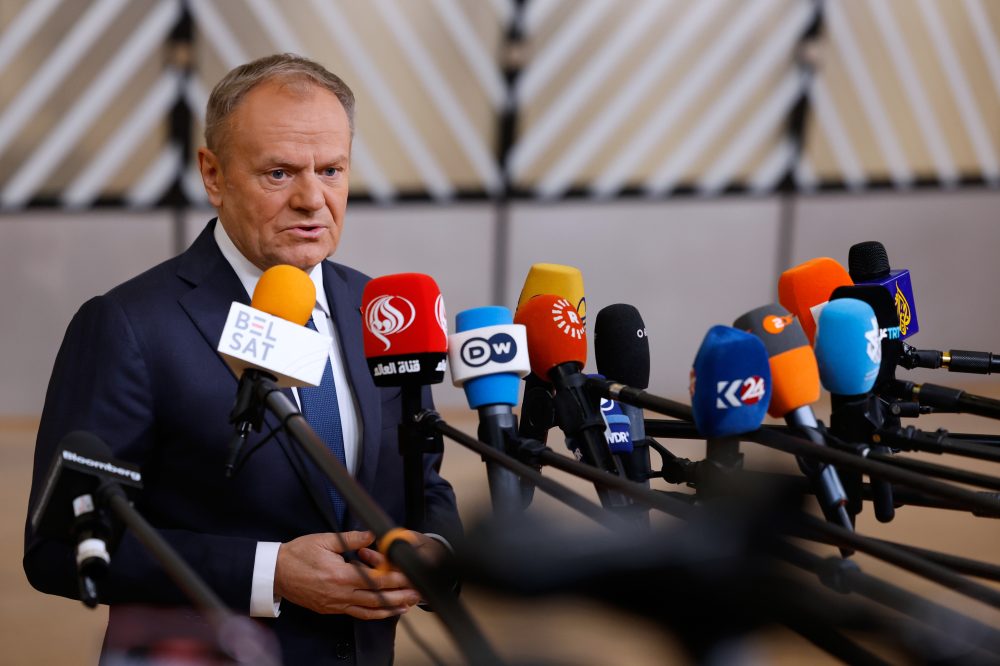
WARSAW, Poland (AP) — Polish Prime Minister Donald Tusk promised Friday to find ways to tap into 44 billion euros in defense loans from the European Union, after Poland’s president vetoed a law enabling the country to access the funds.
Poland was set to be the largest beneficiary of the 150 billion-euro EU loan program dubbed SAFE, or Security Action for Europe, meant to boost Europe’s defense readiness at a time when the U.S. has been diminishing its role in the continent’s security.
But President Karol Nawrocki, who has positioned himself as a main opponent of Tusk, said Thursday he is vetoing the legislation allowing Poland to access the EU defense loans.
“Poland is in shock,” Tusk said Friday. “People are wondering if this is betrayal, the work of lobbyists, or lack of common sense.”
Successive Polish governments have boosted the country’s defense spending since Russia’s full-scale invasion of neighboring Ukraine in 2022. But while the liberal government led by Tusk wants to coordinate efforts with the European Union, the nationalist president has proven more euro-skeptic and maintained a friendlier rapport with the Trump administration.
Nawrocki was skeptical of Poland’s participation in SAFE from the start, arguing it will indebt Poles and increases the country’s dependency on Germany.
On Tuesday, he proposed an alternative draft law suggesting national resources that could be used instead of European loans to pay for further investments in defense. Tusk has dismissed that option as unrealistic.
Tusk said on Friday that the presidential veto will not prevent the Polish government from taking advantage of the defense funds, but “it will be more difficult, sometimes slower, and it will take much more effort to convince everyone involved in this project.”
The U.S. has also openly criticized SAFE.
“The United States has expressed concerns about how EU defense initiatives like Security Action for Europe (SAFE) and the European Defense Industry Program (EDIP) restrict market access for American companies,” Andrew Puzder, the U.S. ambassador to the EU, and Matthew Whitaker, the U.S. ambassador to NATO, wrote in an opinion piece published in February by POLITICO Europe.
The two wrote that such European programs “undermine collective defense” by limiting competition, stifling innovation and depriving U.S. companies of necessary orders.
Brought to you by www.srnnews.com
 All 6 U.S. crew members killed in military plane crash in Iraq
 Sweden investigates tanker accused of using a false flag in the Baltic Sea
 Two long-lost episodes of ‘Doctor Who’ have been found. Fans will soon be able to watch them
 Pope Leo says Christians who start wars should go to confession