
By Marco Aquino
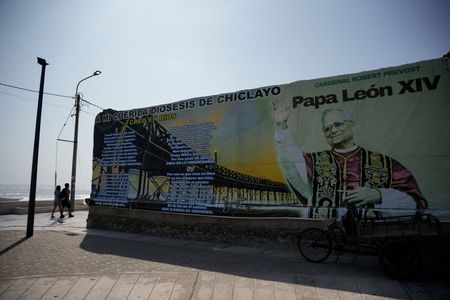
ZAÑA, Peru Oct 27 (Reuters) – As Pope Leo prepares to return to South America next week, many Peruvians remember him as the priest who helped feed hungry families, delivered aid after floods and walked alongside migrants in the country he would eventually call his own.
When the pandemic emptied the streets of northern Peru and one of the world’s longest quarantines left many struggling to eat, Bishop Robert Prevost, as Leo was known, helped launch a soup kitchen in 2020 in the small town of Zaña.
“He gave us an example of human charity, and we prepared the ‘aguadito con fe’,” recalled former cook Betty Burga Campos, referring to the traditional soup of rice, meat and vegetables that volunteers served.
Prevost left Peru for Rome three years later after Pope Francis tapped him to lead the Vatican office that recommends candidates for bishop appointments worldwide.
After rising from missionary and bishop in Peru’s far north to cardinal and ultimately pope, Leo, 71, is set to revisit the country where he became a citizen and built some of the relationships that defined his ministry, weeks after undergoing surgery for lung cancer. The Vatican confirmed on Monday that his November 6 to 17 South America tour remained on schedule.
Across northern Peru, regional governments are refurbishing churches and residents are preparing celebrations for his visit, which also includes earlier stops in Uruguay and Argentina.
For many Peruvians, memories of the Chicago-born head of the Catholic Church are less about Vatican titles than muddy boots, long drives across the country’s rugged north and a hands-on approach to helping people.
“He had become Peruvian, even in the way he spoke. He no longer had much of that American accent,” said José Manuel Zamora Romero, a priest in Lambayeque who knew him for years.
The share of adults in Peru who identify as Catholic has fallen from 76% to 67% over the decade to 2024, according to Pew Research Center. The decline is often linked to social changes and distrust of institutions, following years of political instability that have caused Peru to cycle through nine presidents in a decade.
A BISHOP ON THE MOVE
Prevost arrived in Peru in 1985 at age 30. After years based in the United States and Rome with his Augustinian order, he returned in 2014 and became bishop of the Peruvian city of Chiclayo in 2015. In 2023, Pope Francis brought Prevost to the Vatican. Francis named him a cardinal later that year and he was elected pope in 2025.
Across northern Peru’s sun-baked farm belt, residents and priests recall a churchman constantly on the move.
For the future pontiff, “the distances were not limits, the distances were opportunities,” said David Farfán, a priest in Zaña, one of the towns on the pope’s upcoming itinerary.
Many remember Prevost riding horseback to isolated Andean communities. Others recall him driving hundreds of kilometers himself across Peru’s rugged north.
“His hobby was driving,” Zamora Romero said. “And I know he taught some priests to drive so they could get their licenses … and they all passed the test.”
That practical approach became evident during emergencies.
When severe flooding linked to the El Niño climate phenomenon inundated northern Peru in 2023, photos circulated on social media of Prevost wading through knee-deep water in rubber boots as he helped deliver aid.
When natural disasters occurred, “he was on the front lines to bring the help that the population needed,” said Rev. Jorge Villegas of Chiclayo, where the pope will spend two full days.
Residents pointed to moments like those as evidence of a bishop who preferred action over visibility.
“He wasn’t very focused on being with the press; he was more with the poor and in social conflicts,” said Verónica Castillo, a journalist in Chiclayo who witnessed his intervention during a 2015 labor conflict.
“He was a bishop who intervened, who took action, and people remember that,” she added, recalling how Prevost helped mediate the prolonged protest by workers against a sugar company, which turned violent.
‘PUT HIMSELF IN SHOES OF A MIGRANT’
Migration has reshaped much of Latin America over the past decade, as millions of Venezuelans fled economic collapse and political turmoil. Peru hosts the world’s second-largest Venezuelan diaspora community, with more than 1.5 million migrants. Many arrived without proper documentation and live with inadequate access to healthcare and basic services.
Prevost founded a Catholic organization in Chiclayo in 2018 to assist newcomers.
“He put himself in the shoes of a migrant first and foremost and knew what the situation was like,” said Augusto Martínez, who leads the organization.
The group has assisted thousands of Venezuelans.
As pope, Leo has called for migrants to be treated with dignity, condemned human trafficking and warned traffickers to repent or face divine judgment. He has criticized anti-immigration policies, including measures pursued by US President Donald Trump.
“He supported migrants on how to have a dignified life here in Peru,” said Lisbeth Coromoto Díaz, who received help through the Chiclayo organization and said he held Masses in honor of migrants.
Leo’s planned return to Peru has revived hopes among Catholics in Eten, near Chiclayo, that he could advance a long-running campaign to secure Vatican recognition of the town’s reported Eucharistic miracle. As bishop, he supported the cause, presenting historical records and thousands of testimonies of faith in Rome, linked to a 1649 apparition in which devotees say the image of the Christ Child appeared in a consecrated host.
Tourism officials are promoting routes tied to the places Leo lived and worked. Souvenir shops are stocking shelves with pope-inspired hats, key chains and pins.
In a shop window in the capital Lima’s Gamarra textile district, an image of Leo on a T-shirt depicts him smiling while enjoying a plate of Peruvian food.
“We’ve got the pope looking spirited; we’ve got the pope as a foodie, enjoying delicious ceviche and rotisserie chicken. We even have the play on words: ‘The Pope and the papa (potato) are Peruvian’,” said clothing maker Victoria Quiñones.
Quiñones predicted a 200% increase in her workload and was running low on fabric for the T-shirts.
Nearby, Maria Rodriguez, 70, was shopping for pope T-shirts.
“I’m buying several,” Rodriguez said.
“I’ll be wearing them all through November because I am Catholic: Roman and Peruvian,” she added.
(Reporting by Marco Aquino; additional reporting by Alfredo Galarza, Carlos Valdez and Joshua McElwee; Writing by Cassandra Garrison in Mexico City; Editing by Lucinda Elliott and Rod Nickel)
Brought to you by www.srnnews.com
 Jordan says it killed more than 20 Islamic State militants in airstrikes on Syria
 Norway’s prime minister, Finland’s president in phone call with Putin
 Soccer-Mbappe dropped by Chinese brands over alleged Mao meme comments