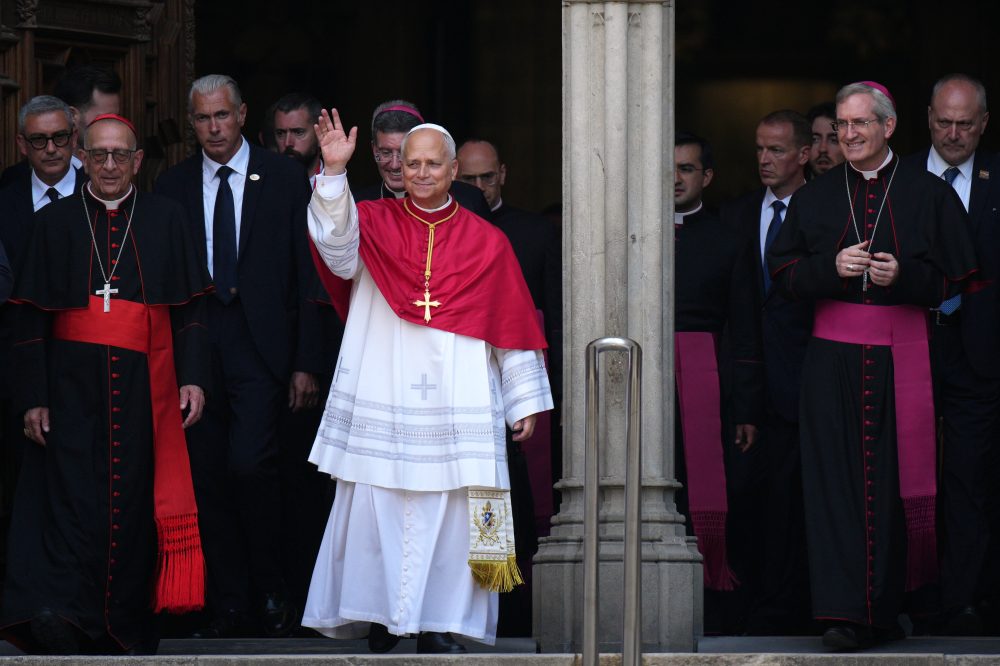
BARCELONA, Spain (AP) — Pope Leo XIV waded into two of Spain’s classic culture wars as he landed in Barcelona on Tuesday during his weeklong visit to the country, but sought to defuse one quickly by speaking first in the Catalan language instead of Spanish upon his arrival.
The U.S.-born pontiff earlier rubbed soccer fans in Barcelona the wrong way by saying he actually roots for Real Madrid instead of their beloved Barça.
The other matter was likely unavoidable. Many Catalans wanted the pope to speak more Catalan publicly instead of Spanish, which Leo speaks fluently and is expected to use predominantly during his visit to Barcelona before heading to the Canary Islands.
“The pope is for all teams, but Prevost is for Real Madrid” were the words that sealed Leo’s sporting fate with many a Barça fan when he responded to a question on the papal plane en route to Spain.
Madrid proudly posted the video of the moment, and social media filled with comments about how Madrid is “the team of God.”
Tomás Roncero, a popular sports commentator for the widely read Spanish sports daily AS, said in a video that “the pope can’t be for Barça because it is a sinful club … in his heart he is of a pure and clean club like Madrid.”
For many non-Madrid fans, especially those in Spain’s regions with different languages and strong local identities like Catalonia, Real Madrid is associated with strong central power. Many consider it almost a pillar of the state, along with the central government and the Catholic Church.
The pope aligned himself closely with Madrid during events in the capital. He visited Real Madrid’s museum to peruse its packed trophy case with club president Florentino Pérez, who gave him a Madrid shirt with “Robert F. Prevost” on the back.
On Monday, thousands of Catholics packed the home venue of Real Madrid for a rally with the pope featuring dancers kicking soccer balls while dressed in the white and yellow colors of the Holy See.
“Today the Church in Madrid has scored a great goal to always be remembered!” Leo said.
Folks in Barcelona noticed.
“A figure as important as he is shouldn’t take sides. Now that he has said that he supports Real Madrid, well, I am sorry, he has messed it up,” said Eduard Modroño, an office worker and Barcelona fan.
Modroño spoke outside the Sagrada Familia basilica, where the pope on Wednesday will hold a Mass in the major event of his stop in Spain’s second city.
Leo began his homily at Barcelona’s cathedral with a few words in Catalan and switched between it and Spanish in his first public address in the city.
“Beloved brothers and sisters, it is with great pleasure that I start my visit holding the midday prayer at this cathedral,” he said in Catalan.
Catalan and Spanish are spoken side-by-side without problem in Catalonia but are often weaponized politically.
Catalan, spoken by some 10 million people, was suppressed by Spain’s 20th-century dictatorship under Francisco Franco. Catalans remain protective of their tongue, and its survival was an important driver of separatist sentiment during a recent push for independence that reached its peak in a failed breakaway bid in 2017.
Popes John Paul II and Benedict XVI used some Catalan when they visited Barcelona in 1982 and 2010, respectively. Spain’s king speaks Catalan when he is in Catalonia, but it is rare for Spanish politicians from non-Catalan speaking regions to do so.
The pope speaking a few words in Catalan may not be enough for many residents.
“Speaking the language of the land that welcomes you is a wonderful act of love and respect. I hope you enjoy your visit to Catalonia, my nation,” Míriam Noqueras’ political party, Junts, said she told the pontiff — in English — when they briefly spoke at Spain’s parliament on Monday.
The archbishop of Barcelona, Juan José Omella, has tried to downplay the issue.
“The pope knew beforehand that he is coming to a country (Catalonia) where people speak a very old language that has never been lost through the centuries,” Omella told reporters. “He knows this and has prepared his speeches and his homily, while keeping in mind that he can only do so much and doesn’t want to end up looking silly in a language he doesn’t speak.”
For Modroño, the soccer fan, speaking in Catalan is more important than anything related to sports.
“It is a lack of respect not to speak entirely in Catalan,” he said.
Brought to you by www.srnnews.com
 First war crimes complaint against Sudan’s paramilitary forces filed in Kenya
 Police arrest a Sudanese suspect in a Belfast stabbing as Starmer calls for calm
 Christian leaders in Lebanese city of Tyre call for quick international action after Israeli warning
 Exclusive-US reports delay in freeing more Belarusian prisoners, opposition says