
By Edward McAllister and Alex Lefkowitz
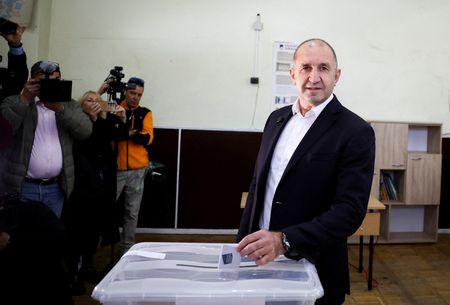
SOFIA, April 20 (Reuters) – When Rumen Radev stepped down from his role as president of Bulgaria in January to run in Sunday’s parliamentary election, he urged voters to ditch the “corrupt officials, conspirators and extremists” that he said were running the country.
Bulgarians responded by handing the former fighter pilot the single biggest vote haul in a generation. The outcome will allow Radev to head Bulgaria’s first single-party government in nearly three decades, and paves the way for greater political stability after eight elections in five years.
Radev, 62, described the result as a “victory of hope over distrust, a victory of freedom over fear”.
It was also the result of good timing by Radev, who had served as Bulgaria’s ceremonial head of state for nine years.
Since a political crisis erupted in 2020, he sat above the parliamentary mess, appointing caretaker governments when needed, and gradually amassing influence, just as veteran parties in parliament were mired in shaky coalition-building.
Radev, who espoused pro-Kremlin talking points during his campaign, has opposed military aid for Ukraine in its war against Russia, and criticised Bulgaria’s adoption of the euro in January, has waited years for this moment.
He made his move into parliamentary politics just as popular opposition to the older parties was reaching boiling point. Nationwide protests forced out the last short-lived government in December, feeding a strong desire for reform.
Long-dominant parties like the pro-European GERB of former Prime Minister Boyko Borissov, and the Movement for Rights and Freedoms party run by oligarch Delyan Peevski, who is under U.S. and UK sanctions for corruption, saw large losses in Sunday’s vote.
“The main factors driving Radev’s victory (were) deep frustration over years of futile anti-corruption efforts, concern over rising prices… and a potent mix of pro-Russian sentiment,” said Atanas Rusev, director of the security program at the Centre for the Study of Democracy in Sofia.
“Radev played astutely on all these anxieties.”
RADEV’S PRESIDENTIAL TERMS HELPED IMAGE
Radev was first sworn in as president in January 2017 after a military career and training in the United States. In his first term, he became a critic of then-Prime Minister Borissov, who faced corruption allegations.
When prosecutors raided Radev’s offices in 2020, Bulgarians saw the move as a hit job and it triggered the largest demonstrations since Bulgaria joined the EU in 2007. The protests presaged an end to Borissov’s tenure, while Radev was re-elected for a second presidential term in 2021.
A period of political crisis then ensued, in which weak coalitions struggled to last very long. Protests flared again last year, triggered by a new budget that proposed high taxes.
When the government stepped down, Radev announced his decision to resign the presidency and to run for parliament.
He has faced criticism for a vague campaign and many voters say he lacks charisma, including in his campaign posters where he stares out from billboards in a white shirt and maroon tie.
Still, he has managed to project strength with videos of him on Facebook flying fighter jets.
CHALLENGES ABOUND FOR RADEV
Voters, analysts and diplomats are waiting to see how pro-Russian a Radev government will be. In a final campaign rally last week, he displayed photos on a big screen of himself with world leaders, including Russian President Vladimir Putin.
Radev’s campaign drew comparisons with Hungary’s pro-Kremlin former Prime Minister Viktor Orban when he talked about resuming the free flow of Russian oil and gas into Europe.
“I’m very anxious because if he’s so pro-Russian, this might be very problematic,” said Tsvetan Hristov, 36, who works in IT.
Still, there are no signs yet that he would veto aid to Ukraine or try to pull the country out of the euro, and analysts doubt he would do anything to jeopardise much-needed EU funds allocated for Bulgaria.
His biggest challenges come at home in one of the EU’s poorest and most corrupt members, where prosecutors allege that hundreds of millions of euros in European funds have been diverted into the pockets of businessmen and officials, public tenders have been fixed, and election fraud is widespread.
“Given his landslide victory at home, he is likely to now seek external legitimacy through building relationships with other European leaders,” said Maria Simeonova, the head of the Sofia office at the European Council on Foreign Relations.
(Reporting by Edward McAllister and Alex LefkowitzEditing by Gareth Jones)
Brought to you by www.srnnews.com
 Migrants rush to apply under Spain’s new mass legalization program
 Did Pope Leo find his voice in Africa? Or did the world finally hear him?
 Amy Winehouse’s father loses legal bid for funds friends made selling singer’s memorabilia
 Here’s what to know about Timmy, the humpback whale that’s sick and stranded in the Baltic Sea