
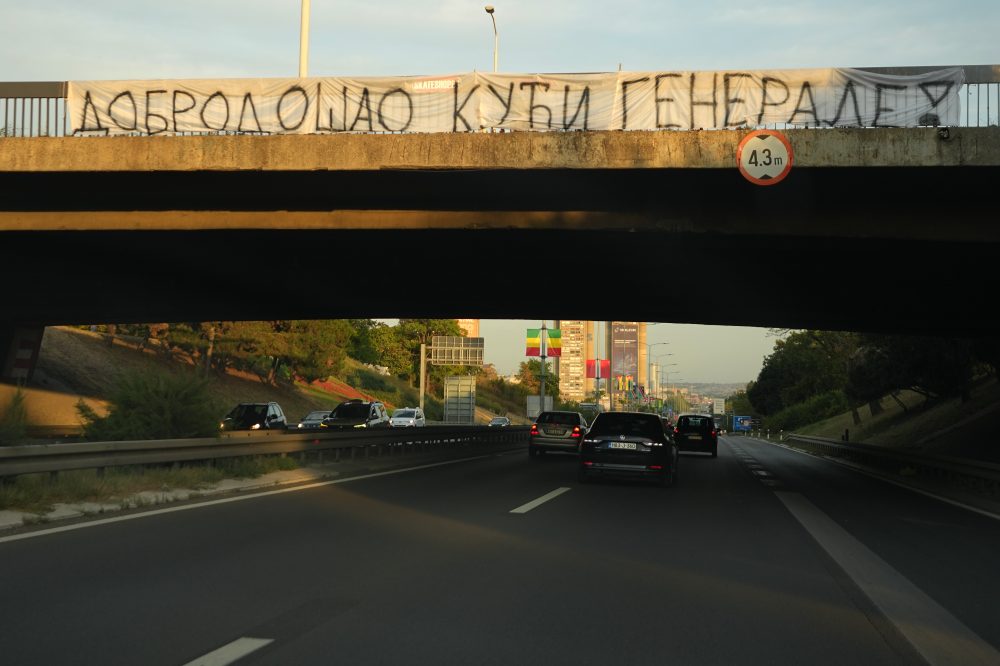
BELGRADE, Serbia (AP) — The European Union is closely watching how membership candidate Serbia will handle the funeral of the former Bosnian Serb army commander Ratko Mladic, who was convicted of genocide by a U.N. court but remains a hero to many Serbs, an EU official said on Friday.
The EU’s Enlargement Commissioner Marta Kos said that the next few days “will be a very important test” after Mladic’s remains were flown to Serbia on a government plane Thursday from The Hague, Netherlands, following his death in a hospital there last week.
Mladic was sentenced in 2017 to life imprisonment for orchestrating the massacre of more than 8,000 Muslims in Srebrenica in 1995; the yearslong siege of Bosnian capital of Sarajevo during the 1992-95 conflict; and other war crimes, including setting up concentration camps for detained non-Serb civilians and enemy soldiers.
Upon landing in Belgrade, Mladic’s coffin was wrapped in the national flag and Serbian army soldiers carried his body from the plane to a van for transport to the military hospital. Serbia’s Justice Minister Nenad Vujic was on the plane with Mladic’s family members while groups of nationalist admirers lit flares as the convoy with the coffin passed under escort.
Mladic’s son, Darko Mladic, said on Friday that his father will be buried on Monday while a military commemoration ceremony is planned for Saturday. Mladic’s coffin will placed in a church in Belgrade on Monday morning so people can pay their respects, his son said at a news conference.
Vujic had previously said that Mladic would receive full state honors at the funeral, sparking outrage across the volatile Balkans. The region remains ethnically divided decades after the war in Bosnia in 1992-95 killed over 100,000 people and left millions homeless.
Last year, Serbia buried another convicted war criminal, the former army chief of staff Nebojsa Pavkovic, with full military honors at a cemetery for distinguished individuals.
Serbia, which backed the Bosnian Serbs during the war, is formally seeking EU entry but remains defiant over its war role, accusing the West of an anti-Serb bias. After Mladic died last week, thousands of Serbs in their political entity in Bosnia and many in Serbia held vigils in his honor, and thousands could come to the funeral.
The Council of Europe Commissioner for Human Rights, Michael O’Flaherty, on Friday urged authorities in Serbia and in the Serb-run entity of Bosnia to “counter the glorification of convicted war criminals” that is illegal in Bosnia and “is not protected speech under the European Convention on Human Rights.”
“I abhor the public glorification of Ratko Mladic, a deceased war criminal convicted for the Srebrenica genocide and crimes against humanity, including statements by officials in Bosnia and Herzegovina’s entity of Republika Srpska and in Serbia,” Flaherty said in a statement.
Belgium’s Foreign Minister Maxime Prevot said granting funeral honors for Mladic would be “shameful and disrespectful for the victims” He added that “I condemn that act in the strongest terms, and have passed this message to my Serbian counterpart in charge of European affairs this morning.”
In Serbia, populist President Aleksandar Vucic, a former extreme nationalist who backed Serbia’s expansionist policies in the past, said Friday that he has previously scheduled meetings on Monday, and that the funeral arrangements have been decided by Mladic’s family.
“I have spoken to the Mladic family and I wish it all passes in a dignified way,” Vucic said, according to the pro-government Informer television. He added without elaborating that “I did all I could so that the funeral would pass as it should.”
Serbia’s EU bid has been stalled under increasingly authoritarian Vucic due to a general democratic backsliding and his refusal to join the international sanctions against Russia over the invasion of Ukraine.
The massacre in Srebrenica was Europe’s first acknowledged genocide after World War II. A U.N. “safe haven” for Bosniaks (Bosnian Muslims), Srebrenica ended up being overrun by Serbs who forced men and boys to strip, killed them and bulldozed their bodies into mass graves.
Mladic was one of the most notorious figures of the war in Bosnia that left more than 100,000 people dead and over 1 million homeless before it ended in 1995 in a U.S.-brokered peace agreement.
____
AP Writers Lorne Cook and Sam McNeil contributed from Brussels.
Brought to you by www.srnnews.com
 Trump turns to a dual economic and military approach in latest attempt to squeeze Iran
 Kenya’s Ruto orders Indian company Tata Chemicals to leave the country
 China exerts tight grip on information after floods
 Netanyahu partners renew calls for removal of Gazans as Israeli election nears